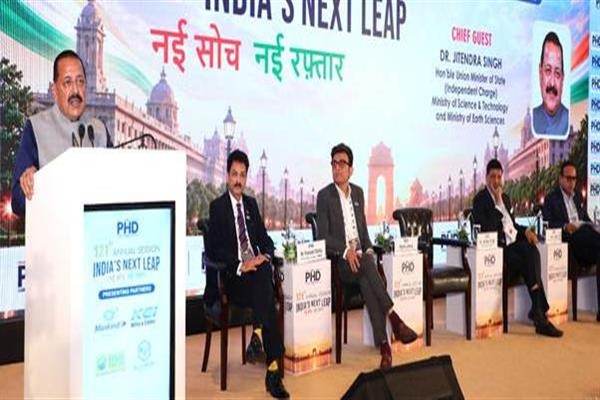
New Delhi, Oct 10 : India has achieved a quantum-secure communication milestone of 1,000 kilometres within three years against an eight-year target of 2,000 kilometres, Union Minister of State for Science and Technology Jitendra Singh said on Saturday, highlighting the country’s progress in strategic technologies and calling for greater private-sector participation in research and innovation.
Addressing the 121st Annual Session of the PHD Chamber of Commerce and Industry (PHDCCI) in New Delhi, Singh said India must move beyond adopting technologies developed elsewhere and focus on building indigenous solutions capable of competing in global markets.
The Minister said the progress under the National Quantum Mission demonstrated India’s growing capabilities in frontier technologies, particularly in areas critical to national security and strategic autonomy.
He emphasised that quantum-secure communication had significant implications for the country’s technological sovereignty and underscored the need to accelerate domestic research, development and commercial deployment.
Singh said the next phase of India’s technological growth would depend on closer collaboration among the government, industry, academia, research institutions and start-ups to transform scientific discoveries into commercially viable products and enterprises.
He urged industry leaders to become involved in research projects from their inception rather than waiting until technologies reached the final stages of development.
Such participation, he said, would help researchers identify market requirements, address technological challenges and develop solutions with clear commercial potential.
Highlighting the expansion of India’s biotechnology sector, Singh said the country’s bioeconomy had grown from approximately USD 10 billion in 2014 to nearly USD 196 billion, with the government targeting USD 300 billion by 2030.
He attributed the expansion to advances in biotechnology research, the growing start-up ecosystem and increasing opportunities for commercial applications in life sciences and related sectors.
The Minister said the rapid development of biotechnology enterprises demonstrated how scientific research could generate economic value, create new businesses and strengthen domestic technological capabilities.
Referring to reforms in the space sector, Singh said greater private-sector participation had opened new opportunities for entrepreneurs and technology companies to contribute to strategically important industries.
He said policy reforms and an enabling business environment were essential to encourage innovation and attract investment into emerging technologies.
Singh also highlighted the government’s Research, Development and Innovation (RDI) initiative, stressing that private-sector investment in research and development must increase to accelerate the commercialisation of scientific discoveries.
Industry associations, including PHDCCI, could play a crucial role in connecting scientific institutions with businesses, facilitating investments and helping promising innovations progress from laboratories to market-ready products, he said.
The Minister further emphasised the importance of indigenous technologies and reliable energy supplies for India’s expanding artificial intelligence ecosystem, data infrastructure and advanced manufacturing industries.
He said strengthening domestic capabilities in these sectors would be critical to reducing technological dependence and ensuring long-term strategic sovereignty.
Singh maintained that achieving India’s development objectives by 2047 would require not only scientific breakthroughs but also faster execution, greater industry participation and the ability to scale successful innovations.
He called for sustained partnerships between government institutions, researchers, entrepreneurs and industry to build a globally competitive innovation ecosystem and strengthen India’s position in emerging technologies. (KNS)