Sagar Firdous
In a milestone achievement that marks a defining chapter in the history of higher education in Jammu and Kashmir, the University of Kashmir has been awarded the prestigious A++ grade by the National Assessment and Accreditation Council (NAAC) — the highest possible rating under the council’s revised assessment framework. The news, confirmed by top university officials in a detailed media interaction, is not just a feather in the cap for the varsity but also a beacon of transformation for higher education institutions in conflict-torn regions.
This coveted A++ grade places Kashmir University among the most elite public universities in India, reaffirming its academic credibility, administrative reforms, infrastructural evolution, and research productivity — all underpinned by what the university called “a psychosocial story of resilience, reform, and reinvention.”
Over a span of months, stretching from document-intensive internal evaluations to a rigorous peer review, the university navigated one of the most intense cycles of accreditation under NAAC’s updated methodology. This cycle not only measured infrastructure and academics but also stressed evidence, transparency, and national relevance. That the University of Kashmir emerged from it all with top honours has been hailed as both a systemic triumph and a regional landmark.
The NAAC A++ accreditation was based on a 70:30 assessment model, where 70% of the weight was assigned to data submitted via a detailed Self-Study Report (SSR) and third-party validation, and 30% to an on-site peer team visit. As per the University’s officials, the institution had submitted its report nearly six months before the visit, comprising 65 qualitative and quantitative parameters.
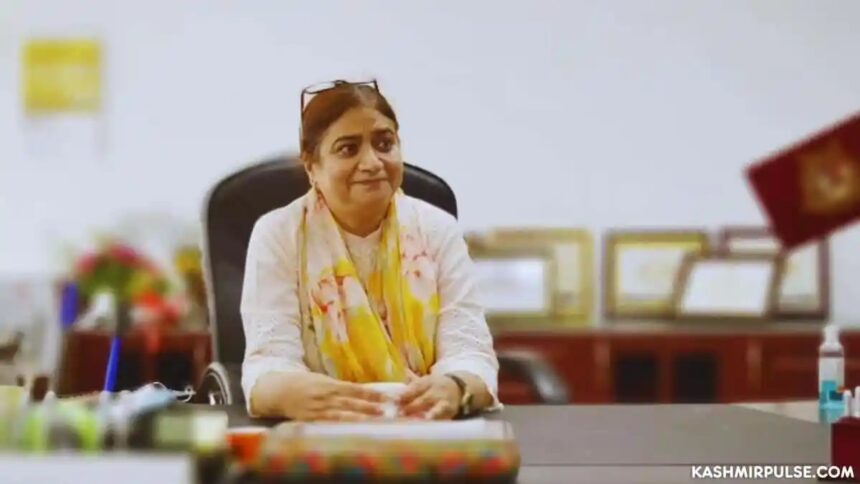
“Our SSR was thoroughly scrutinized by the NAAC data validation team, who repeatedly asked us for evidence — sometimes on three specific parameters dozens of times,” said VC KU Prof Nilofer Khan. “And every time, we delivered.”
The NAAC Peer Team’s physical visit, which was carried out in a hybrid mode, consisted of seven members, five connected virtually and two physically visiting the campus. It wasn’t a staged exercise; departments weren’t cherry-picked, and visits were often unannounced or repeated for cross-verification. “Some departments were visited three times in two days,” revealed an official. “It was exhausting, but fair and we were prepared.”
VC KU, in her address to the media, said that the Peer Team could only witness “the tip of the iceberg” during their short visit. “Many institutional strengths and academic achievements could not be showcased due to time constraints,” she said, “but our documents and research records speak louder.”
Prof. Khan also said that Kashmir University had been compelled to transition to the ‘dual mode’ model as per UGC guidelines since July 2022, integrating both regular and distance education into a unified structure, a shift that required deep curricular and administrative reforms.
One of the biggest logistical hurdles during the visit was the hybrid model of assessment. The university with campuses spread across varied terrains in the Valley had to ensure uninterrupted, real-time digital connectivity for virtual members of the NAAC Peer Team.
The IT department of the university was credited for ensuring seamless digital participation, despite geographical and technical challenges. “Hybrid monitoring of institutions of this size was no easy feat, but we pulled it off without a glitch,” Khan said.
A major highlight of the media briefing was the implementation of the National Education Policy (NEP) 2020. The university was among the earliest in the region to operationalize NEP-aligned undergraduate programs in 2022 and has since introduced integrated programs, new Bachelor’s and Master’s degrees, and curriculum reforms across departments.
This forward-thinking approach earned the university additional scoring in academic indicators during the NAAC evaluation. Prof Khan said, “We did not just talk about NEP 2020; we executed it with real, measurable results.”
The addition of futuristic disciplines such as Artificial Intelligence and Cybersecurity also bolstered the university’s relevance in emerging knowledge domains. AI courses were started at the Zakura and North campuses, while nursing and medical programs are being launched at Khawara and South Campuses.
Perhaps the most underscored aspect of the media interaction was the university’s growing research profile. Faculty members proudly cited publications co-authored with scholars from Harvard, Stanford, and Cambridge, as well as a sharp rise in the h-index and i10-index scores, indicating higher impact and citation rates.
“Our research isn’t limited to volume anymore,” Prof Khan said. “We’ve focused on quality, social relevance, and international collaborations.”
Scholars and students from the university have also been making their presence felt at global conferences, presenting papers and forging cross-border academic partnerships. These developments aligned well with NAAC’s revised criteria, which increasingly value research impact over volume.
Another major point of pride for the administration was the successful recruitment drive after a five-year freeze due to multiple factors including COVID-19, legal complications over reservation policies, and administrative restructuring post the J&K Reorganization Act.
In 2023, the university advertised over 250 teaching positions, and within months, 50 appointments were made, adhering strictly to reservation norms and national eligibility guidelines.
According to the Registrar:
“Some of the posts were filled by applicants from other states, which is rare and commendable in a region like ours. It speaks volumes about our growing academic reputation.”
While non-teaching recruitments remain partially stalled due to a pending court case, the administration expressed optimism about resolving the matter soon. 60 posts were advertised, but legal petitions around multiple advertisements have led to delays.
The university has undertaken a number of administrative reforms, including a single-window clearance system for student services. Certificates, once delayed for months, are now issued within 10–15 working days. The examination system has been overhauled, and academic calendars are being followed with precision.
“What we’re seeing is not just a change in policy, but a change in institutional culture,” said a member of the Controller of Examinations office. “And that’s where real transformation happens.”
At the heart of this accreditation success are the faculty, non-teaching staff, officers, and support services — from library staff to IT, security, medical teams, and janitorial workers — all of whom worked round-the-clock for months. Several senior professors and administrative heads credited this collective effort, calling it the true backbone of the university’s performance.
Even during the COVID-19 pandemic, the university persisted in its reforms and continued academic and administrative operations with remote mechanisms — an experience that, ironically, prepared it well for the hybrid demands of the NAAC assessment.
With the A++ grade now officially secured, the University of Kashmir is aiming even higher. Officials made it clear that the achievement is not an end in itself, but a launchpad for further reforms, collaborations, and regional development. “We are now accountable to the expectations that come with this A++ recognition,” said the Vice-Chancellor.
“Our next goal is to elevate this institution into a global knowledge hub not just in ranking, but in innovation, social engagement, and national service.”