Five consecutive years of rainfall deficit have reshaped Kashmir’s winters, turning a once reliable snow season into a period of uncertainty. With plains snow absent by mid-January 2026, rivers like the Jhelum run low, forests burn more often, and water stress begins earlier. Across the Valley, data, science and ground indicators point to a shifting climate baseline. Sagar Firdous reports
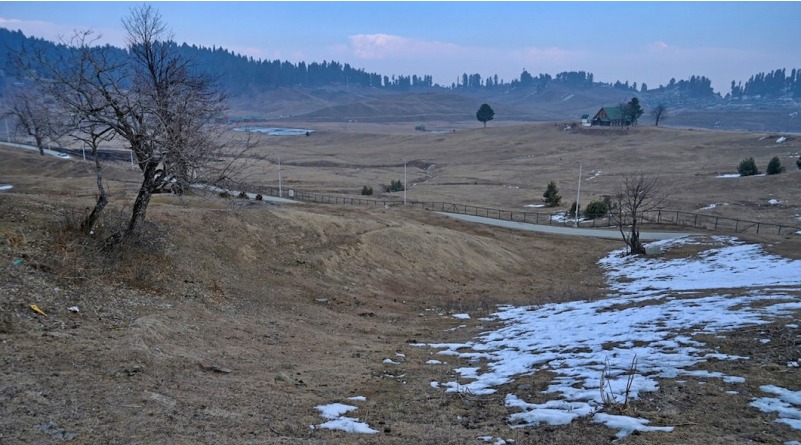
Winter in the Kashmir Valley has never been only about cold. For generations, it has functioned as the Valley’s most important water-building season. Snowfall accumulated quietly across mountains and forests, storing water in a form that did not appear in reservoirs or canals but determined river flows, spring discharge, agriculture cycles and hydropower availability months later.
The expectation that winter would rebuild this invisible reserve shaped how water, land and livelihoods were planned.
By mid-January 2026, that expectation is again under strain. Large parts of the Valley plains remain snowless, precipitation has been sporadic, and rivers are running lower than is typical for this point in winter. This is not an isolated season. It follows five consecutive years of below-normal precipitation and a pattern of winters that increasingly deliver cold without the snow that once defined them.
The most direct measure of winter drying comes from rainfall and snowfall totals. Jammu and Kashmir recorded 870.9 mm of rainfall in 2024, against a normal annual average of 1232.3 mm, a 29 percent deficit. This made 2024 the driest year in roughly five decades and marked the fifth consecutive year of below-normal precipitation in the Union Territory.
The preceding years show a consistent shortfall rather than an erratic pattern. In 2020, rainfall stood at 982.2 mm (20 percent deficit). 2021 recorded 892.5 mm (28 percent deficit). 2022 saw 1040.4 mm (16 percent deficit). 2023 recorded 1146.6 mm (7 percent deficit). Each year fell below the long-term average, reducing the system’s ability to recover between dry phases.
Equally important is how that rainfall was distributed through the year.
Monthly data for 2024 shows that deficits were concentrated in the months that traditionally contribute to snow accumulation. January recorded a 91 percent deficit, February 17 percent, and March 16 percent. April was the only month with excess precipitation, recording a 48 percent surplus. From May onwards, deficits returned, with shortfalls of 67 percent in May, 38 percent in June, 36 percent in July, and renewed large deficits in autumn and early winter—74 percent in October, 69 percent in November and 58 percent in December. In hydrological terms, a surplus outside the core winter window does not compensate for lost snow storage.
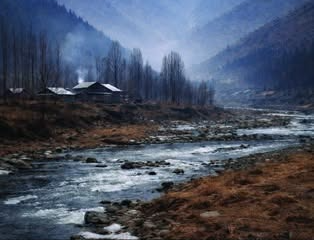
By January 15, 2026, the winter has followed the same structure. Chillai Kalan, the forty-day core of winter, passed its midpoint without any sustained snowfall in the plains. Higher reaches recorded intermittent snow, but accumulation has been uneven and limited. Meteorological forecasts through early and mid-January pointed to weak Western Disturbances and extended dry spells, with only brief precipitation windows.
The absence of plains snowfall by mid-January matters beyond symbolism. Plains snow historically contributed to slow groundwater recharge, soil moisture retention and early-season base flows in rivers. When snow is absent or delayed, those functions weaken. A winter that delivers cold nights but little precipitation does not rebuild the same water reserve as a winter with steady snowfall.
Kashmir’s winter precipitation is dominated by Western Disturbances—storm systems that travel eastward from the Mediterranean region and West Asia. In years when these systems arrive frequently and retain moisture, they deliver sustained snow and rain. In recent winters, two changes have been observed repeatedly: longer gaps between effective disturbances, and systems that weaken or pass north of the Valley, delivering limited precipitation.
Meteorological outlooks during the winter of 2025–26 reflected this pattern, describing feeble disturbances and below-normal precipitation over much of the western Himalayan region. The result has been a winter defined by extended dry intervals rather than continuous accumulation. This does not mean that snowfall will not occur at all, but that it is increasingly concentrated in short events, often confined to higher elevations.
Temperature plays a critical role in determining whether winter precipitation falls as snow or rain. Even modest warming around the freezing point can convert snowfall into rainfall in lower elevations and accelerate melt when snow does fall. Research across the Himalayan region shows that winter temperatures are rising faster than the global average, particularly at higher altitudes.
The consequence for Kashmir is that precipitation which might once have contributed to snowpack now runs off quickly as rain, offering little long-term storage. This helps explain why some winters still record precipitation events but fail to build lasting snow cover. Cold conditions persist, but the phase of precipitation has shifted in ways that reduce water retention.
Satellite-based assessments by the International Centre for Integrated Mountain Development (ICIMOD) provide a regional context for Kashmir’s winter experience. ICIMOD’s snow update reports have documented sustained below-normal snow persistence across the Indus basin, of which Kashmir is a key part. In 2024, snow persistence across the region was reported to be among the lowest in decades, and although 2025 showed some improvement, it remained below normal.
Snow persistence—the length of time snow remains on the ground—is a critical metric because it determines melt timing and river behaviour. Reduced persistence means earlier melt, lower late-spring flows and greater pressure during summer. Kashmir’s winter dryness aligns with this broader pattern, suggesting that local observations reflect a regional shift rather than an isolated anomaly.
The Jhelum River is the Valley’s hydrological spine, and its winter behaviour offers insight into upstream conditions. Traditionally, winter flows are sustained by gradual snowmelt and groundwater contributions. In recent winters, including 2025–26, reporting and field observations have pointed to unusually low winter levels, with exposed banks and reduced discharge for the season.
While comprehensive, publicly released gauge data for January 2026 remains limited, the reported low levels are consistent with reduced snow accumulation and weak winter recharge. When the Jhelum enters spring with diminished base flows, the system has less flexibility to meet irrigation, drinking water and hydropower demands. Winter is meant to be the period of rebuilding; when that fails, stress is pushed earlier into the year.
The implications extend to downstream wetlands such as Wular Lake, which depends on steady inflows to maintain ecological balance and flood moderation capacity. Reduced winter inflow lowers lake levels earlier, affecting fisheries and biodiversity and altering the hydrological rhythm of the basin.
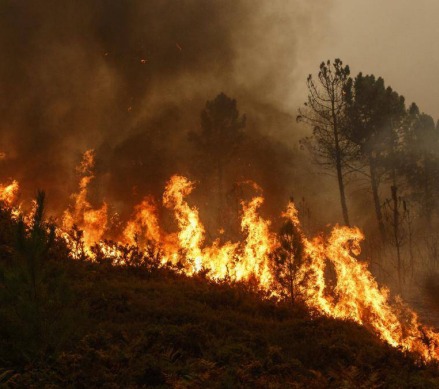
An unexpected but telling indicator of winter drying is forest fire incidence. In 2025, Kashmir recorded 310 forest fire incidents, affecting 880.77 hectares of forest land. Division-wise data shows that the impact was widespread rather than localized. Kulgam alone accounted for 307.85 hectares, while significant areas were also affected in Lidder, Sindh, Bandipora and Kamraj divisions.
Forest fires were once rare in winter and early spring because snow and moisture suppressed ignition. Their increasing occurrence points to low soil moisture, dry leaf litter and prolonged dry spells extending into colder months. Fires not only reflect dryness; they exacerbate it by damaging soil structure and reducing a watershed’s capacity to retain water, creating a feedback loop between winter drying and long-term hydrological stress.
Winter conditions shape agricultural outcomes months later. Rabi crops depend on winter soil moisture, while orchards—particularly apples—rely on both adequate winter chill and moisture. Research conducted by Sher-e-Kashmir University of Agricultural Sciences and Technology of Kashmir (SKUAST-K) provides baseline phenological data for apple varieties under Kashmir conditions, documenting the timing of key stages such as bud break and flowering.
While SKUAST-K’s published studies focus on phenology and yield characteristics rather than long-term climate attribution, they establish reference points against which change can be measured. Broader scientific literature on temperate fruit cultivation shows that insufficient winter chill and moisture can lead to delayed or uneven flowering and yield variability. In Kashmir, dry winters increase reliance on irrigation in spring, adding pressure to water resources already strained by reduced snowmelt.
Most urban and rural water supply schemes in Kashmir depend on surface flows and springs rather than deep aquifers. Winter precipitation and snowmelt recharge these sources. When winters are dry, spring discharge weakens, and water stress begins earlier. Reports in recent years have described tanker dependence and supply constraints appearing before the onset of peak summer demand, a shift that aligns with reduced winter recharge.
This early stress changes how water systems must be managed. It compresses the buffer period that winter once provided and increases competition between domestic, agricultural and ecological needs.
Climate science distinguishes between short-term variability and longer-term change. One or two dry winters fall within natural variability. Five consecutive years of precipitation deficit, combined with repeated snowless plains winters, reduced snow persistence across the region, low river flows and rising winter fire incidence, point toward a shift in winter behaviour rather than a temporary fluctuation.
This does not mean that snowfall will disappear from Kashmir. It means that snowfall has become less reliable, more unevenly distributed and more sensitive to small temperature changes. Winters may still deliver intense snow events, but they are increasingly separated by long dry intervals that undermine the season’s role as a water reservoir.
The winter of 2025–26 matters not because it is uniquely dry, but because it reinforces a pattern already visible in data. By mid-January 2026, the Valley has again passed the core of winter without rebuilding its traditional snow reserve in the plains. The precipitation deficit of previous years has not been corrected. Rivers are under pressure, forests are more vulnerable to fire, and water systems face earlier stress.
For decades, Kashmir’s winter provided stability to a system otherwise exposed to monsoon variability. That stabilising function is weakening. The evidence—rainfall records, snow persistence research, river behaviour and ecological indicators—points in the same direction.
The Valley has entered an era where cold no longer guarantees snow, and where winter can no longer be assumed to rebuild water reserves automatically.
The challenge ahead is not to romanticise past winters, but to recognise that the climatic baseline has shifted. Planning based on historical expectations of winter accumulation now carries risk. Kashmir’s future water security, ecological health and economic stability will increasingly depend on how this new winter reality is understood and addressed.
The drying of Kashmir’s winters is no longer a distant projection. It is a measurable, lived condition visible in data, rivers, forests and fields. What remains uncertain is not whether winters have changed, but how quickly systems built on older assumptions can adapt to a season that no longer behaves as it once did.