Kyiv, Oct 13: Ukrainian President Volodymyr Zelenskyy on Tuesday said Kyiv received no advance intelligence warning from its Western allies before Russian ballistic missiles struck civilian infrastructure in the capital, raising concerns over intelligence sharing amid US pressure on Ukraine to halt attacks on Russian oil refineries.
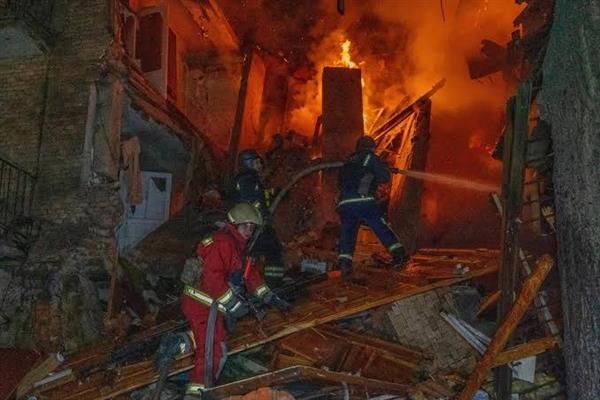
According to Reuters, five ballistic missiles struck civilian infrastructure in Kyiv overnight, while air raid alerts sounded only after explosions had already been heard across the city.
“Intelligence on Russian ballistic missile launches helps save lives,” Zelenskyy said in a post on X, describing advance warning as one of the most critical elements of Ukraine’s defence against Russian attacks.
The Ukrainian President said Russia had launched more than 100 weapons, including ballistic missiles and drones, against Ukrainian targets since Monday evening.
According to the Associated Press, Zelenskyy said a Russian strike destroyed a residential building in Kharkiv, killing four people and injuring 41 others.
He said the overnight attacks demonstrated the continuing threat to Ukrainian civilians despite diplomatic efforts to secure a limited ceasefire covering energy infrastructure.
Reuters reported that the intelligence warning failure came amid mounting pressure from Washington on Kyiv to stop targeting Russian oil refineries.
US officials have reportedly threatened to suspend intelligence sharing and weapons sales unless Ukraine halts such strikes.
However, Zelenskyy did not directly link the absence of advance warnings to the reported American threats.
Ukraine’s Foreign Minister Andrii Sybiha said the country continued to receive military intelligence from the United States.
Speaking at the Warsaw Security Forum, Sybiha suggested that the delay in warnings was related to the characteristics of the Russian weapons used in the attack.
The Ukrainian air force also acknowledged that it had not received surveillance warnings before the ballistic missile launches and said the circumstances were being investigated.
According to Reuters, Ukraine depends heavily on American satellite-based early-warning systems to detect Russian ballistic missile launches.
Fabian Hoffmann, a missile expert at the Norwegian Institute for Defence Studies, said European countries had limited capacity to replace American intelligence capabilities.
“Ukraine relies on the so-called Space-Based Infrared System which the US deploys,” Hoffmann told Reuters, adding that the American system remained unmatched in its capabilities.
Meanwhile, Russia did not strike Ukrainian energy facilities overnight for the first time since US President Donald Trump announced a proposed energy ceasefire on Sunday.
However, Russian forces continued attacking Ukrainian transport and logistics infrastructure with ballistic missiles and drones.
Reuters reported that Russia had struck six Ukrainian energy sites on Monday, while no fresh attacks on such facilities were reported on Tuesday.
It remained unclear whether Moscow had deliberately avoided targeting energy infrastructure in response to the proposed ceasefire.
A Kremlin spokesperson declined to confirm details of the arrangement, saying discussions were continuing.
Zelenskyy said Ukraine had refrained from attacking Russian oil refineries since Trump’s announcement and remained prepared to take reciprocal steps towards de-escalation.
He accused Moscow of continuing attacks on critical infrastructure despite the proposed agreement.
According to the Associated Press, Zelenskyy said Russia’s continued military operations indicated that Moscow had not committed to a broader reduction in hostilities.
The latest developments come as Washington seeks to secure an energy ceasefire between Moscow and Kyiv, while disagreements over Ukrainian strikes on Russian oil infrastructure continue to complicate diplomatic efforts.
Russia’s full-scale invasion of Ukraine, launched in February 2022, has entered its fifth year, with both sides continuing military operations despite renewed international efforts to reduce hostilities. (KNS)