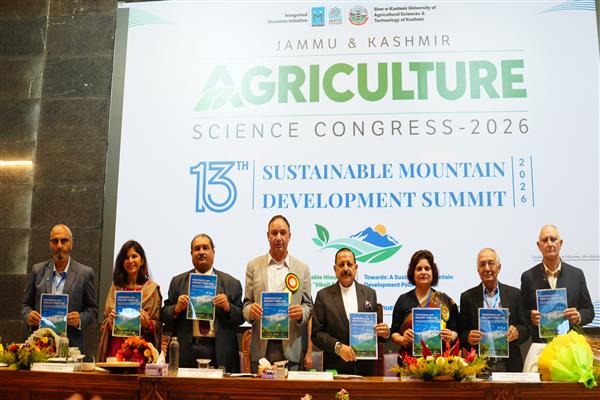
Srinagar, Oct 13 : The Centre may consider a proposed sustainable mountain development policy for Jammu and Kashmir as concerns grow over climate change, glacier-related hazards and the vulnerability of Himalayan communities, Union Minister Jitendra Singh said on Tuesday.
Speaking at the 13th Sustainable Mountain Development Summit and J&K Agriculture Science Congress at SKUAST-K, Shalimar, Singh said scientific research must move beyond academic discussions and produce practical solutions capable of addressing the environmental and developmental challenges facing the Himalayan region.
The Minister for Science and Technology and Earth Sciences referred to ongoing government programmes monitoring glacier dynamics and glacial lake outburst floods (GLOFs), which pose risks to settlements and infrastructure in mountainous regions.
He said scientific findings needed to be translated into measures that could strengthen disaster preparedness, protect fragile ecosystems and support sustainable economic activity.
Singh welcomed the preparation of a draft Sustainable Mountain Development Policy for Jammu and Kashmir by SKUAST-K in collaboration with the Integrated Mountain Initiative (IMI) and other institutions.
He indicated that the proposal could be considered by the Government of India after further consultations with stakeholders.
The proposed framework comes amid growing concerns over the impact of changing climatic conditions on Himalayan ecosystems, agriculture, water resources and communities dependent on mountain-based livelihoods.
At the summit, experts raised questions about how scientific research could be incorporated into government planning and translated into measures addressing environmental risks without compromising economic development.
SKUAST-K Vice-Chancellor Prof Nazir Ahmad Ganai said the university had secured 146 patents and nurtured 115 startups, highlighting the role of research institutions in developing technologies and enterprises relevant to regional challenges.
However, discussions at the summit also underlined the need to ensure that scientific advances translate into measurable benefits for mountain communities.
Director General of IISD India Dr S K Panigrahi said Himalayan catchment systems supported nearly 40 per cent of India’s population, indicating that environmental disasters in the region could have consequences far beyond the mountain belt.
Arushi Chopra, Director at SYSTEMIQ, stressed that ecological conservation and economic development needed to be addressed together, particularly when planning infrastructure in environmentally sensitive areas.
Former IMI president Sushil Ramola called for stronger links between scientific research and government decision-making, while IMI representative Dr Rajan Kotru said institutional coordination was essential to convert recommendations into action.
J&K Commissioner Secretary for Science and Technology Babila Rakhwal said the department was committed to supporting science-based initiatives for sustainable mountain development.
The three-day summit, jointly organised by SKUAST-K, IMI and the J&K Science, Technology and Innovation Council, is examining climate resilience, sustainable agriculture and governance challenges in the Himalayan region.
While the proposed policy has received support from participating institutions, its implementation will depend on subsequent government decisions, including the adoption of recommendations and the identification of mechanisms to translate them into action.
No timeline for the Centre’s consideration or adoption of the proposed framework was announced. (KNS)