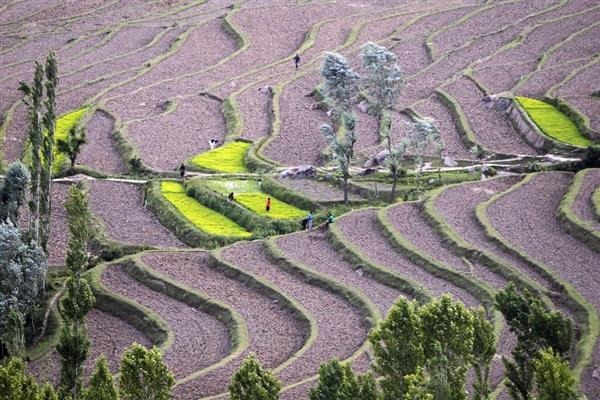
Srinagar, Oct 14 : Jammu and Kashmir has lost 45,660 hectares of paddy cultivation in nine years, while rice supplies from outside states have increased by nearly 30 per cent in just two years, exposing a growing gap between the region’s food production and consumption requirements amid the rapid expansion of apple cultivation.
Official figures show that paddy acreage declined from 3,04,500 hectares in 2015-16 to 2,58,840 hectares in 2024-25, a reduction of 15 per cent. During the same period, dependence on rice sourced from other states has emerged as a major concern for the Union Territory’s agricultural economy.
Data from the Food, Civil Supplies and Consumer Affairs Department show that rice supplies sourced largely from surplus-producing states increased from 3.74 lakh tonnes in 2022-23 to 4.36 lakh tonnes in 2023-24 and 4.86 lakh tonnes in 2024-25.
The increase of 1.12 lakh tonnes over two years comes as agricultural land across Kashmir continues to shift towards commercial horticulture, particularly apple orchards.
The area under apple cultivation in Jammu and Kashmir expanded from 1,07,930 hectares in 2004-05 to 1,73,073 hectares in 2024-25, an increase of 65,143 hectares, or 60.4 per cent.
Although the figures cover different periods, they reflect a long-term shift in land use, with food crops increasingly giving way to higher-value horticulture.
The changing pattern is particularly evident in south Kashmir, where apple cultivation now occupies substantially more land than paddy in some traditional rice-growing districts.
In Kulgam, apple orchards covered 18,255 hectares in 2024-25, against only 6,951 hectares under paddy cultivation.
Similarly, Pulwama recorded 15,928 hectares under apple cultivation compared with 10,990 hectares under paddy.
The figures indicate that apple cultivation now occupies more than two-and-a-half times the paddy acreage in Kulgam and nearly one-and-a-half times the paddy area in Pulwama.
Despite producing approximately 6.5 lakh tonnes of rice in 2024-25, Jammu and Kashmir continues to rely substantially on supplies from outside.
Professor Ashaq Hussain, an agronomist at Sher-e-Kashmir University of Agricultural Sciences and Technology of Kashmir (SKUAST-K), estimates that the Union Territory produces around 50 to 55 per cent of its rice requirement, while 45 to 50 per cent is sourced from other states, particularly Punjab.
The growing dependence has raised concerns about the long-term sustainability of local food production, particularly as rice remains the principal staple consumed across Kashmir.
Scientific studies also indicate that the decline in agricultural land is not a recent development.
A satellite-based study published in 2019 found that agricultural land in Kashmir Valley declined by approximately 28 per cent between 1992 and 2015, while plantation cover increased by nearly 88 per cent.
Another land-use study covering 1990 to 2017 recorded a decline of around five per cent in cropland agriculture alongside an expansion of 4.3 per cent in horticulture.
In Kulgam, a spatial analysis found that land under rice cultivation declined from 18,500 hectares in 2011 to 12,900 hectares in 2020, while apple orchards expanded from 14,667 hectares to 20,787 hectares.
Agricultural experts attribute the shift largely to higher returns from apple cultivation, particularly high-density plantations, compared with paddy farming.
However, they warn that the cumulative conversion of food-producing land into orchards could reduce the region’s ability to meet its staple food requirements locally.
Javaid Iqbal Khan, Associate Professor of Economics at the University of Kashmir, has cautioned that the shift could create a structural vulnerability, as households dependent on horticulture earnings may face difficulties purchasing food during years of poor apple production or unfavourable market conditions.
The decline in paddy cultivation also carries implications for water management.
A study of the Lidder watershed in Anantnag found that agricultural land declined by 39 per cent between 1980 and 2018, while orchard area expanded by 176 per cent.
Hydrogeologists have highlighted the role of paddy fields in groundwater recharge and temporary floodwater retention, warning that large-scale changes in land use could affect local water systems.
Significantly, the Agriculture Department does not maintain specific records of the total area of paddy land converted into orchards, according to Kashmir Agriculture Director Sartaj Ahmad Shah.
The absence of conversion-specific data makes it difficult to assess the exact extent of the shift or formulate targeted measures to protect important rice-growing areas.
Meanwhile, scientists at SKUAST-K’s Rice Research Station in Khudwani are developing high-yielding and climate-resilient paddy varieties to improve production from the remaining cultivated land.
SKUAST-K Vice Chancellor Professor Nazir Ahmad Ganaie has said some improved varieties have a yield potential of up to 12 tonnes per hectare.
With paddy acreage continuing to shrink and rice supplies from outside increasing, experts have stressed the need to protect strategically important agricultural land while ensuring that the expansion of horticulture does not further weaken the region’s food-producing capacity.(KNS)