The hills of Budhal subdivision in Rajouri district are not kind to ambition. They are beautiful, swathed in pine and quiet but unforgiving. Internet signals falter. Workshops are a dream. A broken tool means a day’s walk to the nearest town. And yet, in this silence, a 16-year-old boy heard something louder than the stream outside his home: the whisper of an idea.
Zahid Ali, a Class 10 student of Government High School, Targain, has spent the last several months doing what no one in living memory has done here. He has built, with his own hands, a fully functional earth excavation machine model and a mini hydropower project using nothing more than household discards, scrap wire, broken plastic, and an unstoppable will.
No formal training. No soldering station. No mentor. Just raw, stubborn, Himalayan-grade curiosity.
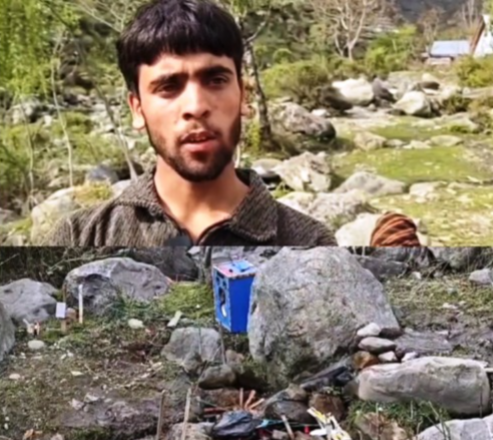
Targain is the kind of village where children grow up watching their fathers mend tractors with rope and jugaad. Zahid watched differently. “Since childhood, I was always curious about how machines work,” he said, sitting outside his kutcha home, his models laid out on a torn plastic sheet. “I used to observe things, water flowing, wheels turning, levers moving and try to recreate them with whatever I could find at home.”
His first model was the excavator. Using discarded syringes as hydraulic pistons, cardboard for the arm, and a wooden spool for the pivot, he replicated the precise scoop-and-lift motion of a real earthmover. The joints are held together with twisted wires and melted plastic. There is no glue from a fancy craft store, only the adhesive of patience.
“I did not have any proper tools. So I used scrap items and adjusted them again and again until the model started working properly,” he says, his voice soft but steady.
What stands out is not the sophistication of the model, it is the understanding. The excavator’s moving parts mirror real mechanical linkages. A local science teacher who later saw it whispered, “This boy has internalized levers and pressure without ever opening a textbook on fluid mechanics.”
But the excavator, impressive as it is, is only the opening act.
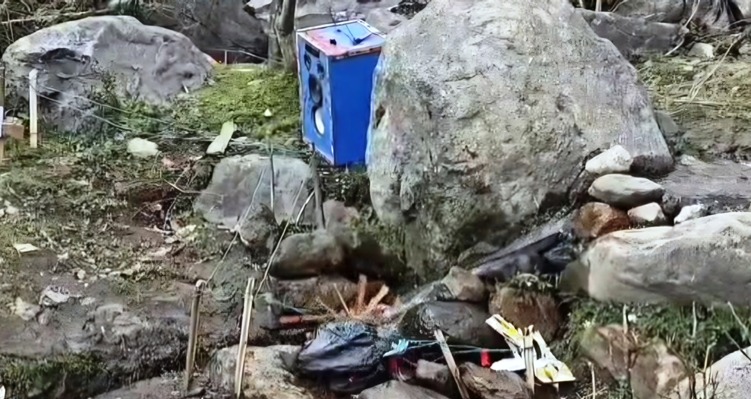
Zahid’s mini hydropower project is the kind of innovation that makes you lean forward. He noticed a perennial stream near his home nothing grand, just a narrow rush of snowmelt over stones. While others saw a place to wash utensils, Zahid saw kilowatts.
He built a small turbine from a plastic bottle, cut and shaped with a heated knife. He fashioned a rotor from old CDs. The generator? A recycled DC motor salvaged from a broken toy. Wiring came from an unused charger. A discarded battery acts as storage.
When the water flows, the turbine spins. The motor generates current. And the bulb a simple 3-volt LED glows.
“When the bulb first lit up and later when I charged a phone, it gave me a lot of confidence,” Zahid says, his eyes widening at the memory. “I wanted to use the natural resources around us in a useful way. When I saw water flowing in the stream, I thought why not try to generate electricity from it?”
This did not happen overnight. Zahid describes months of failure. The turbine wouldn’t spin. The wiring shorted. The voltage was too weak. “There were many times when things did not work,” he admits. “But I did not give up. I kept trying different ideas until I succeeded. That process taught me more than any book could.”
He never once went to a lab. He never once had a teacher hold his hand. His laboratory was the courtyard. His assistant was the setting sun.
What makes his achievement extraordinary is not just the functionality, it is the context. Budhal has no maker spaces. No electronics shop. No YouTube mentor in the local language. Zahid learned by watching ceiling fans, bicycle chains, and the way his father’s old radio hummed.
“He is a beacon,” says Mohammad Shafi, a local shopkeeper. “Our children think they can’t do anything without city facilities. Zahid has shown that a mind can be a factory.”
When asked what he wants next, Zahid does not ask for money. He does not ask for a smartphone.
“I want to learn more and build bigger projects in the future,” he says. “If I get proper guidance and support, a mentor, some basic tools, maybe a small workshop space, I believe I can do much better.”
He wants to build a larger hydel unit that can power not just a phone but a home. He wants to design low-cost farm machinery for the villagers who still till land with oxen. He wants to study science after Class 10, but the nearest good coaching centre is three hours away.
“I want other students like me to try new things and not feel limited by resources,” he adds, his voice rising just a little. “If we have interest and dedication, we can create something meaningful.”
Back in Targain, Zahid has become something rare, a village hero who does not own a single trophy. Neighbours stop by to see the bulb glow. Younger kids bring him broken toys, hoping he will revive them. His mother, who initially scolded him for “wasting time with junk,” now proudly shows visitors the hydel setup by the stream.
This is not a story about a prodigy. It is a story about possibility. About what happens when a curious mind refuses to be defeated by geography.
In an India that often measures talent by access, Zahid Ali is a quiet rebellion. His hands have no calluses from luxury, only from wire, wood, and water. And yet, they have lit a bulb, spun a turbine, and sparked a conversation that deserves to reach every corner of this country.
Because if a 16-year-old in Budhal can build a power plant from scrap, imagine what he could do with just a little help.