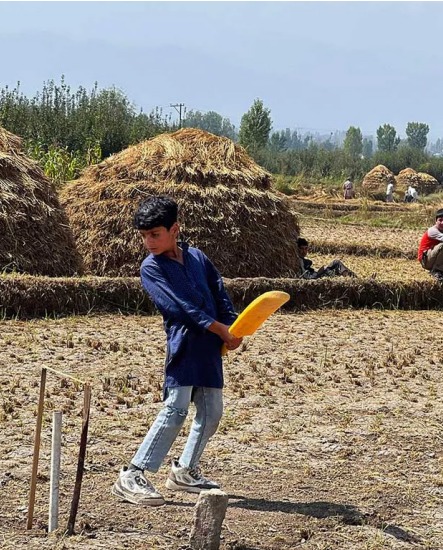
The first light of dawn in Zaloora, a village in North Kashmir’s Sopre area of Baramulla district, does not just reveal the majestic Chinars turning gold. It illuminates a transformation. Overnight, the vast, rain-fed paddy fields, their harvest recently gathered, have been converted into a dozen irregular cricket grounds. The boundaries are marked by haystacks, the sight-screens are towering poplar trees, and the pitch is a 22-yard strip of matting, rolled out over the moist, forgiving earth.
“This is our maidan. Our Lord’s,” says 22-year-old Ishfaq Ahmad, tapping his bat on the matting. He captains one of the dozens of unofficial village teams that compete in this annual ritual. “The city boys have their academies with cement pitches. We have this. And this,” he says, gesturing to the stunning backdrop of mountains and the clear autumn sky, “teaches you to play like a king.”
This is the story of cricket in Kashmir’s paddy fields, a story not just of sport, but of identity, aspiration, and an unyielding spirit that finds a way to play, even on a field of mud.

The scale is staggering. In districts like Pulwama, Shopian, Anantnag, and Baramulla, nearly every harvested paddy field becomes a cricket ground from late September to November. The tournaments are hyper-local, organized by village elders and funded through small contributions from participating teams. The prize money is modest, often a few thousand rupees and a trophy but the prestige is immeasurable.
The structure is a testament to grassroots organization. “We have a committee,” says Mohammad Sultan, a driver by profession and the de facto organizer of the Zaloora tournament. “We collect chanda (contributions), arrange for a makeshift generator for the loudspeaker, and invite teams. It’s our own mini-IPL.”
The players are a mix of students, farmers, carpenters, and shopkeepers. Their kits are often a collection of shared resources, one boy owns the pads, another the gloves. The bats are usually the inexpensive, locally available ‘Kashmir Willow’, but they are wielded with the authority of an international pro.
“When I hit a six over those poplar trees,” says Aamir, pointing to the distant boundary, “the feeling is the same as if I’ve hit it out of the Wankhede. Maybe better. Because here, everyone knows my name.”
The quality of cricket is raw but fiercely competitive. The matting pitches are unpredictable, the outfield is slow and lumpy, demanding a different set of skills. It forces batsmen to play late and bowlers to master cutters and slower balls. It is here, in these challenging conditions, that the unique talent of Kashmiri cricket is forged.
“These boys learn to read the game, not just the pitch,” says Ubaid lefty, the local player playing cricket on state level, speaking to The Kashmir Magazine over the phone. “I started on exactly these kinds of fields. When you play on a matting over mud, every delivery is a test. It builds character and ingenuity. This is our real cricket academy.”
The most crucial cog in this wheel is the ‘matting-wala’. Men like Ghulam Mohammad Dar own the coir matting strips that serve as pitches. He has ten strips, each 22 yards long, which he rents out to different tournaments across North Kashmir.
“This is my harvest season too,” Dar says, smiling as he unrolls a matting on a freshly prepared mud base. “From September to November, these mattings are never idle. They travel from one village to another on my tractor. Without them, there is no game. The mud is too soft.”
The games are community spectacles. Hundreds of villagers, men, women, and children, gather along the boundaries, sitting on wooden planks or their own shawls. The air is thick with the scent of wet earth, the sound of leather on willow, and the passionate, often partisan, commentary in Kashmiri that blares from the loudspeaker.
“For two months, this is our cinema, our theatre, our everything,” says 65-year-old Mohd Asadullah, who hasn’t missed a match in his village for years. “We forget our worries. We just watch these boys and dream.”
This phenomenon is more than just pastime; it is a powerful narrative device. The paddy fields have emerged as arenas of unadulterated joy and peaceful competition. Cricket becomes a language of normalcy, a vehicle for ambition that transcends the difficult socio-political landscape.
The pipeline from these fields to professional cricket, however, remains narrow and fraught with challenges. While the BCCI’s infrastructure has improved in the region with the Jammu and Kashmir Cricket Association (JKCA) undergoing reforms, the gap between a paddy-field cricketer and one from a structured academy in a metro is vast.
“The talent is there, in abundance,” says Ubaid. “But they need exposure to turf wickets, qualified coaches, and fitness regimes. We are getting there, but slowly. The raw diamond comes from these fields; it needs polishing in the system.”
With the winter chill begins to set in by mid-November, the games wind down. The matting is rolled up and the fields are left fallow, waiting for the next sowing season. The cricketers hang up their kits, their minds already dreaming of the next autumn.
But the impact of these two months is lasting. The tournaments are a scouting ground for district and state-level selectors. Every year, a handful of gems are discovered, a fast bowler with a slingy action honed on a muddy run-up, a batsman with extraordinary hand-eye coordination developed on unpredictable matting.
The ultimate dream for every boy here is to escape the metaphorical boundaries of the paddy field and make it to the real stadiums. They look to their hero, Umran Malik, the Jammu-born “Express” paceman, as proof that it is possible.
“We watch Umran Malik on our phones,” says Ishfaq, his eyes gleaming. “When he runs in on that flat, perfect pitch, we see ourselves. We know our run-up is uneven, our field is muddy. But the fire in the belly is the same. Maybe one day, someone will see me play here and I will get a chance. That hope is what keeps us playing.”