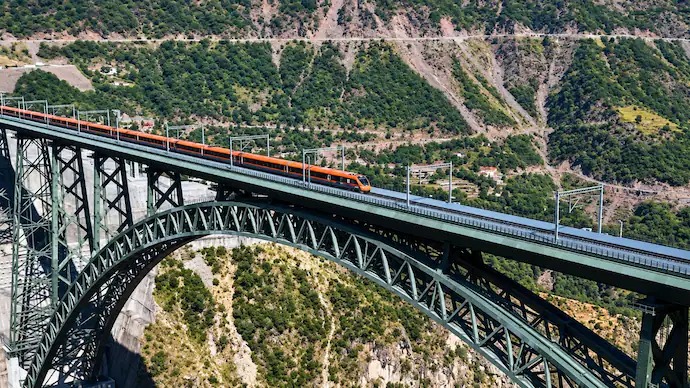
Srinagar, Oct 02 : The Jammu-Srinagar Vande Bharat Express has crossed the Chenab and Anji bridges at 100 kmph for the first time, with the Railway Board raising the maximum permissible speed on the 111-km Katra-Banihal section from 75 kmph to 100 kmph, officials said.
The speed trial was conducted on October 2 using train numbers 26401/26404, they said.
Railway Minister Ashwini Vaishnaw announced the development on X as per news agency Kashmir News Service (KNS), calling it a historic day for the rail network in Jammu and Kashmir.
The Chenab Rail Bridge, the world’s highest railway arch bridge, stands 359 metres above the riverbed — 35 metres taller than the Eiffel Tower. Spanning 1,315 metres across the Chenab river, the steel arch bridge has been built to withstand wind speeds of up to 260 kmph and has a designed lifespan of 120 years.
The train also crossed the Anji Bridge at 100 kmph. India’s first cable-stayed railway bridge, it is another major structure on the Udhampur-Srinagar-Baramulla Rail Link (USBRL) route and spans the deep Anji river valley, south of the Chenab, connecting the Katra-Banihal section.
Located around 80 km from Jammu city, the Anji Bridge towers 331 metres above the riverbed and stretches 725 metres across the valley. It is supported by 96 high-tensile cables, with an inverted Y-shaped pylon rising 193 metres above its foundation. A total of 653 km of cable strands has been used in its construction, officials said.
The speed enhancement is expected to make train operations on the Katra-Banihal section smoother and help reduce travel time. The section is an important part of the USBRL project connecting the Jammu region with the Kashmir Valley.
Currently, two pairs of Vande Bharat services operate on the 266-km corridor. The service was initially introduced with eight coaches, but 16 additional coaches were added earlier this year due to high passenger demand, taking the total to 20.
Developed by the Chennai-based Integral Coach Factory, the Vande Bharat trains in the Kashmir Valley can operate in temperatures as low as minus 20 degrees Celsius, officials added. (KNS)