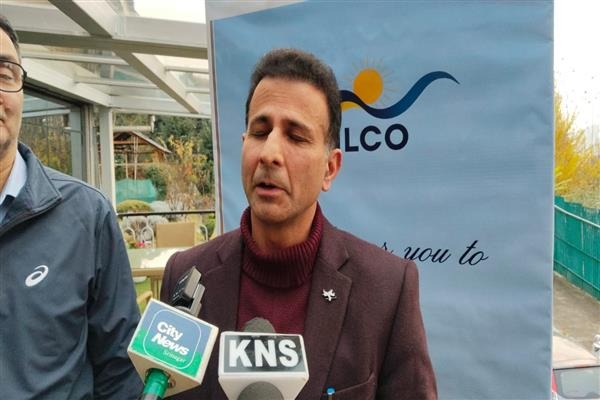
Srinagar, Nov 14 : Warning that unchecked construction, rising pollution and increasing traffic congestion could threaten Kashmir’s natural identity, Joint Director Tourism Waseem Raja on Saturday called for a shift towards sustainable development, saying the Valley’s future depended on protecting its fragile ecology rather than following the development models of metropolitan cities.
Speaking at an event organised by the Nigeen Tourist Traders Association, Raja said Kashmir needed to seriously reconsider its approach to development, particularly in the tourism sector, where increasing concretisation was gradually changing the natural character of several destinations.
“Kashmir cannot become another Delhi or Mumbai. We are Kashmir, with our own identity, topography and fragile ecology,” Raja said, stressing that development should not come at the cost of the environment.
He said protecting Kashmir’s ecology was no longer merely a subject for academic discussions or government policies but had become a question of the region’s long-term survival.
Expressing concern over the increasing construction of concrete structures across Srinagar and major tourist destinations, Raja said the region needed environmentally sustainable alternatives that would preserve its natural landscapes.
He suggested promoting camping, glamping and prefabricated structures instead of allowing indiscriminate concrete construction in ecologically sensitive areas.
Referring to Gulmarg, Raja recalled that nearly two decades ago, visitors travelling towards the tourist destination could see extensive paddy fields on both sides of the road, but the landscape had undergone considerable changes due to construction activities.
He said such changes should prompt serious reflection on whether the current pattern of development was sustainable in a region known for its natural beauty.
The Joint Director Tourism also advocated introducing green carbon ratings for hotels and other tourism establishments to encourage environmentally responsible practices.
He said greater emphasis should be placed on locally manufactured products, which could help reduce carbon emissions associated with transportation while creating opportunities for local entrepreneurs and start-ups.
Highlighting the importance of renewable energy, Raja called for wider adoption of solar power and waste-to-energy projects at tourist destinations.
He said places such as Gulmarg could explore systems through which locally generated waste could be converted into energy, reducing the environmental burden associated with waste disposal.
Raising concern over deteriorating air quality, Raja said clean air had traditionally been one of Kashmir’s biggest attractions, but increasing pollution was threatening that advantage.
Recalling an interaction with a visitor from Delhi, he said the tourist had told him that he had travelled to Kashmir primarily to breathe fresh air because pollution in the national capital had made breathing uncomfortable.
Raja said the incident reflected the importance of Kashmir’s natural environment and warned that continued environmental degradation could eventually deprive the Valley of the very qualities that attract visitors.
He also expressed concern over the growing number of private vehicles and frequent traffic congestion, saying tourists were increasingly complaining about spending long hours on roads.
According to Raja, some visitors had even shortened their stays because of traffic-related inconvenience, highlighting the need for better transport planning and sustainable mobility solutions.
He urged government departments, tourism stakeholders, academicians and the public to collectively examine the growing dependence on private vehicles and explore environmentally responsible alternatives.
Emphasising that environmental protection required public participation, Raja called upon people to become green ambassadors and set examples for younger generations through their daily practices.
Sharing his experience from Ladakh, he said drivers there often collected garbage during their journeys and ensured its proper disposal, demonstrating how individual responsibility could contribute to environmental protection.
He said Kashmir needed to develop a similar culture in which keeping tourist destinations and public spaces clean became a shared responsibility.
Raja also advocated reducing the use of single-use plastics and encouraging household composting to minimise waste generation.
Recalling an awareness programme held around four years ago, he said he had encouraged children and officials to pledge against bringing plastic and polythene into their homes.
He said he had continued following the practice in his own household, adding that environmental awareness would remain ineffective unless people translated it into everyday action.
Referring to old photographs of Kashmir from the 1970s and 1980s, Raja said places such as Lal Chowk, Gulmarg and Pahalgam once had fewer vehicles, less construction and more open natural spaces.
He said the changes witnessed over the past three decades required serious introspection, particularly about the responsibility of the present generation towards preserving the environment.
Raja observed that Kashmir did not always need to look towards Western countries for solutions, as several lessons could be drawn from the region’s own traditional lifestyle and environmentally conscious practices.
He said previous generations had passed on a beautiful Kashmir, and it was now the responsibility of the present generation to ensure that the same natural heritage was available to future generations.
Calling for collective action, Raja said government institutions, tourism businesses, civil society and ordinary citizens must work together to address environmental challenges.
He maintained that although Kashmir faced serious ecological concerns, practical solutions were available through sustainable construction, renewable energy, responsible tourism, effective waste management and changes in public behaviour.
Raja said protecting Kashmir’s natural environment was essential not only for the tourism industry but also for preserving the region’s distinct identity and ensuring its long-term survival. (KNS)