At 80, India’s Independence Day address was less a catalogue of promises than a map of the capacities the country will need by 2047. From semiconductors and artificial intelligence to nuclear power, manufacturing, defence, agriculture and soft power, the government is trying to connect several long-running projects into one development framework. The scale of the ambition is clear. So is the distance still to be covered. Sagar Firdous Reports
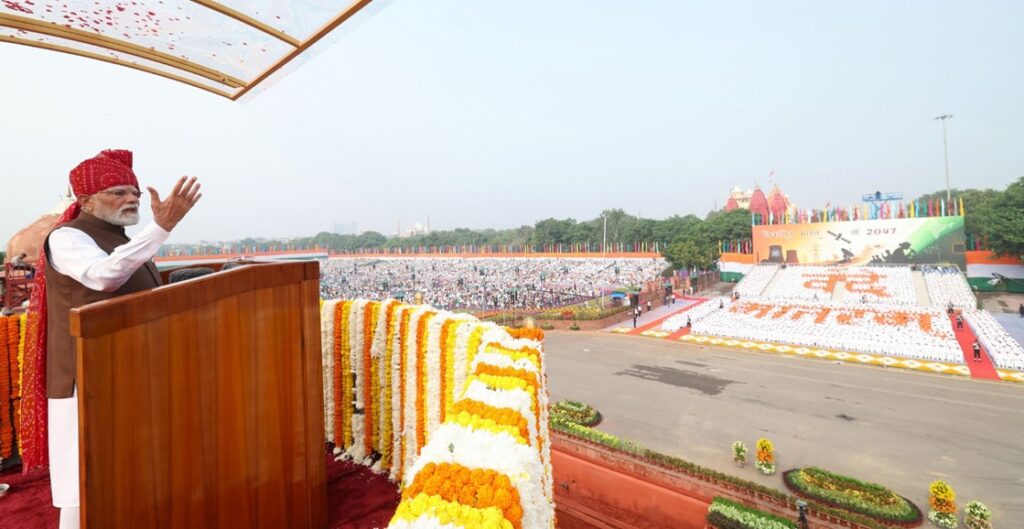
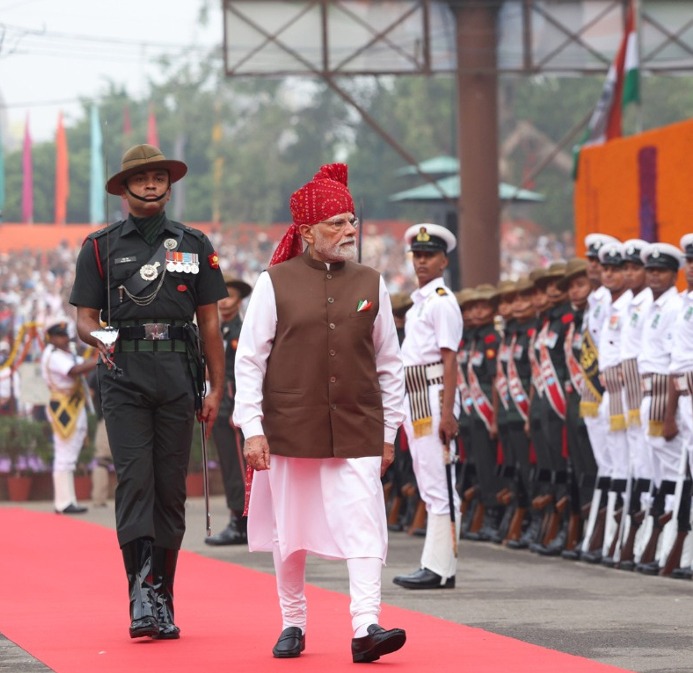
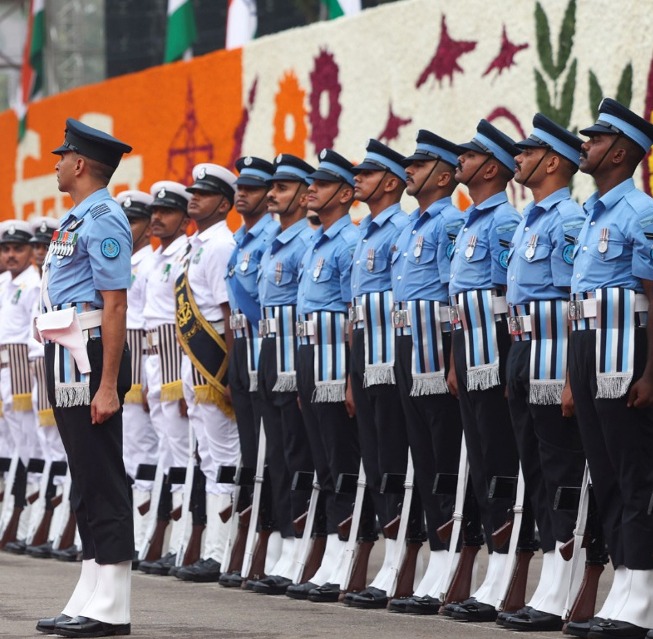
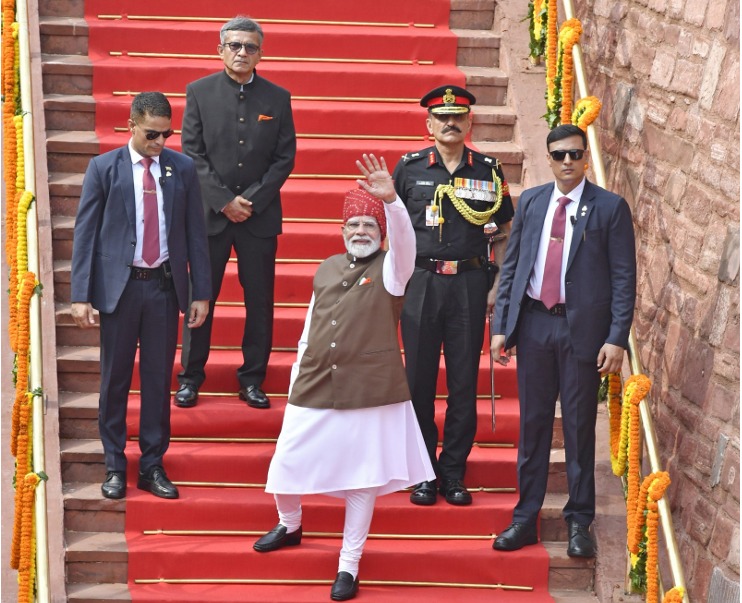
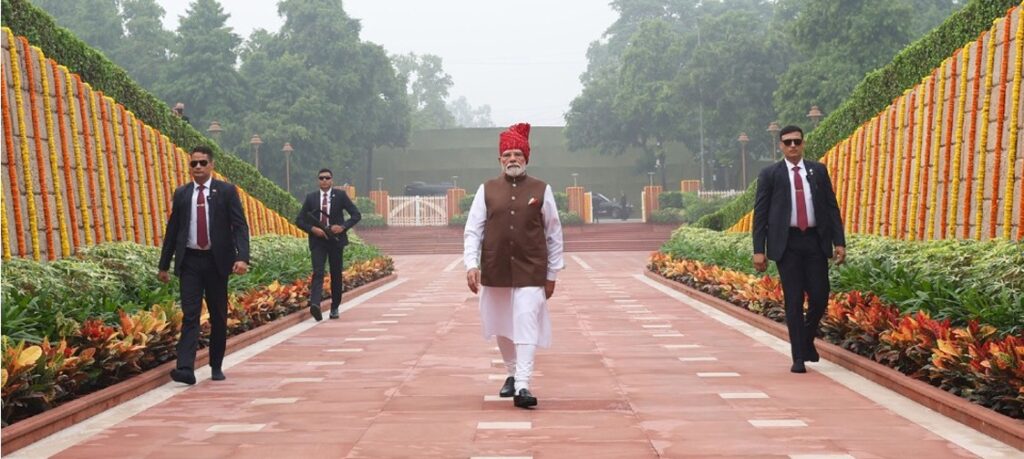
On a warm August morning in Delhi, the familiar rituals of Independence Day unfolded around the Red Fort: the national flag, the ceremonial guard, the gathering of dignitaries and the Prime Minister’s address from the ramparts. But the substance of the 80th Independence Day speech was directed less towards the symbolism of the present and more towards the architecture of the next two decades.
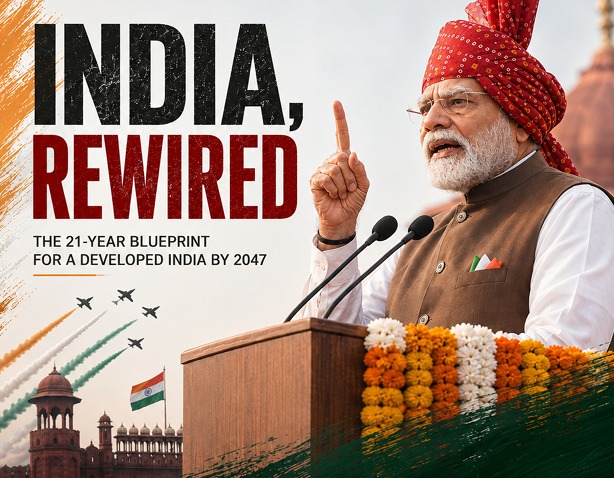
Prime Minister Narendra Modi placed 2047, the centenary of Independence at the centre of the country’s development narrative and presented what he described as ‘Saptadhara’, seven streams of national strength. They cover manufacturing; agriculture and food production; technology and innovation; infrastructure and connectivity; defence; the green and blue economy; and India’s soft power. Alongside that framework came a series of specific announcements, including a programme to train one crore young Indians in artificial intelligence, free online coaching for competitive examinations, a nationwide sports talent search, further expansion of semiconductor manufacturing and a target of 100 GW of nuclear power capacity by 2047.
Taken individually, none of these themes is entirely new. Semiconductor manufacturing has been under construction for several years. The IndiaAI Mission is already building computing capacity and supporting startups and researchers. Renewable-energy capacity has expanded sharply. Defence manufacturing has been moving towards greater domestic participation. Infrastructure investment has been reshaping road, rail and logistics networks. J&K, too, has been pursuing tourism diversification, horticulture value addition and greater private investment.
What the 2026 address did was put these strands into a common frame.
That makes the speech useful not simply as a record of what the Prime Minister announced on August 15, but as a snapshot of where India’s development strategy is heading. The important question is no longer whether India has ambitions. It is whether the various pieces now being built—industrial capacity, energy, infrastructure, skills, technology, research and markets—can begin reinforcing one another at the speed required to meet the 2047 objective.
For Jammu and Kashmir, that question has a particular resonance. Its economy is dominated by services, while agriculture and allied activities continue to employ a far larger share of the workforce than their contribution to economic output. Tourism and horticulture remain major strengths, but the region also needs new sources of productive employment for a young population. The national shift towards food processing, digital services, tourism, renewable energy, sports, manufacturing and technology therefore has direct regional relevance.
The story of the next 21 years will be written in different places and at very different scales. Some of it will happen inside semiconductor fabrication plants and research laboratories. Some will happen on farms, in food-processing units, workshops, classrooms and tourist destinations. Much of it will depend on infrastructure that is rarely visible in a political speech but determines whether an idea can become an industry.
The Red Fort provided the vision. The harder part begins after the speech.
For much of the past several decades, India’s economic story was built around the scale of its market, the expansion of services and the gradual integration of its businesses with the global economy. That story remains important. But the policy emphasis has increasingly shifted towards something more fundamental: the ability to produce strategically important goods and technologies within the country while becoming a larger exporter.
The numbers show why this shift matters. India’s total exports reached a record $863.1 billion in 2025-26, comprising $441.8 billion in merchandise exports and $421.3 billion in services exports, according to the Commerce Ministry.
The composition is revealing. India’s services economy has long been a global strength, particularly in information technology and business services. Merchandise exports, meanwhile, face the more complicated task of competing against established manufacturing centres in East and Southeast Asia, Europe and North America.
The government’s manufacturing push is therefore not simply about adding factories. It is about building supply chains around those factories, developing domestic suppliers, creating skilled employment, reducing strategic dependence and enabling Indian firms to participate in global production networks.
That is the underlying logic behind the semiconductor programme, the Production Linked Incentive framework, defence indigenisation, renewable-energy manufacturing and several other initiatives that now form part of the broader development strategy.
The transition is unlikely to be uniform. Some sectors are already operating at considerable scale; others are only beginning to establish themselves. The semiconductor industry belongs to the latter category, and that makes it one of the clearest tests of India’s industrial ambition.
There was a time when India’s semiconductor story was largely about engineers designing chips for companies whose manufacturing facilities were located elsewhere. India developed a formidable pool of design and engineering talent, but fabrication—the expensive and technologically demanding process of actually manufacturing chips—remained concentrated in a handful of countries and economies.
That equation is beginning to change.
By 2026, the government had approved multiple semiconductor projects under the Semicon India programme, covering fabrication, assembly, testing and packaging. Three approved projects had entered commercial production by July, with additional plants expected to become operational by the end of the year. The government has also approved Semicon India Programme 2.0 with an outlay of ₹1.275 lakh crore, signalling an attempt to move beyond individual projects towards a broader semiconductor ecosystem.
The importance of the programme is not simply that India will manufacture chips. Semiconductors sit inside almost every modern industrial system: automobiles, mobile phones, telecommunications equipment, computers, appliances, defence systems, medical equipment and increasingly artificial-intelligence infrastructure.
A domestic semiconductor ecosystem could therefore influence several other sectors simultaneously.
But semiconductor manufacturing also exposes the difficulty of building high-technology industries. A fabrication facility needs extremely reliable electricity and water, specialised equipment, highly controlled environments and a workforce with expertise in areas ranging from materials and device physics to process engineering and testing. Around the major plants, suppliers of chemicals, equipment, packaging materials and other inputs must develop as well.
The real measure of success will consequently not be the number of plants announced. It will be whether India can create a network of companies and institutions around them and eventually compete internationally on technology, quality, cost and reliability.
That is a much larger proposition than building a factory.
If semiconductors represent the hardware ambition, artificial intelligence represents the human and software side of the same transformation.
The announcement from the Red Fort that one crore young Indians would be trained in AI over the coming year is therefore one of the more consequential elements of the speech. It places technological skills alongside manufacturing and infrastructure as a national development priority.
India is already attempting to build an AI ecosystem through the IndiaAI Mission, which has an approved outlay of ₹10,372 crore. By March 2026, the government said more than 38,000 GPUs had been onboarded through the common compute facility and made available to startups, researchers and academia. The objective is to make computing resources more accessible while developing indigenous applications and capabilities.
The next question is how those capabilities translate into employment.
AI is no longer confined to software companies. It is being introduced into manufacturing, agriculture, banking, healthcare, logistics, education, public administration and media. A farmer can use AI-enabled systems for crop monitoring and weather analysis. A manufacturer can use it for quality control. A hospital can employ it for diagnostics and administrative work. A logistics company can use it to optimise routes and inventory.
That makes AI literacy relevant even for workers who will never become software engineers.
At the same time, India will need a much smaller but highly specialised pool of advanced researchers, engineers and scientists capable of developing foundational models, chips, computing systems and applications. The challenge is therefore two-layered: make technology accessible to millions while developing the advanced talent required to remain competitive internationally.
The one-crore target addresses the scale of the first challenge. The quality of training, the availability of jobs and the development of advanced research capacity will determine how far it goes.
Every major development strategy eventually reaches the same question: who gets the work?
A country can increase its GDP, attract investment and build technologically advanced industries without automatically creating enough employment for its entire working-age population. India’s demographic scale makes this issue particularly important.
The government has therefore increasingly linked manufacturing, MSMEs, skills, startups, infrastructure and technology. The Independence Day speech also included free online coaching for competitive examinations and a nationwide sports talent search for children between five and 15 years of age.
These measures address different parts of the same problem: access to opportunity.
The coaching initiative is aimed at reducing the cost burden on young people preparing for highly competitive examinations. AI training is aimed at preparing workers for a changing labour market. Sports identification seeks to widen the pool of talent beyond established urban centres.
But training programmes alone cannot solve the employment challenge. The economy must generate businesses large enough and numerous enough to absorb those skills.
That is why the manufacturing and MSME components of the strategy matter as much as the education announcements. A trained worker ultimately needs an employer, a market or the capacity to become an entrepreneur.
India’s development story will therefore depend on the relationship between its education system and its productive economy.
Few targets in the speech demonstrate the scale of the 2047 challenge as clearly as nuclear power.
India’s installed nuclear capacity is currently around 8.78 GW. The Prime Minister has now set a target of 100 GW by 2047. The country therefore has to multiply its nuclear capacity more than elevenfold over the next two decades.
At the same time, India has been rapidly expanding renewable energy. Official figures show renewable-energy capacity at 288.58 GW as of June 30, 2026, comprising 162.15 GW of solar, 57.44 GW of wind, 11.75 GW of bio-power and 57.24 GW of hydro power. Including nuclear, India’s non-fossil electricity capacity stood at 297.36 GW.
The figures tell a more complicated story than a simple nuclear-versus-renewable debate.
India’s electricity demand is expected to grow as manufacturing expands, transport becomes more electrified, data centres consume more power and household consumption rises. Solar and wind can provide large quantities of electricity, but their variable nature creates requirements for storage, grid management and other forms of firm power.
Nuclear energy offers a different characteristic: continuous generation with relatively low operational carbon emissions.
The government is consequently seeking to expand both clean-energy capacity and the infrastructure needed to integrate it.
The nuclear target will be particularly demanding. Existing projects will have to be completed on schedule, additional reactors commissioned, financing sustained and supply chains expanded. The government’s new policy framework also seeks greater participation by public-sector and private entities.
The scale of the ambition makes execution the central issue.
A 100-GW target is not achieved by announcing 100 GW. It requires years of engineering, construction, financing, regulatory approvals, fuel arrangements and skilled manpower.
The nuclear target attracts attention because of its size, but the renewable-energy numbers tell a different story: this part of the transformation is already occurring at considerable scale.
India’s renewable capacity has risen from 76.38 GW in 2014 to 288.58 GW in June 2026, according to the Ministry of New and Renewable Energy. The government said the sector attracted about $45.72 billion in FDI between FY2014 and FY2026, while domestic financial institutions deployed ₹12.32 lakh crore towards renewable-energy projects during the period.
Solar power has become the largest component, with 162.15 GW installed by June 2026. Wind capacity stood at 57.44 GW and generated 106 billion units of electricity during FY2025-26.
This is increasingly becoming an industrial story as well as an energy story. Solar modules, cells, batteries, power electronics, transmission equipment and other components create manufacturing opportunities around the energy transition.
The objective is therefore shifting from merely installing renewable projects to building a domestic ecosystem around them.
For India, energy security and industrial policy are beginning to overlap.
The defence component of the 2047 agenda follows a similar logic.
India’s long-standing dependence on imported defence equipment has increasingly been accompanied by efforts to expand domestic production. Procurement rules, defence corridors, startup programmes and greater private-sector participation are intended to increase the share of Indian companies in defence manufacturing.
In the Independence Day address, Modi highlighted drones, counter-drone systems and hypersonic technology among the capabilities India should develop.
These are not isolated military technologies. They require expertise in electronics, sensors, communications, artificial intelligence, advanced materials and precision manufacturing.
That creates potential spillovers into civilian industries.
Drone technology, for example, is now relevant to agriculture, land surveys, infrastructure inspection, disaster management and logistics as well as defence.
A mature defence-industrial ecosystem could therefore contribute to the wider advanced-manufacturing base.
The government’s ambition to become a larger defence exporter also changes the objective. Producing for the domestic market is one thing; meeting international specifications and competing with established global suppliers is another.
Exports become a test of quality and competitiveness.
Infrastructure is perhaps the least glamorous part of the seven-stream framework, but it is the layer on which the others depend.
A semiconductor plant requires roads, reliable power and water. A farmer needs transport and cold storage. An exporter needs ports, customs systems and freight networks. A tourist destination needs roads, airports and telecommunications. A manufacturing cluster needs access to suppliers and markets.
This is why Gati Shakti is not simply an infrastructure programme.
It is an attempt to reduce the friction between different parts of the economy.
For a geographically large country, logistics can determine whether a manufacturer can compete internationally. A factory that receives components late or spends too much moving finished products to ports will struggle even if the production line itself is efficient.
The same principle applies to Jammu and Kashmir, where geography makes connectivity particularly consequential.
A road or railway project can change the economics of a region by reducing travel time, improving access to markets and making investment more viable.
Infrastructure, in other words, does not merely connect places. It changes their economic possibilities.
The 2047 development agenda looks different when viewed from Jammu and Kashmir, but many of its central questions are remarkably similar.
The latest J&K Economic Survey estimates real GSDP growth at 5.82 per cent in 2025-26. Services account for 61.02 per cent of GSVA, while agriculture and allied activities contribute 20.45 per cent. Yet agriculture and allied activities account for 42.99 per cent of the workforce, according to the employment data cited by the UT government.
That imbalance is one of the most important economic facts about J&K.
It indicates that agriculture remains a major employer while generating a substantially smaller proportion of economic output. Improving productivity and increasing value addition can therefore have a greater impact than simply increasing production.
Horticulture provides a ready example.
The 80th Independence Day speech thus offers a useful way of looking at the years ahead. It is not a single-sector plan, nor can its targets be achieved by one level of government or one class of institutions. It is an attempt to assemble the industrial, technological, physical and human capacities required for a developed economy.
The real test will come in the quieter years between Independence Days: when a factory has to meet its production schedule, when a researcher needs funding, when a student needs a job, when a farmer needs a better market, when a small enterprise seeks its first export order and when a remote destination tries to become economically viable without losing what makes it distinctive.
By 2047, the question will not be how ambitious the vision sounded from the Red Fort in 2026.
It will be how much of that vision became capacity on the ground.