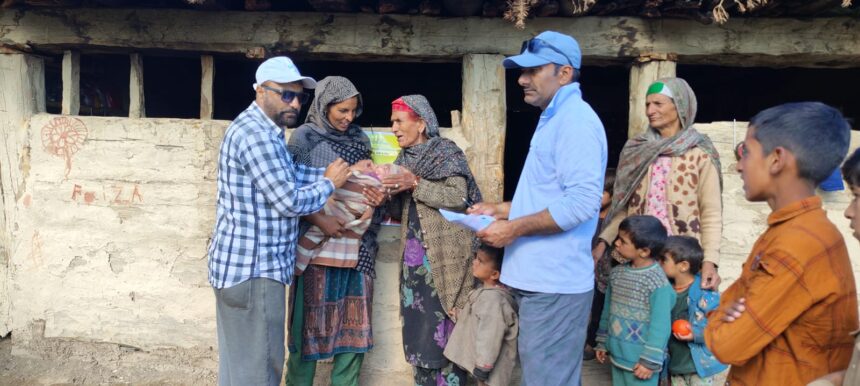
Srinagar, June 30: A team of health workers trekked nearly 38 kilometres through rugged mountains in Jammu and Kashmir’s remote Gurez Valley, walking for almost 10 hours to reach an isolated alpine meadow where they vaccinated nomadic children against polio and conducted a medical camp, officials said.
The team travelled from Dawar to Patalwan, a high-altitude alpine meadow and lake located on the eastern side of Gurez in Bandipora district, to ensure that children from nomadic families were not left out of the National Pulse Polio Immunisation Campaign held on last Sunday.
The round trip on foot covered nearly 38 kilometres, with the team spending the night at the remote location before returning the next day.
Health worker Bashir Ahmad Teroo, accompanied by two health workers Shams Din Nasir and Rubina, carried vaccines and essential medical supplies through steep mountain trails to reach the seasonal settlement.
“We started early in the morning from Dawar and walked continuously for around 10 hours to reach Patalwan. The terrain was difficult and there were long uphill stretches, but we knew children there were waiting for us,” Teroo told KNS.
Besides administering pulse polio drops to around 30 children, the team also organised a mini medical camp for the nomadic community.
“The Block Medical Officer (BMO) had instructed us not only to complete the immunisation drive but also to hold a medical camp so that families living in these remote meadows could receive basic healthcare. We examined patients, distributed medicines and addressed common health concerns,” he said.
Teroo said the journey highlighted the contrast between healthcare delivery in urban centres and inaccessible mountain regions.
“Giving a child polio drops in a town or city takes only a few minutes. But this is the real work of public health. Here, every dose means walking for hours through mountains so that no child is left behind,” he said.
Despite the physical exhaustion, the team remained determined to complete the assignment.
“It was one of the toughest journeys we have undertaken. We stayed overnight because returning the same day was impossible. When we saw the children receiving the vaccine, all the hardship felt worthwhile,” he said.
ASHA worker Rubina said ensuring healthcare reaches the last person is at the heart of their work.
“These families spend months in high-altitude pastures and often have little access to medical facilities. If we don’t go to them, many children could miss essential immunisation. That is not an option for us,” she said.
For the nomadic families, the visit came as an unexpected gesture of care.
Mohammad Kaleem, a 45-year-old nomad staying in Patalwan with his family, said he had never seen health workers undertake such a difficult journey.
“We never imagined a health team would walk such a long distance just to reach us. They came with medicines and ensured our children received polio drops. We are grateful for their dedication,” he said.
He said such efforts deserved recognition.
“These are the real heroes of the health department. The government should acknowledge their commitment to people living in remote areas,” Kaleem added.
Abdul Rahman, a 38-year-old shepherd from the nomadic community, said, “The nearest health facility is a long distance away, and reaching it means losing an entire day’s work”
“Seeing health workers climb these mountains with vaccines and medicines for our children is something we will always remember. They came to us instead of waiting for us to come to them,” he added.(KNS).