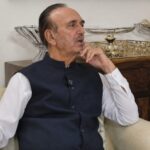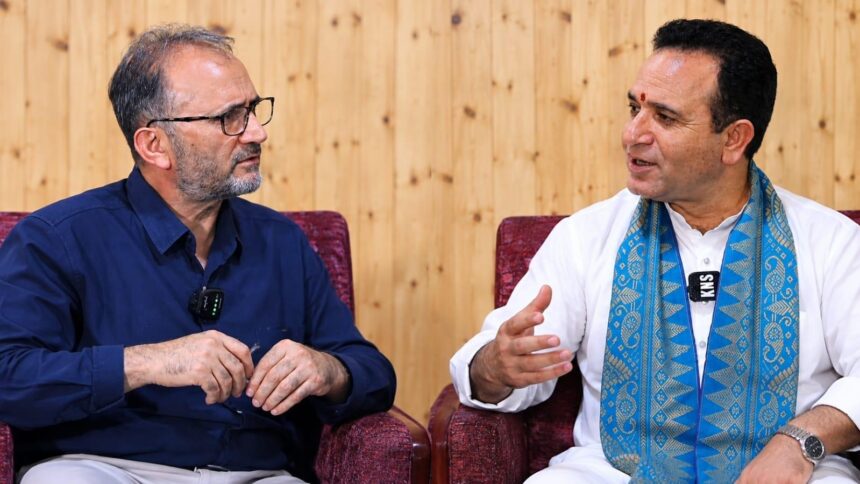
In a wide-ranging conversation with Kashmir Magazine Editor Mohammad Aslam Bhat, Leader of Opposition and senior BJP leader Sunil Sharma takes on the National Conference’s Jantar Mantar protest, its demand for statehood, the legacy of Article 370, the Centre–UT relationship and the government’s record on jobs, electricity and development. He rejects the charge that the BJP’s politics is driven by Hindu-Muslim polarisation and insists that the party’s larger objective is to move Jammu and Kashmir beyond dynastic politics.
Excerpts
KM: The ruling party recently held a protest at Jantar Mantar in Delhi. Do you think the government is under pressure?
Sunil Sharma: The Jantar Mantar episode needs to be studied in great detail. I would urge the intelligentsia, opinion makers and people who follow Jammu and Kashmir politics to research what actually happened and why.
For three generations, one family has been deceiving the people of Jammu and Kashmir. They have repeatedly made promises, raised expectations and then failed to deliver. People understand this, but they continue to get trapped in the same political cycle.
Look at the period between 2019 and 2024. After the 2024 elections, people had enormous expectations from the elected government. They believed that with a popular government in place, their day-to-day problems would be addressed.
But look at what happened during the election campaign.
The National Conference said it would restore Article 370 and Article 35A. Alongside that, it made promises on electricity, free power, ration, LPG cylinders and jobs. It also tried to give the election a religious and emotional colour.
There was even a promise in its manifesto relating to changing the name of the Shankaracharya temple to Takht-e-Sulaiman. These were all part of an attempt to consolidate a particular vote.
The BJP, on the other hand, fought the election primarily on two issues, security and development. Our position was clear: every innocent citizen should feel secure and every region and section of society should receive equal development.
The National Conference secured the mandate and formed the government. We have more votes in percentage terms, but I have said repeatedly: if you lose an election by two runs, you are still defeated.
KM: You have repeatedly accused the government of failing on its promises. What, in your view, has gone wrong?
Sharma: The same family that has repeatedly betrayed the people came back to power with a new set of promises. But where are those promises now?
A resolution was brought in the Assembly in the name of special status. I challenged it. I said that if there is any provision in the Constitution that can restore the special status of Jammu and Kashmir, show it to me. If there is, I am ready to face whatever punishment follows.
The truth is that neither Article 370 is coming back nor are the promises being fulfilled.
There was also a major controversy over electricity. First, they talked about giving 200 units of free electricity. Then they tried to link it with the PM Surya Ghar Yojana. The same thing happened with ration, jobs and other promises.
This is the background against which the Jantar Mantar protest has to be understood.
When the government began facing questions from the public and even from its own MLAs, different issues were raised. At one point it was Dachi Gam, at another point something else. There was talk of expansion and reshuffling. Nothing worked. Then they decided to demonstrate their strength in Delhi. I call it a planned drama.
KM: Why do you call the Jantar Mantar protest a “drama”? Was the timing really inappropriate?
Sharma: The timing was one issue. The bigger issue was the intention. When your intention is not clear and you are trying to walk on two sides simultaneously, people will question you. You announce a protest. At the same time, you meet the Prime Minister, the Home Minister and the Defence Minister. Before that, you say you will not meet Prime Minister because you are protesting against him, and then you negotiate with him. People understand these contradictions. You have to take a clear position.
The National Conference has itself said that statehood will come from the BJP-led government. If that is what you believe, then why keep repeating the same political drama?
Do what you have promised. Do what you said you would do.
KM: There was also criticism that the BJP postponed its protest. Was it because Omar Abdullah had pressured you?
Sharma: No. Omar Abdullah had nothing to do with it. The BJP gives priority to humanity. There was a demand that we should first reach Rajouri because people had suffered there. We had planned to go, but the situation evolved because of heavy rains and floods. Roads were closed and people were facing difficulties. So we postponed the protest. We did not cancel it.
We can protest after four days. There is no competition that if they come to Jammu, we have to immediately go somewhere else.
Our priority was humanitarian. When there is a tragedy, the BJP goes there. Recently, when Aashiq Hussain was martyred in Budgam, we went there. We do not wait to see whether someone else reaches first.
KM: But statehood is not the issue of the National Conference alone. The BJP has 29 MLAs. Why did you not support the government’s demand for statehood?
Sharma: Support what? A drama? Lies?
We support the truth. We have already said that statehood will be restored. It will come. But it does not need this kind of drama. Our agenda was to end Article 370. That has happened. Article 35A is gone. Everyone has accepted that Article 370 is not coming back. Now even the National Conference is saying that statehood is the priority. I appreciate that.
But why is there such a hurry?
KM: You have spoken strongly against the Abdullah family. But isn’t statehood also about restoring the political dignity of Jammu and Kashmir?
Sharma: Statehood will come. But let us ask another question: what was the situation before 2019?
For 36 years, Jammu and Kashmir suffered terrorism, violence, shutdowns and separatism. It was difficult to travel even within Srinagar. Schools were affected. Businesses suffered. Government employees could not work normally.
As a minister, I remember situations where even government programmes could not be conducted properly because of threats and protests.
Today, compare that with the present situation. You cannot compare decades of violence with one isolated incident and say that nothing has changed.
Every year, hundreds of young people were recruited into terrorism. Today, that number has drastically reduced. The biggest achievement is that no young Kashmiri is coming forward in the same numbers to take up arms against the country. That is a historic change.
KM: But the government argues that peace has returned after the abrogation of Article 370. How do you assess that claim?
Sharma: Peace has certainly improved, but I would not say that the threat has disappeared.
There was a proxy war for decades. The difference today is that the ecosystem that sustained violence has been dismantled to a large extent. There are no large-scale stone-pelting incidents. Civilians are not routinely caught in crossfire. The kind of pellet injuries we saw during earlier periods is no longer the norm.
Tourism has increased. People are travelling. Markets are functioning. You have to look at the complete picture. There is still an element that tries to keep the Pakistan narrative alive. But the situation is fundamentally different from what it was for decades.
KM: There has been speculation that the National Conference is getting closer to the BJP. Where does the BJP stand on that?
Sharma: Let it be close to the BJP. The BJP is running the government of India. We have no problem. But I will say this very clearly: the BJP will not form a government with the National Conference.
Especially with people whom we believe have betrayed Jammu and Kashmir and whose politics, in our view, have contributed to the suffering of the people. We have no intention of forming a government with them.
KM: What about the PDP? There is also speculation about its proximity to the BJP.
Sharma: Our fundamental position is that politics in Jammu and Kashmir must move beyond two families. Whether it is the PDP or the National Conference, the BJP believes political power should not remain confined to two political families.
We want a Chief Minister who can emerge from an ordinary household, a worker’s family, a poor family, whether that person comes from Jammu or Kashmir, whether he is Hindu, Muslim, Sikh or from any other community.
The Chief Minister should be chosen on merit.
Why should the fourth generation of one family automatically be considered entitled to the chair?
KM: But these parties have been elected by the people. Why blame them for being in power?
Sharma: I am not stopping anyone from being in power. The people have given them the mandate. Let the people judge them again. But elections cannot forever be fought on the same emotional issues. Our objective is to clean the political and security ecosystem first. Once that happens, people should freely decide whom they want to support.
KM: What, according to you, is missing from the present government?
Sharma: A roadmap.
When a government is formed, it should tell people what it intends to achieve in 100 days, six months, one year and two years.
Tell people: within one year, we will repair these roads. We will equip these hospitals. We will fill these vacancies. We will strengthen school education. We will improve healthcare.
Where is that roadmap?
I have not seen it.
Take Uttar Pradesh as an example. When Yogi Adityanath became Chief Minister, he set specific targets for governance, law and order and infrastructure. Whether one agrees with his politics or not, there was a clear vision.
That is what governance requires.
KM: You have also criticised the Chief Minister over finances. He argues that the Union government has not provided adequate funds. What is your response?
Sharma: I will not agree with that argument.
The Chief Minister himself has said on several occasions that the Union government is providing substantial financial support. He has also spoken about receiving additional funds.
So why continuously defend the argument that Delhi is stopping everything?
If there are funds available, use them. The problem is not always money. The problem is governance, prioritisation and execution.
Bhat: You have been particularly critical of the Chief Minister. Is that because he refuses to engage with the Leader of Opposition?
Sharma: The Chief Minister has said that he will not answer questions from the Leader of Opposition. He keeps speaking against us. My job is to expose the shortcomings of the government. If I am the Leader of Opposition, I have a responsibility to ask questions.
I am not doing this personally. But unfortunately, I have to say that the chair on which I am sitting has become a curse in the sense that there is so much political drama around it and so little focus on governance.
KM: Your critics often say that the BJP’s politics in Kashmir is built around Hindu-Muslim polarisation. How do you respond?
Sharma: The BJP does not work merely to win seats or elections. Our objective is security, development and peace.
We want every innocent citizen to be safe. We want tourists to come. We want investors to come. We want young people to get opportunities.
The BJP wants politics to move beyond identity-based family politics. We want a political system where a person from an ordinary family can become Chief Minister on merit.
That is the larger change we are seeking.
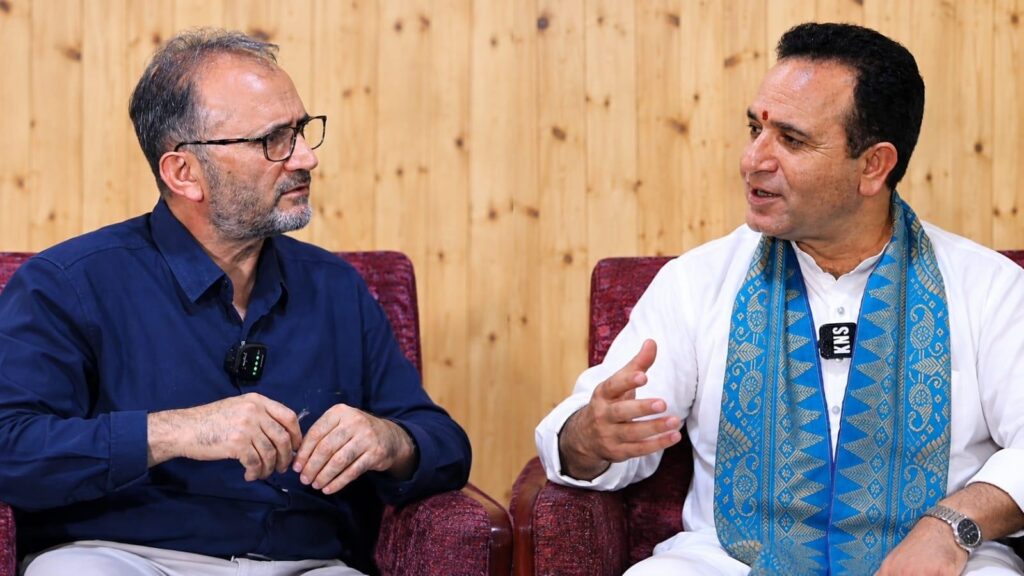
KM: But critics argue that the BJP’s political agenda remains divisive and that it has struggled to build trust among Kashmiris.
Sharma: The BJP is not asking anyone to vote for us merely because we want to win an election. Our politics is about changing the political system.
If someone from an ordinary Kashmiri family, a labourer’s family or a poor household becomes a leader because of his merit, that is democracy.
For decades, two families have dominated the political space. Our objective is to change that. Let the people decide.
If the people believe we are right, they will support us. If they believe we are wrong, they will reject us. That is democracy.
KM: Thank you for having us
Sharma: Thank you