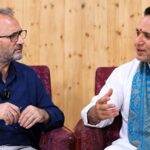
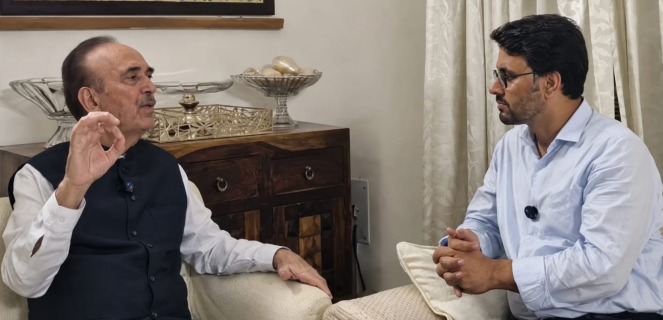
In a conversation with Kashmir Magazine Correspondent Tawseef Hamdani in New Delhi, Former Chief Minister and Chairman Democratic Progressive Azad Party Chairman, Ghulam Nabi Azad speaks about the unfinished question of statehood, the absence of coordination between the Centre and J&K, unemployment, his experience of using double and triple shifts to accelerate development, and the political choices facing the region.
Excerpts
KM: Jammu and Kashmir has been demanding restoration of statehood. How do you view the issue?
G N Azad: When I was the Leader of the Opposition in the Rajya Sabha on August 5, 2019, the government suddenly introduced the measures relating to Jammu and Kashmir. It was not part of the business that had been scheduled for that day.
I have spoken extensively on Article 370 and the reorganisation of Jammu and Kashmir. But almost seven years have passed, and unfortunately, hardly anyone talks about Article 370 anymore.No political party consistently raises the issue. Perhaps it comes up during elections to attract votes, but there is no sustained political campaign around it. Today, the major demand is statehood.
KM: You have served as Chief Minister, Union Minister and Leader of the Opposition. Do you think there is a lack of political integrity among the leadership in Jammu and Kashmir today?
G N Azad: I do not want to accuse any individual or speak against anyone personally. I don’t speak against either the state government or the Central Government as individuals.
I speak about policies. But yes, there is a lack of coordination. There is a lack of coordination between the Central Government and the J&K Government. Both governments sometimes speak on completely different issues.The Central Government says one thing, while the state government says another. And in this fight between the two, if somebody suffers, it is the poor person. The ordinary citizen ultimately pays the price.
KM: You have often spoken about employment. What do you think is the biggest challenge before Jammu and Kashmir today?
G N Azad: Unemployment is a major challenge. There are different categories, educated unemployment, skilled and unskilled unemployment, and technical unemployment.There are highly educated young people who are unemployed. There are also workers who may have little formal education but possess skills and work with their hands. Even graduates sometimes end up doing manual work without being adequately paid.
If you look at unemployment in Jammu and Kashmir in comparison with the national and global situation, our position remains extremely difficult. The workers, whether skilled, unskilled or educated, need opportunities.
KM: You were Chief Minister of Jammu and Kashmir. What did you do differently to address employment and development?
G N Azad: I found a way of accelerating construction and employment. Nobody suggested it to me and I did not ask anyone for it.
People today remember it as the double-shift and triple-shift system.In rural areas, we used double shifts. In urban areas, we used triple shifts.There was a practical reason. In rural areas, electricity was limited. In urban areas, particularly at district headquarters, there was electricity at night. So we installed powerful lighting and continued construction work after normal working hours.It had three major benefits.
First, projects were completed faster. Second, more people got employment. Third, public money was put to productive use.Hospitals, colleges and other public buildings were constructed through this system. The Tulip Garden and Haj House are among the projects that benefited from accelerated construction.
During my two-and-a-half-year tenure, I worked extremely long hours. I hardly slept more than a few hours because I wanted projects to move quickly.This is not about one government or one political party. If you want to create employment, large institutions and infrastructure projects can generate jobs for highly educated people as well as skilled and unskilled workers.
\KM: During your political career, did you ever get an opportunity to speak directly to the Prime Minister or Home Minister about Jammu and Kashmir?
G N Azad: Yes, many times.
KM: And what was their response?
G N Azad: They always said that they had given certain assurances. But now I feel enough time has passed.
The present government in Jammu and Kashmir has also been given an opportunity. They have made promises to the people. They should be given a chance to work.
KM: Can Chief Minister Omar Abdullah build a better relationship with the Central Government and make the relationship more productive?
G N Azad: Omar Abdullah is a capable Chief Minister. He is educated and has an advantage that many of us did not have—he has a good understanding of finance.
He has more knowledge of financial matters than many Chief Ministers, including some who are senior to him.I believe he should be given an opportunity to govern.If Jammu and Kashmir is given full statehood, the elected government will have greater responsibility and greater space to make its own decisions. If mistakes are made, they will have to own those mistakes.
KM: You, Mufti Mohammad Sayeed and Farooq Abdullah are three major political figures from Jammu and Kashmir who also served as Chief Ministers. Do you think your generation of leaders bears some responsibility for the political situation the region finds itself in today?
G N Azad: If you go back to the 1970s, I was one of the people who raised these issues.I earned my political position through my own work. The speeches I gave and the support I received were not simply because of someone else’s political backing.I have always spoken about the employment and future of the youth of Jammu and Kashmir.You can ask the old political leadership about that period. I have always maintained my position on these issues.
KM: Where do you see the future of Ghulam Nabi Azad and Jammu and Kashmir politics? Is there a new generation of leaders capable of leading the region?
G N Azad: I cannot name one person.Leadership depends on ability and capability. There are many people who can emerge.But politics has changed dramatically.I have been in Delhi for 30, 40 and even 45 years. I have interacted with leaders from almost every political party. I have worked during the eras of Indira Gandhi, Sanjay Gandhi, Rajiv Gandhi and P. V. Narasimha Rao.That was a different political world.Today, politics is very different.
KM: What is the biggest difference between the politics you experienced and the politics we see today?
G N Azad: Today’s politics is increasingly based on religion, caste and money. The political environment has changed considerably.Earlier, political debates were more focused on ideology, policy and issues. Today, identity and money have become much more prominent in electoral politics.
KM: You have been a Leader of the Opposition in the Rajya Sabha and have spent decades in Parliament. How do you assess Rahul Gandhi’s work?G N Azad: When I resigned, I did not say anything personally against Rahul Gandhi.I still believe he is sincere. He raises issues. There is no doubt about that. He wants to debate different subjects and brings several issues before Parliament.
But I believe there are certain deficiencies that need to be corrected. If he addresses those shortcomings, he can become more successful.Parliamentary functioning is important.
KM: You have spoken about the importance of parliamentary debate. Where did that belief come from?
G N Azad: I learnt it very early in my political career.When we became MPs in 1980, there were around 40–50 young Congress members in Parliament. We were part of the Youth Congress generation associated with Sanjay Gandhi.During the first session, we created a lot of noise. We did not allow the Opposition to function properly.Indira Gandhi saw us standing there. She stayed for some time and later called us.She told us that if we wanted to become leaders, we had to learn how Parliament worked.She asked whether we went to the Parliament Library.I said no.
She told us that people still visit the library to read the speeches of Jawaharlal Nehru and other great leaders. Those speeches are preserved because they contributed something to parliamentary debate.Her message was simple: if you want to be a leader, prepare your subject and speak with substance.If you only create noise, nothing meaningful remains in the record.But if you study an issue, understand it and speak effectively, your words become part of parliamentary history.That lesson has stayed with me.
KM: Finally, after such a long political journey, what do you think Jammu and Kashmir needs most today?
G N Azad: It needs development, employment and political stability.
It needs coordination between the Central Government and the J&K Government and above everything else, the ordinary people should not become victims of political differences.Governments may disagree. Political parties may fight. But governance must continue and the people must come first.
KM: Thank you for having us
G N Azad: Thank you.