Chief Minister Omar Abdullah’s ₹1.27 lakh crore Budget walks a careful line between welfare
expansion and fiscal restraint in a Union Territory still recovering from economic shocks and structural
strain. With growth projected at 9.5 per cent but dependence on central aid persisting, the real test lies
in delivery. Aaqib Khan reports.
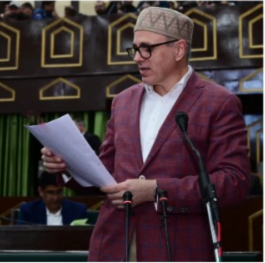
On February 6, inside the Jammu and Kashmir Legislative Assembly in Jammu, Chief Minister Omar Abdullah rose to present what he described as his “second Budget as Finance Minister.” But beyond the ritualistic parliamentary phrasing, the moment carried deeper political and economic resonance.
This was not merely a fiscal document.It was a confidence-building exercise in a Union Territory still negotiating structural uncertainty, administrative recalibration and political sensitivity. It was also a statement from a government keen to signal stability after a year marked by security shocks, floods, and sectoral distress.
With total gross receipts and expenditure estimated at ₹1,27,767 crore for 2026–27, the Budget appears expansive on paper. But as always, the true story lies beneath the headline number.
At first glance, ₹1.27 lakh crore sounds like a leap toward fiscal ambition. Yet embedded within that figure is a provision of ₹14,000 crore under ways and means advances and overdraft. Once that is excluded, the effective net Budget stands at ₹1,13,767 crore. The composition of spending tells a revealing story.
Revenue expenditure accounts for ₹80,640 crore. Capital expenditure stands at ₹33,127 crore. Nearly 71 per cent of the Budget is therefore committed to revenue expenditure — a pattern that underscores structural rigidity.
Revenue expenditure largely covers salaries, pensions and debt servicing. Indeed, the Chief Minister himself acknowledged that nearly 60 per cent of overall spending is pre-committed toward these obligations.
This is the inherited architecture of Jammu and Kashmir’s public finance system: a high salary burden, limited revenue elasticity and restricted fiscal flexibility. In such a framework, transformation becomes harder than consolidation.
Abdullah projected the Gross Domestic Product for 2025–26 at ₹2,88,422 crore, reflecting 9.5 per cent growth over the previous year. For 2026–27, GDP is estimated at ₹3,15,822 crore, maintaining a similar trajectory.
On paper, these are healthy numbers. But they arrive after a turbulent fiscal year. The Chief Minister explicitly acknowledged that geopolitical factors, the Pahalgam terror attack and devastating floods in parts of the Jammu region adversely affected economic activity. Tourism suffered. Handicrafts slowed. Horticulture and agriculture faced distress. Job losses followed.
The projected 9.5 per cent growth, therefore, represents recovery as much as expansion. Whether the rebound sustains will depend on two factors: internal
stability and external calm.
The fiscal deficit numbers tell a story of recent correction but emerging caution. In 2024–25 (RE), the deficit stood at 5.5 per cent. In 2025–26 (RE), it dropped to 3.63 per cent. For 2026–27, it is projected at 3.69 per cent.
The slight upward tick is modest, but it indicates expanding commitments. With welfare schemes added and capital expenditure protected, maintaining deficit discipline becomes more complex.
The tax-to-GDP ratio is projected at 6.6 per cent for 2026–27, compared to 7.5 per cent in 2025–26. This decline suggests either slower tax buoyancy or structural collection constraints. For a region aspiring to fiscal maturity, strengthening internal revenue remains a critical challenge.
Perhaps the most revealing admission in the Budget speech was this: own tax and non-tax revenues meet only about 25 per cent of the Union Territory’s budgetary requirements.
The numbers reinforce that reality. Own revenues: ₹31,800 crore. Central assistance: ₹42,752 crore. Centrally Sponsored Schemes: ₹13,400 crore.
Jammu and Kashmir remains fiscally dependent on New Delhi. This is not unusual for a Union Territory, but it shapes policy autonomy. Budgetary planning must align with central fiscal frameworks. Growth narratives are therefore inseparable from Centre–UT coordination.

Abdullah acknowledged the Centre’scontinued support, particularly through the Special Assistance to States for Capital Investment scheme. Funds under this scheme will be directed toward infrastructure, hydroelectric projects and disaster mitigation works.
In many ways, the Budget’s expansionary capacity rests on this partnership. For the third consecutive year, austerity measures remain in force. Borrowings are being kept within approved limits. Non-priority spending is being curtailed. Liquidity management is being tightened. This quiet discipline
rarely makes headlines, but it shapes fiscal sustainability. The administration appears determined to avoid reckless populism. Instead, it has chosen calibrated expansion.
The Budget’s most politically resonant announcements lie in welfare measures. Full fee waivers for economically weaker students from Class 9 to college could ease educational strain on thousands of households. In a region where private schooling and professional courses impose heavy financial burdens, this move carries social impact. Six free LPG cylinders for eligible households address inflation concerns directly. In colder climates, energy costs form a significant portion of household expenditure. Monthly support for orphan children, scholarships or tribal students and free government transport for persons with disabilities add a targeted inclusion dimension. These are not structural reforms; they are protective buffers. They signal a government attentive to social distress.
Crop insurance for apple, saffron, mango and litchi is among the more strategic interventions. Apple alone underpins large sections of the Valley’s rural economy. Weather volatility, market fluctuations and transport disruptions have repeatedly hurt farmers.
Insurance expansion could stabilise incomes if claim settlement mechanisms function efficiently. Storage expansion and irrigation modernisation address chronic inefficiencies.
Medicinal plant cultivation hints at diversification. Livestock genetic improvement labs suggest productivity enhancement.
Yet agriculture reforms yield results slowly. Political impatience often outruns agrarian timelines. JK e Pathshala DTH channels for Classes 1–12 aim to expand digital reach, particularly in remote districts where connectivity remains uneven.
Modernising anganwadi centres strengthens early childhood infrastructure. Indoor sports facilities in government schools respond to youth engagement needs. Priority hiring of local youth in subsidised industries attempts to align employment policy with demographic pressure. In a region where unemployment carries both economic and psychological weight, youth policy cannot afford symbolic gestures alone.
The power sector remains a fiscal drain. Loss reduction works, consumer base expansion and hydroelectric investments aim to reduce financial stress. If successful, hydropower expansion could strengthen revenue streams and energy stability.
But power sector reform requires sustained administrative resolve — something that has eluded successive governments.
Throughout his speech, Omar Abdullah’s language was aspirational. “This Budget is not merely a ledger of figures,” he said, “it is a fiscal compass.” He invoked resilience, collective effort and participatory governance.
The messaging is deliberate. In a post-Revocation of Article 370 landscape, economic governance becomes the most visible instrument of political credibility. If roads improve, irrigation expands, jobs materialise and subsidies reach beneficiaries, governance legitimacy strengthens. If delivery falters, fiscal optimism will ring hollow.
The Budget’s architecture suggests a government walking a tightrope. On one side lies the demand for welfare expansion in a region that has endured economic shocks, security disturbances and climate vulnerabilities. On the other lies the imperative of fiscal discipline in a Union Territory where internal revenue meets barely a quarter of total requirements.
The result is a document that is cautious yet ambitious, protective yet forward-looking, and politically conscious without being overtly populist.
The most immediately visible elements of the Budget are its welfare announcements. Full fee waivers for economically weaker students from Class 9 to college are framed as an investment in human capital. In a region where educational aspiration runs high but affordability remains uneven, this intervention could have a tangible social impact.
Yet such waivers are fiscally recurrent. They create obligations that grow with enrolment. The long-term sustainability of this policy will depend on revenue growth matching social commitments. Without that balance, welfare spending risks crowding out developmental capital.
Similarly, the announcement of six free LPG cylinders for eligible households reflects an attempt to mitigate inflationary pressures. Energy costs in Jammu and Kashmir carry particular weight due to climatic conditions. For families struggling with income volatility, such subsidies offer immediate relief.
However, subsidy-driven models often present a structural challenge: once introduced, they are politically difficult to withdraw. Over time, they accumulate into fiscal rigidity. Monthly support for orphan children and scholarships for tribal students extend the welfare net to vulnerable segments. These targeted measures align with inclusive development rhetoric. Free government transport for persons with disabilities adds an accessibility dimension that signals administrative sensitivity.
Collectively, these interventions form a social safety buffer. They are not designed to generate growth; they are designed to protect dignity and cushion distress.
Agriculture and horticulture remain pillars of the Union Territory’s economy. The Chief Minister’s acknowledgment of distress in these sectors following floods and security shocks is significant.
The proposed crop insurance coverage for apple, saffron, mango and litchi aims to address income volatility. Apple, in particular, anchors a substantial share of Kashmir’s rural income. A robust insurance mechanism could reduce vulnerability to climate and market fluctuations.
Yet crop insurance implementation.Nationally has often struggled with delayed claim settlements and procedural bottlenecks. If administrative reform accompanies expansion, the scheme could become transformative. Without it, expectations may outpace delivery.
The expansion of storage infrastructure addresses post-harvest losses, an area that has long undermined farmer earnings. Micro and sprinkler irrigation initiatives respond to water efficiency concerns, especially in a climate-vulnerable region. Medicinal plant cultivation introduces diversification into the rural economy.
Livestock genetic improvement laboratories in every district aim to enhance productivity. These are structural measures, but their impact will unfold over years, not months. The political cycle is shorter than the agricultural cycle, and therein lies the challenge.
With ₹33,127 crore allocated to capital expenditure, the Budget attempts to protect long-term investment even amid revenue pressure. Infrastructure development remains central. Roads, connectivity, flood mitigation systems and urban expansion projects are essential in a geographically complex terrain.
Inclusion under the Special Assistance to States for Capital Investment scheme provides fiscal breathing room. Funds are earmarked for hydroelectric projects and disaster mitigation works.
Hydropower remains Jammu and Kashmir’s comparative advantage. If projects are executed efficiently, they could strengthen revenue streams and reduce dependence on central transfers. However, hydro projects often face land acquisition, environmental clearance and logistical delays.
Flood mitigation investments respond directly to last year’s devastation in parts of the Jammu region. Climate vulnerability is no longer theoretical; it is fiscal reality. Preventive spending in embankments, drainage systems and resilient infrastructure may not capture headlines, but its absence would guarantee future deficits.
The sustainability of capital expenditure will depend on execution efficiency. Delayed projects inflate costs and erode fiscal credibility.
Youth unemployment remains a persistent concern in Jammu and Kashmir. The Budget’s emphasis on JK e-Pathshala DTH channels for Classes 1–12 reflects an attempt to broaden digital inclusion.
Modernisation of anganwadi centres signals attention to early childhood development foundational for long-term human capital. Indoor sports facilities in government schools address youth engagement and physical infrastructure gaps. Priority hiring of local youth in subsidised industries attempts to align industrial policy with employment needs.
However, employment generation ultimately depends on private sector vitality. Government hiring capacity is limited by fiscal constraints. Unless industrial investment accelerates meaningfully, employment pressure may persist.
The power sector has long strained Jammu and Kashmir’s finances. Transmission losses, distribution inefficiencies and revenue gaps have eroded fiscal space.
The Budget proposes expansion of the consumer base and loss reduction works to ease financial stress. Hydroelectric expansion, if managed well, could improve both energy security and fiscal sustainability. Yet power reform demands sustained administrative will and technological upgrades. Without structural overhaul, incremental adjustments may prove insufficient.
Despite the optimistic tone, structural risks remain embedded within the Budget framework. First, high committed expenditure restricts flexibility. With nearly 60 per cent of spending tied to salaries, pensions and debt servicing, discretionary space narrows.
Second, own revenue generation remains limited. Until tax buoyancy improves and non-tax sources expand, dependence on central transfers will persist.
Third, the projected 9.5 per cent growth rate assumes relative stability. Security disruptions or climate shocks could dampen momentum.
Fourth, welfare expansion increases recurring obligations, adding to revenue expenditure over time.
Finally, execution capacity remains a critical variable. Administrative efficiency will determine whether announcements translate into measurable outcomes.
Beyond economics, this Budget carries political implications.
Omar Abdullah has positioned himself as both Chief Minister and Finance Minister, consolidating fiscal authority within the political leadership. This dual role signals accountability but also centralises responsibility.
The rhetoric of participatory governance consultations with elected representatives, industry leaders and stakeholders attempts to create a narrative of inclusivity.
The question that hovers over this Budget is whether it represents transformation or consolidation.
Transformation requires structural overhaul revenue expansion, expenditure rationalisation and institutional reform. This Budget is more evolutionary than revolutionary. It strengthens welfare nets, protects capital spending and enforces deficit discipline within limits.
It does not radically restructure fiscal architecture. It does not eliminate dependence on central transfers. It does not significantly alter the revenue-expenditure ratio. Instead, it attempts calibrated progress within structural constraints.
The ₹1.27 lakh crore Budget is a careful balancing act. It acknowledges fiscal limitations yet refuses stagnation. It expands welfare while retaining deficit discipline. It invests in infrastructure without abandoning social obligations.
Its ambition lies not in dramatic reform but in steady consolidation.
Whether it succeeds depends on three factors: execution efficiency, sustained growth and external stability. If GDP growth materialises at projected levels, if welfare schemes reach intended beneficiaries without leakages and if capital projects deliver visible outcomes, this Budget could mark a stabilising phase in Jammu and Kashmir’s economic journey.
If structural constraints overwhelm ambition, it may be remembered as a cautious attempt constrained by arithmetic.
For now, Omar Abdullah’s fiscal blueprint stands as a measured gamble, one that seeks to align aspiration with arithmetic in a region where both carry profound significance.