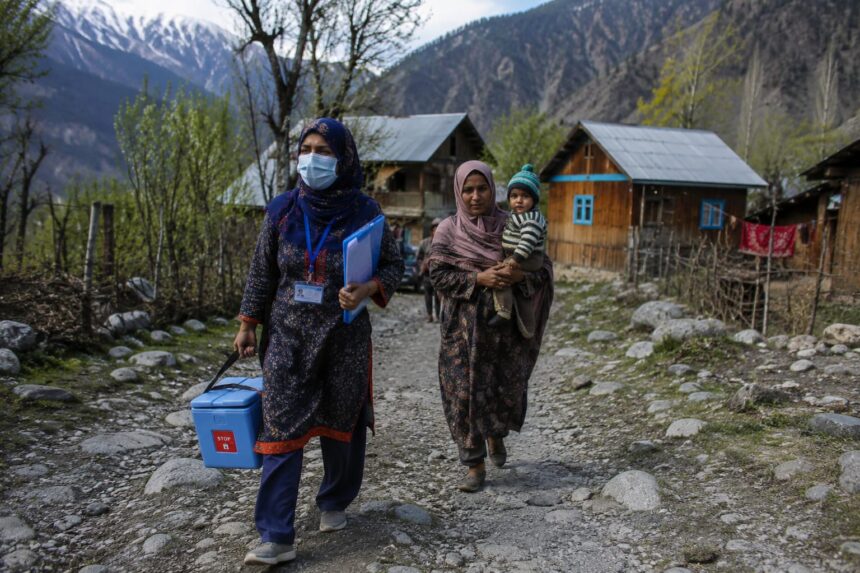
In the quiet villages of Kashmir, where snow-covered mountains, winding roads, and scattered hamlets often make access to healthcare difficult, there is one person every family knows. She may not wear a doctor’s coat or work in a hospital, but when a pregnant woman needs help, a child misses a vaccination, or an elderly patient requires medical guidance, she is usually the first to arrive.
She is the Accredited Social Health Activist (ASHA)—the backbone of rural healthcare and one of the most trusted faces in every community.
Across Jammu and Kashmir, thousands of ASHA workers serve as the bridge between the people and the healthcare system. They visit homes, counsel expecting mothers, ensure newborns receive timely care, motivate families to vaccinate their children, spread awareness about hygiene and nutrition, and identify patients suffering from diseases such as tuberculosis. Their work begins before sunrise and often continues well after sunset, with little recognition and limited financial security.
More Than a Health Worker.
An ASHA worker is much more than a healthcare volunteer. She is a counsellor, caregiver, educator, emergency responder, and often a source of emotional support for families.
In remote districts like Kupwara, Bandipora, Gurez, Kishtwar, and parts of South Kashmir, where health facilities may be several kilometres away, ASHA workers walk long distances across rough terrain to ensure no family is left behind. During harsh winters, heavy snowfall, and even natural disasters, many continue their duties despite personal hardships.
For many villagers, especially women, the ASHA worker is the first person they approach before visiting a doctor. Her familiarity with local customs, language, and traditions helps build trust that formal healthcare institutions often struggle to achieve.
A Crucial Role During the Pandemic
The COVID-19 pandemic highlighted the true value of ASHA workers.
While many remained indoors during lockdowns, ASHA workers went door-to-door identifying suspected cases, monitoring patients in home isolation, creating awareness about preventive measures, assisting vaccination drives, and ensuring essential health services continued.
They became the government’s frontline force in villages, risking their own health to protect others.
Health experts widely acknowledge that India’s successful vaccination campaign would have been significantly more difficult without the dedication of ASHA workers.
The Challenge Behind the Dedication
Despite their enormous contribution, ASHA workers continue to face significant challenges.
Unlike regular government employees, they are considered community health volunteers under the National Health Mission (NHM). Their earnings are largely based on performance-linked incentives rather than a fixed salary.
Every institutional delivery they facilitate, every child vaccinated, every tuberculosis patient monitored, and every health awareness programme they conduct contributes to their incentive-based income.
However, many workers argue that these payments are often delayed and insufficient considering the growing responsibilities placed upon them.
In Jammu and Kashmir, the issue has repeatedly sparked protests, with ASHA workers demanding better honorariums, timely payments, social security benefits, pension facilities, and formal recognition of their services.
Their demands reflect a broader national conversation about the need to strengthen and fairly compensate India’s frontline healthcare workforce.
Healthcare’s Silent Revolution
The success of maternal and child healthcare in Kashmir owes much to the quiet efforts of ASHA workers.
Over the years, institutional deliveries have increased, awareness about immunisation has improved, and more women now seek antenatal care because someone from their own community encouraged them to do so.
These improvements are not always visible in headlines, but they are reflected in healthier mothers, safer childbirths, and stronger communities.
Every successful vaccination drive, every healthy newborn, and every life saved through early medical intervention carries the invisible fingerprints of an ASHA worker.
Stories Hidden Behind Every Door
Behind every ASHA worker is a story of sacrifice.
Many balance household responsibilities with demanding fieldwork. They often travel on foot through difficult terrain, spend hours counselling families, and respond to emergencies at any time of day or night.
Yet their names rarely appear in newspapers or official ceremonies.
Their greatest reward is often the gratitude of the communities they serve.
For many mothers in rural Kashmir, the ASHA worker is not just a health volunteer; she is the reassuring face that arrives during moments of uncertainty and hope.
Investing in the Future
Experts believe that strengthening primary healthcare in Jammu and Kashmir requires greater investment in ASHA workers through improved training, digital tools, timely incentives, insurance coverage, and enhanced financial support.
As healthcare challenges evolve from non communicable diseases to mental health and climate-related emergencies the responsibilities of ASHA workers will continue to expand.
Empowering them is not merely a welfare measure; it is an investment in the health and resilience of every village.
The Heartbeat of Rural Healthcare
Modern healthcare is often associated with advanced hospitals, specialist doctors, and sophisticated medical technology. Yet in the villages of Kashmir, healthcare begins with a simple knock on the door.
That knock belongs to an ASHA worker.
She carries no stethoscope of authority, yet she carries the trust of an entire community.
She may never receive national recognition, but her work saves lives every single day.
As Kashmir continues its journey towards stronger public health, one truth remains undeniable: the future of rural healthcare rests not only in hospitals, but also in the dedication, compassion, and resilience of the women who walk from door to door, ensuring that no family is left behind.