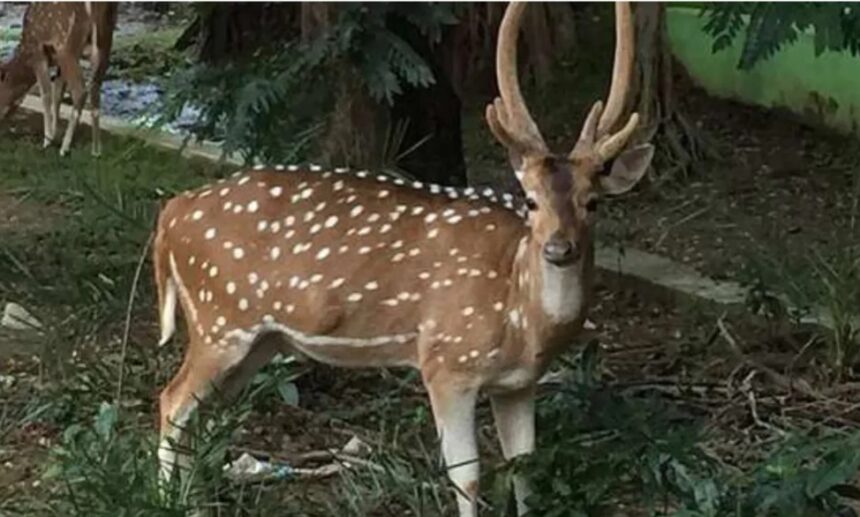
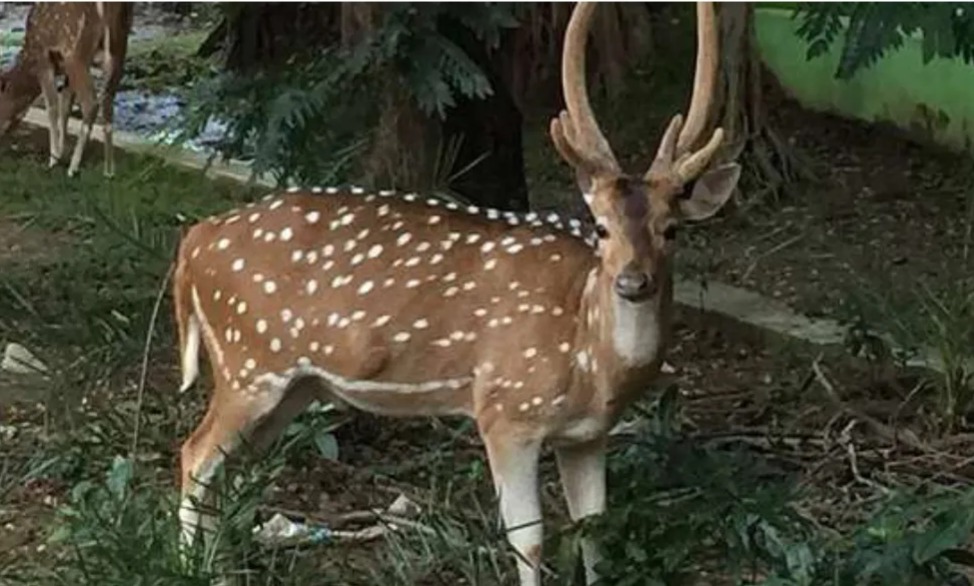
There is something disorienting about watching a herd of spotted deer cross a busy road inside an engineering institute, with students walking past, vehicles slowing down and the animals carrying on as though the campus belongs to them as much as it does to the people who study and work there. At IIT Madras, this is not an unusual sight. The deer emerge from the wooded stretches of the campus, move across roads and lawns and disappear again into the trees, leaving behind little more than a moment of curiosity among those passing by.
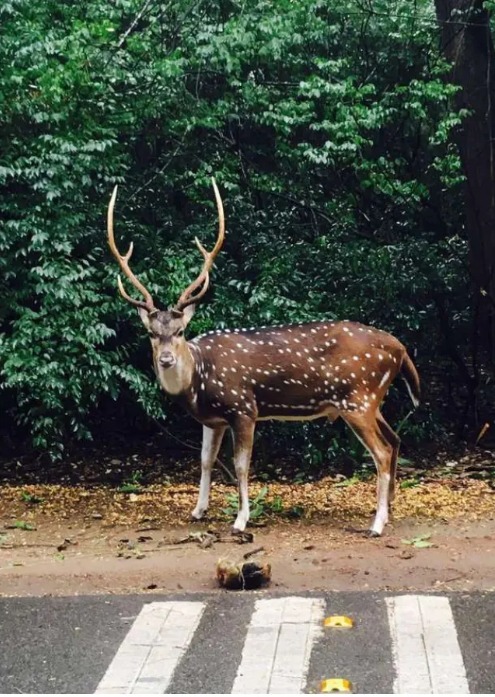
For someone from Kashmir, however, the sight acquires a different meaning. The animal moving through the campus is a chital, or spotted deer, while Kashmir’s better-known deer is the Hangul, a subspecies of red deer found in Jammu and Kashmir and classified as critically endangered. They are different species in different landscapes, with very different conservation histories, but watching one move freely through an inhabited landscape in Chennai inevitably brings to mind the difficulty of finding the other in the Kashmir of today.
The latest Hangul census in 2025 recorded 323 animals in Jammu and Kashmir. The figure represents a steady increase over the past decade—from 183 in 2015 to 214 in 2017, 237 in 2019, 261 in 2021, 289 in 2023 and 323 in 2025. The numbers suggest a recovery, but they also have to be read against the longer history of the species. The Hangul once occupied a far wider area of Kashmir and historical accounts place its population in the thousands. Over the decades, its range contracted, leaving Dachigam as its principal stronghold and making the protection of remaining habitats and movement corridors an important part of conservation efforts.
That is perhaps what makes the scene at IIT Madras linger. The contrast is not simply between 323 Hangul and a population of chital moving around a university campus; it is between two landscapes and the relationship each has retained with its wildlife. IIT Madras occupies about 617 acres and has substantial wooded areas because the campus was established on land adjoining Guindy National Park. The institute continues to list spotted deer and blackbuck among the wildlife found within its premises, creating the unusual spectacle of an active academic institution where wildlife remains part of the everyday surroundings rather than being confined to a designated enclosure.
The campus has also had to adapt to that reality. IIT Madras has removed more than 2,500 metres of chain-link fencing in parts of the campus to facilitate wildlife movement, while grassland areas have been created and water troughs installed for deer and blackbuck. The institute’s 2024-25 annual report records water troughs at 90 locations, reflecting an effort to maintain some of the conditions required for wildlife to continue using the campus even as it remains a busy educational institution.
This coexistence, however, is not without its problems. The deer at IIT Madras have faced road accidents, disease and other risks associated with an urban environment, while feral dogs and construction activity have also posed challenges. A 2022 census cited by The Times of India placed the spotted deer population at around 150 and blackbuck at about 50, while reports have also documented deaths of deer from road accidents, disease and other causes. The campus, therefore, is not a sanctuary untouched by human pressure; it is a functioning institution trying to accommodate wildlife within a landscape that is simultaneously being used by thousands of people.
Kashmir’s Hangul has been dealing with a much more severe version of the habitat question. The concern is no longer only how many animals survive, but where they can survive and whether the remaining habitats are sufficiently connected for the population to expand beyond its present confines. The rise from 183 animals in 2015 to 323 in 2025 is important, but it has not restored the larger geographical range that the Hangul once occupied. A larger population living within a restricted and fragmented range remains a very different proposition from a large population moving across an extensive landscape.
This is why the conservation story of the Hangul cannot be reduced to the census figure alone. Protecting feeding and breeding areas, maintaining movement corridors and preventing further fragmentation of habitat are central to any long-term recovery. The increase in numbers provides one measure of what conservation efforts have achieved; the shrinking range provides another measure of what has already been lost.
The IIT Madras campus offers no direct template for Kashmir, and the comparison has clear limits. Chital are adaptable animals living within a relatively small, wooded campus in the middle of Chennai, whereas the Hangul is a critically endangered red deer surviving in a Himalayan landscape whose historical range has contracted substantially. Their ecological circumstances are not comparable, and neither is the scale of the conservation challenge.
Yet the Chennai experience makes visible something that statistics alone cannot. At IIT Madras, a wild deer can remain part of an inhabited landscape without becoming an extraordinary event. It can cross a road between a classroom and a hostel, graze beside a lawn and disappear into the trees while the business of the campus continues around it.
In Kashmir, the Hangul has become an animal whose survival is measured through census figures and conservation programmes. Three hundred and twenty-three is a number that offers reason to look at the recovery with care, but it also carries the memory of a much larger population and a much wider landscape.
And perhaps that is what stays with a Kashmiri visitor after the deer have disappeared into the trees at IIT Madras: not simply that Chennai has deer, but that here the sight can still be ordinary, while in Kashmir the survival of a deer has become something the region has to count.