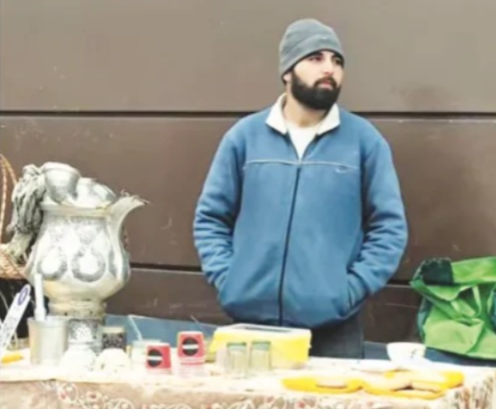
Every morning in Plan, Bandipora, Umair Ahmad sets up his small food cart by the roadside. People know him by two names. Some call him Umair Ahmad. Others know him as Umair Mir. By the time the first customers arrive, steam rises from his Samovar and the smell of Kashmiri kahwa spreads in the air.
Umair holds a diploma in civil engineering. Like many young people in the region, he once hoped to work in his field. He applied for jobs and waited. Months passed, then years. The opportunities did not come.
“I studied with the hope of getting a job,” Umair says. “But when nothing worked out, I knew I had to do something on my own.”
Instead of waiting longer, he chose self-employment. With limited savings and help from family, he started a small food cart. In summer, he sells lassi to people looking for relief from the heat. In winter, his cart becomes a source of warmth, serving cups of hot Kashmiri kahwa to locals and visitors.
“At first, people were surprised,” he recalls. “They would ask why someone with a diploma was selling tea. I told them that work is work. What matters is earning honestly.”
Umair’s cart now stands as a daily meeting point. Farmers stop by after work. Students gather in the evenings. Travelers pause to rest and drink kahwa. Conversations flow as freely as the tea.
He prepares the kahwa with care. He measures each ingredient and waits for the right moment before serving. People often say his kahwa tastes the same every day. That consistency has earned him trust.
“One cup should make a person feel calm,” Umair says. “If they come back again, that means I am doing something right.”
Unemployment remains a serious issue in many parts of Kashmir. Educated youth often struggle to find work related to their studies. This leads to frustration and long periods of waiting. Umair’s story reflects this reality but also shows another way forward.
“I could not depend on promises,” he says. “I had to depend on myself.”
Running the cart is not easy. Umair wakes up early to buy supplies. He works long hours in the cold during winter and under the sun in summer. There are days when sales are low. There are days when weather keeps customers away.
“Some days are good. Some are not,” he explains. “But every day teaches me something.”
Despite the challenges, Umair does not see his work as temporary. He sees it as a step toward stability. The money he earns helps him support his family and meet daily needs.
“I feel proud when I return home after a full day of work,” he says. “I know I earned that money with my own hands.”
Locals speak positively about Umair. Many say his effort deserves support. They encourage others to buy from local youth rather than large shops.
“He stands here every day,” says a regular customer. “He does not complain. He just works.”
Visitors passing through Plan often stop at his cart after hearing about his kahwa. Some share his story with others. Word spreads slowly but steadily.
Umair believes respect comes through action. He does not talk much about success. Instead, he focuses on routine.
“I open my cart on time,” he says. “I serve people properly. That is enough.”
His journey also raises questions about the value placed on different kinds of work. Umair challenges the idea that education only leads to office jobs.
“My diploma did not go waste,” he says. “It taught me discipline and patience. I use those lessons here.”
For young people who feel stuck, Umair offers simple advice.
“Do not wait forever,” he says. “If one door does not open, build your own.”
He hopes more youth will choose self-employment instead of sitting idle. He believes small efforts can bring change at the local level.
“If many youths start small work, the area will improve,” he explains. “We cannot depend on jobs alone.”
Umair does not see himself as different from others. He sees himself as someone who made a choice when circumstances demanded it.
“I am not special,” he says. “I just did what I had to do.”
As evening falls in Plan, the crowd around his cart grows. Cups of kahwa pass from hand to hand. Conversations continue. Umair moves quietly, focused on his work.
In a region where unemployment is often discussed with worry, Umair Ahmad’s food cart offers a different message. It shows that dignity lies in effort and that self-reliance can begin with simple steps.
For many young people watching him every day, his story serves as a reminder that progress does not always follow planned paths. Sometimes, it is built slowly, one cup at a time.