Budgam, long seen as a National Conference stronghold, experienced a political upheaval like never before. For the first time, the party lost a seat it had held for decades, a defeat made sharper by the absence of Agha Syed Ruhullah Mehdi. His silence during the bypoll, after earlier public dissent and the controversial “Kon Agha?” remark by the Deputy Chief Minister, left a vacuum that reshaped local loyalties. Abrar Nabi reports.
On the 14 Nov evening. the Budgam by-poll results were declared, campaign posters came down and the market around Budgam’s main square felt quieter than it should have been. For decades the constituency had responded to the cadence of the National Conference: its rallies, its candidates, its internal politics. But this time the verdict read differently, a Peoples Democratic Party candidate struck a historic win in a seat long regarded as NC country. The defeat was a commentary on party discipline, on regional sentiment, and above all, on the unraveling bond between one of the NC’s most authoritative local figures and the party he represented: Agha Syed Ruhullah Mehdi.
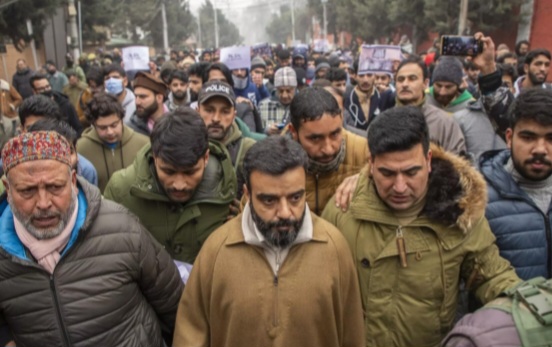
The by-poll did more than deliver a seat. It exposed how political dissent inside the NC and a symbolic act of protest by Ruhullah had matured into an electoral reaction. It also framed a week of inflammatory, terse and now infamous exchanges including a terse remark by Deputy Chief Minister Surinder Kumar Choudhary that local people instantly turned into a controversy known as the “kon Agha” moment. Together, these episodes gave Budgam’s voters a fresh set of signifiers: discontent, divergence, and the tangible absence of a leader many still called “their Agha.”
For decades Budgam was an NC stronghold, a seat where the party’s identity intertwined with local leadership and where familial and religious lineages intersected with party loyalties. Regions of Budgam in central Kashmir, especially the Shia-dominated pockets, had often rallied behind local “Aga” leaders with deep roots in the community. In other words, Budgam was a place where local identity and party politics blurred: a victory for NC was at once a victory for local patrons and a sign of the party’s cultural embeddedness.
That embeddedness came to the fore and then began to fray when a sequence of events, national policy changes, high-stakes local protests, and ruptures in party solidarity pushed the constituency into political reconsideration. The by-poll was the moment of reckoning. When polling was complete and counting finished, the PDP’s Aga Syed Muntazir Mehdi was declared winner with a margin notable enough to be termed historic: the NC lost Budgam for the first time in memory. Multiple outlets reported the significance immediately, describing both the numeric result and its symbolic heft.
Locals this Correspondent spoke with shopkeepers, teachers, and youth activists described a mixture of surprise and inevitability. “There was always loyalty,” said one shopkeeper in Ichgam, “but loyalty is not blind. If the man you relied on is not with the party, why should the party expect votes automatically?” The question encapsulates the central paradox of this contest: Budgam’s allegiance was both to the NC label and, crucially, to the figure of Ruhullah. When the latter decoupled from the former, the stakes changed.
If Budgam’s loss was a culmination, its origins trace to a dramatic and public rupture months earlier: Agha Ruhullah’s decision to join a student protest outside the Chief Minister’s residence over Jammu & Kashmir’s reservation policy.
By late 2024, the reservation changes in J&K which dramatically increased allocations to certain reserved categories had ignited anxieties among open-merit aspirants. The question of how to balance affirmative action with meritocracy proved combustible. On 23 December 2024, Ruhullah a sitting NC MP and a senior leader stood with students holding placards such as “Save Merit,” demanding rationalisation of the policy and urging a fair balance between reservations and open merit. Analysts across outlets noted the extraordinary optics: a ruling party MP publicly protesting at the Chief Minister’s doorstep.

The protest was not a fleeting outburst. Ruhullah’s move carried messaging of principle: he framed his action as standing up for merit while not dismissing the legitimacy of reservations. “We are not against reservation… but there must be logic,” he told reporters. The demonstration forced a larger conversation within the NC and among its supporters: could a party accept such public dissent from a senior member? And could Budgam whose social fabric included many who saw themselves as both merit supporters and beneficiaries of reservation remain politically intact in the face of such a rift?
Ruhullah’s intervention injected something new into the local political grammar. He did not simply dissent internally; he took the dissent to the streets, to where public emotions and students’ anxieties were expressed most vividly. That visual disobedience captured and circulated widely became a durable sign in local political memory.
Public protest created ripples; what followed were faultlines. Within weeks and months, association and disassociation hardened into a pattern: Ruhullah’s increasingly critical tone on multiple issues, juxtaposed against NC’s public posture and its efforts to maintain internal discipline.
Ruhullah’s statements after the protest signalled a broader grievance: that the NC’s leadership had become too cautious, too compromising on matters of political identity and regional rights. He publicly questioned how the NC was positioning itself on major issues including the highly emotive question of Article 370 and statehood restoration priorities. Several reports captured this widening divergence: local observers described Ruhullah as uncomfortable with what he saw as the party’s softer approach to the Centre.
The divergence had tangible campaign implications. Political operatives and NC insiders told reporters that Ruhullah with his local credibility and activist gravitas was pivotal in Budgam’s political ecosystem. When he chose to stay out of the by-poll campaign, or to be overtly non-committal, the NC lost not only votes but the narrative: the impression that party and local leader remained in lockstep.

What produced this gulf? this Correspondent’s reporting suggested Ruhullah’s public stance on reservation and his insistence on a firmer line on core issues suggested a values gap with NC leadership, which increasingly emphasized managerial politics.
In Budgam, family standing, religious leadership, and personal reputation matter. As Ruhullah argued to supporters that principle mattered more than party expediency, the locals took notice.
There is speculation, reflected in multiple local reports, that Ruhullah was building an independent political profile. Whether that calculation was deliberate or emergent, it changed campaign dynamics dramatically.
Inside the NC, tensions mounted. Senior leaders publicly criticised Ruhullah’s methods; local functionaries lamented the optics. To some NC veterans, the problem was not the substance of Ruhullah’s dissent but its publicity and timing it came during a delicate season when the party needed unity.
As the by-poll drew near, campaigns intensified. Candidates crisscrossed the constituency door to door, mosque to market, household to household. Yet, precisely where NC had once relied on the presence and active campaigning of Ruhullah, there was conspicuous silence.
Multiple mainstream reports and local dispatches made the point plainly:
Ruhullah did not campaign for the NC in Budgam. That absence, Chief Minister Omar Abdullah later said, amounted to “political suicide.” Local party organisers confirmed a sense of abandonment and surprise at how quickly electors noticed the missing leader.
On the ground, the practical results of his non-participation mattered. NC’s candidate despite party machinery was deprived of access to networks Ruhullah had curated for decades: religious leaders, local notables, village elders and shopkeepers who had historically deferred to Ruhullah’s endorsements. Where the NC would once have relied on mass door-to-door surges organised around Ruhullah’s presence, this time those surges were weaker.
At the same time, the PDP sensing the opening mobilised hard. Its candidate, Aga Syed Muntazir Mehdi, emphasised a message that combined local identity, assurances to key community stakeholders, and critique of NC’s governance. The combination worked. When counting day arrived, the margin more than symbolic spoke to a re-weighing of loyalties.
If non-participation decided much of the material campaign, a separate flashpoint turned political fissure into public controversy: a video clip and subsequent clarifying comments by Deputy Chief Minister Surinder Kumar Choudhary that local people instantly interpreted as dismissive.
In footage that spread quickly on social platforms and local news outlets, the Dy CM appeared to respond to a question about Ruhullah with an offhand line that translated roughly into urdu became: “Kon Agha?” or “Who is this Agha?” The line, and the broader tone of dismissal, went viral in Budgam and adjacent areas. It triggered protests in Ichgam and other pockets and became a rallying grievance for those sympathetic to Ruhullah.
Within days, the Dy CM would issue a clarification, saying his words had been misinterpreted and were not aimed personally at Ruhullah. Yet the damage had been done. In Budgam’s political culture, where honorifics like “Agha” are also markers of lineage, religious standing and local reverence, the perceived slight was not merely political it was cultural.
The episode Galvanised local sympathy for Ruhullah among his supporters who felt a national-level leader had been insulted, Solidified a narrative that the NC leadership and its governmental apparatus had become dismissive of local figures and Converted a tactical absence (Ruhullah not campaigning) into a moral grievance that could be easily mobilised.

In the world of electioneering, where small moral narratives can sway undecided voters, the Dy CM’s offhand words proved costly. Political strategists told this Correspondent that no single comment alone carries such weight in a well-oiled campaign; but in conjunction with Ruhullah’s absence, it became the final nudge for many voters.
When the result was announced, the NC’s leadership reaction was swift and direct. Chief Minister Omar Abdullah publicly blamed Ruhullah, saying the MP’s decision not to campaign constituted “political suicide.” He framed the loss as avoidable and as a product of internal fissures. News reports captured the tone: chastening, personal, and unforgiving.
Ruhullah responded not with caustic retorts but with measured, sometimes poetically religious language posted on social feeds. He pushed back against accusations of wilful sabotage, instead framing his actions as principled dissent and warning against arrogance among leaders. The tension between the two became, in many eyes, a classic political drama: an elder statesman insisting on conscience versus a party seeking unity and discipline.
Beyond the personal exchange lay a larger dynamic: the NC’s credibility in its own base. For many voters, the argument was simple: if your own MP will not stand with the party when it matters, why should we? For others, the calculus was more practical: they evaluated service delivery, local development projects, and the immediate benefits of aligning with the victorious candidate.
This Correspondent spent several days in Budgam and Ichgam, listening to voters, shopkeepers, community leaders and youth activists.
Several recurring themes emerged:
Identity and Respect Matter. Many voters described the “kon Agha” video as emblematic not only of an insult to a leader but of a broader erosion of respect for local traditions and figures. In Budgam’s layered social texture, respect translates into reciprocity at the ballot box.
Practical Grievances Coexisted. Voters cited electricity woes, unemployment, and unfulfilled promises as drivers of anti-NC sentiment. The by-poll was an opportunity to register discontent.
Ruhullah’s Absence Was Felt. Across social classes, people told me that Ruhullah’s non-participation undermined NC’s campaign narrative. One schoolteacher said: “He is the bridge. If the bridge is missing, people cross elsewhere.”
The PDP’s Local Push. Several respondents said the PDP’s candidate had tapped into local networks effectively and had presented the contest as a chance to test NC’s relevance.
What emerges is a complex mosaic: the by-poll was not simply a moral referendum on a single leader, nor purely a judgment on governance. It was an amalgam of personal loyalties, symbolic slights, service anxieties, and strategic opposition mobilisation.
This correspondent interviewed campaign insiders and political analysts (on and off the record) to understand the structural lessons from Budgam:
Personalised Politics Dominates. In regions with strong local figures, the presence or absence of those figures can shape outcomes as much as policy or aerial campaign blitzes.
Symbolic Moments Have Electoral Utility. The reservation protest and the Dy CM’s comment became symbolic anchors for voters, and symbol sometimes trumps granular policy arguments in by-elections.
Internal Discipline Is a Double-Edged Sword. Parties need discipline, but enforced conformity can produce resentments that manifest electorally when local leaders feel sidelined.
Episodic Gains vs. Structural Realities. The PDP’s win may provide short-term credibility, but whether it signals a long-term realignment depends on the NC’s response and on the PDP’s ability to deliver local governance.
Losing Budgam matters for the NC in three distinct ways:
Electoral: The party lost a seat it had historically held; the practical consequence is a smaller legislative footprint and a demoralised local cadre.
Psychological: For a party whose identity is built on legacy and symbolism, losing a bastion is demoralising and points to a need for re-engagement with local networks.
Organisational: The NC needs to reassess how it manages senior local leaders whose constituencies overlap with party organisation. Will it punish dissent? Reconcile? Or restructure?
What motivated Ruhullah across these months? Publicly, he emphasised principle: fairness in reservation, dignity for local leaders, and a commitment to constituents. Privately as political observers speculate he may have been building a profile beyond NC’s current orbit, testing how much political capital he individually retained.
There is a fine line between principled dissent and strategic repositioning. In another era, party leaders might have smoothed out such differences behind closed doors. But contemporary politics amplified by social media and densely interconnected local networks makes private reconciliation politically costly.
Ruhullah’s trajectory suggests he was willing to accept short-term electoral costs for longer-term credibility. Whether that translates into greater national influence, a future challenge inside NC, or the formation of a distinct political platform remains an open question. What is certain: the man who stood with students at the CM’s door reshaped his political identity in a way that Budgam’s electorate reacted to, emphatically.
The Dy CM’s “kon Agha” remark — whether clipped, miscontextualised, or genuinely dismissive demonstrated the power of a short phrase in a politically charged environment. The clip’s viral spread produced protests in Ichgam and other towns, with residents demanding clarification and respect for local dignitaries. The Dy CM later issued a clarification saying his remarks were misinterpreted, but the clarifying statement did little to erase the emotional memory of the earlier footage.
Political communication scholars this Correspondent spoke with in Srinagar noted that political reputations in the Valley rest as much on cultural and religious markers as on governance. A minor slight, if it resonates with local narratives of disrespect or marginalisation, can convert into political mobilisation as it did in Budgam.
Beyond the local dynamics, the story taps into larger debates that resonate across India: how to reconcile reservation with merit; who decides distribution of opportunities; and how national or regional political reordering affects local loyalties.
Ruhullah’s protest placed him in a national conversation about affirmative action. The movement’s traction among open-merit students lent moral clarity to one set of grievances. But it also highlighted a political paradox: leaders who simultaneously champion policies for historically disadvantaged groups must also convincingly address emerging anxieties among groups who perceive themselves to be now shortchanged.
The NC’s struggle, then, was not merely to manage internal dissent, but to present a coherent policy narrative that accommodated competing claims. Budgam’s voters responded to the absence of such a narrative with a clear vote of no confidence.
Observers told this Correspondent that the NC’s response in the next fifty days would likely shape its trajectory into the next assembly cycle. Will it reach out with humility? Will it double down on discipline? Or will it ignore Budgam’s message and risk further erosion? The answers would tell whether Budgam was a fluke or a harbinger.
The seat lost will be counted and recorded in official returns. The deeper cost, the erosion of a party’s unquestioned claim over a constituency is the real story. Budgam’s verdict was not simply a message to a single party or leader; it was a reminder that in Kashmir’s textured politics, community, culture and personality still matter profoundly and when the personality of an “Agha” is perceived as absent or slighted, even a sturdy party can stumble.