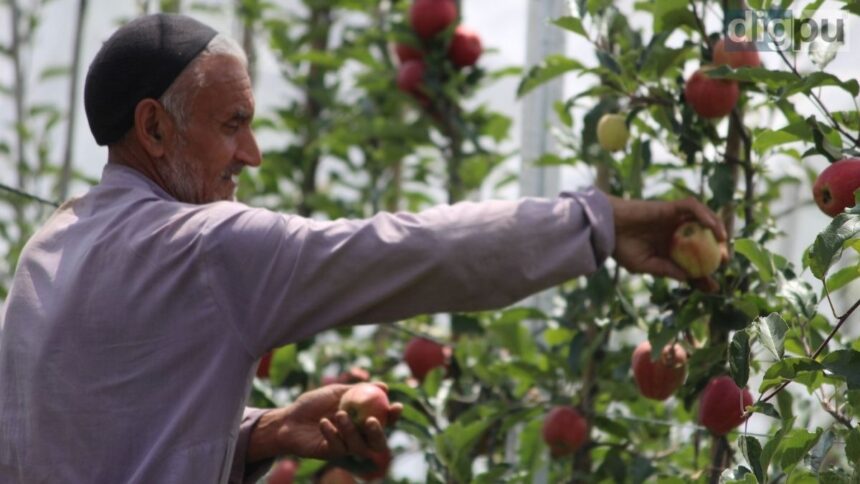
Srinagar, Feb 05 : The horticulture sector remains a key pillar of Jammu and Kashmir’s economy, generating around Rs 10,000 crore annually and providing livelihoods to nearly 35 lakh people, directly or indirectly supporting about seven lakh families, according to official data.
The area under major horticulture crops has increased from 3.44 lakh hectares in 2022–23 to 3.47 lakh hectares in 2025–26 (up to November 2025).
Production during the same period rose from 27.22 lakh metric tonnes to 27.35 lakh metric tonnes. Overall horticulture production, including fresh and dry fruits, increased by about 34.2 per cent, from 20.06 lakh MT in 2018–19 to 26.92 lakh MT in 2024–25.
High-Density Plantation (HDP) has emerged as a major intervention in the sector. During 2024–25, 29.13 lakh high-density plants were distributed, while a cumulative area of 20,034.44 hectares has been brought under high and medium density plantations since the programme’s inception.
Post-harvest and marketing infrastructure has expanded with the capacity of Controlled Atmosphere (CA) storage increasing from 2.10 lakh MT in 2022–23 to 2.92 lakh MT, and is projected to reach 3.07 lakh MT against a requirement of 6.00 lakh MT.
Market integration through the e-NAM platform facilitated trade worth Rs 634.09 crore involving 28.26 lakh quintals of produce up to November 2025.
Fruit exports, including fresh and dry fruits, stood at 8.70 lakh MT in 2025–26 (up to November 2025), generating revenue of Rs 3,809.97 crore. Exports of almond and walnut accounted for Rs 602.53 crore during 2024–25.
Under the Holistic Agriculture Development Programme (HADP), an allocation of Rs 1,028.21 crore has been made for horticulture projects aimed at improving productivity and expanding high-density orchards.
The floriculture sector continues to support tourism and commercial flower production. At present, 278 parks and gardens spread over 10,628.30 kanals, including the Tulip Garden and Mughal Gardens, are maintained by the Floriculture Department.
A chrysanthemum garden, Bagh-e-Gul-e-Dawood, was opened to tourists in October 2025.
Commercial floriculture covers 356.41 hectares with 11,889 registered growers, of whom 2,270 are active, generating income of Rs 42.92 crore during 2025–26 (up to November 2025).
Revenue from gardens through entry tickets, videography permissions and sale of plants increased from Rs 6.70 crore in 2021–22 to Rs 23.71 crore in 2024–25, indicating the growing economic contribution of the floriculture sector in Jammu and Kashmir.(KNS).