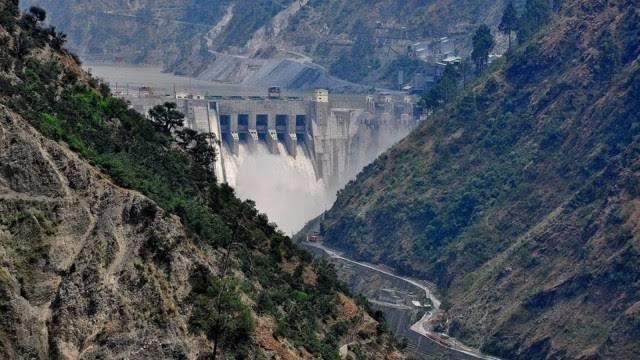
Srinagar, Oct 12 : Despite an estimated hydropower potential of 18,000 megawatts (MW), Jammu and Kashmir has harnessed only about one-fifth of its available resources, with a new economic study flagging delayed project execution, seasonal generation constraints and distribution losses as major obstacles to achieving energy security in the Union Territory.
The study, published in the journal Social Science & Humanities International, copy of which lies with Kashmir News Service (KNS),has highlighted the contradiction between Jammu and Kashmir’s substantial hydropower resources and its continued dependence on electricity purchases to meet demand, particularly during winter.
According to the Jammu and Kashmir government’s Economic Survey 2024–25, of the estimated 18,000 MW hydropower potential, 14,867 MW has been identified for development, while only 3,540.15 MW has been harnessed.
This represents approximately 19.7 per cent of the total estimated potential and 23.81 per cent of the identified potential, leaving a substantial portion of the Union Territory’s hydropower resources undeveloped.
The figures show that 11,283 MW of the identified potential lies in the Chenab basin, followed by 3,084 MW in the Jhelum basin and 500 MW in the Ravi basin.
Of the capacity harnessed, 2,250 MW is in the central sector, 1,197.4 MW in the Union Territory sector and approximately 92.75 MW under independent power producers, according to the official data.
The research study, titled “Jammu & Kashmir Economic & Development Outlook: Growth Momentum, Fiscal Consolidation, and Seasonal Tourism Performance (June–August 2026)”, identifies slow development of hydropower capacity as a significant constraint on the region’s economic potential.
It points out that a large proportion of the existing hydropower generation system is based on run-of-river projects, whose electricity output is sensitive to seasonal variations in water discharge.
Consequently, generation can decline during winter, when electricity demand increases because of heating requirements, leaving Jammu and Kashmir dependent on power purchases despite its considerable hydropower resources.
The study argues that installed generation capacity cannot be treated as equivalent to dependable year-round electricity supply, particularly in a Himalayan region where river flows vary considerably across seasons.
The findings also draw attention to delays in the development of major hydropower projects, including Pakal Dul, Kiru and Ratle, which together have a planned capacity of approximately 2,474 MW.
The report notes that these projects could substantially expand installed capacity once commissioned, but cautions that planned capacity cannot be counted as available generation before projects become operational.
It also identifies construction delays, cost escalation and project ownership arrangements as important factors in determining how much economic benefit Jammu and Kashmir ultimately receives from hydropower development.
According to the study, the benefits accruing to the Union Territory from centrally owned or jointly developed projects depend not merely on installed capacity but also on arrangements concerning free power, royalties and revenue sharing.
The report further identifies financial weaknesses in electricity distribution as a major challenge, pointing to losses and inadequate revenue recovery that can undermine the benefits of additional generation capacity.
It argues that increasing electricity production alone may not resolve the power sector’s financial difficulties unless distribution efficiency, billing and revenue collection improve simultaneously.
The study also questions the adequacy of publicly presented evidence on reductions in distribution losses, noting that clear baseline figures and comparable performance data are necessary to assess improvements.
The assessment links electricity reliability to industrial development, observing that an inconsistent power supply increases operating costs for businesses and can discourage investment in manufacturing and other energy-intensive activities.
It also identifies the dependence on seasonal river flows as a vulnerability, particularly as variations in snowfall, glacier melt and precipitation can affect hydropower generation.
The study maintains that Jammu and Kashmir’s power-sector challenge is not simply one of insufficient natural resources, but of converting available potential into dependable electricity supply while addressing the financial weaknesses of distribution utilities.
However, the study’s estimate of approximately 3,479 MW of installed capacity differs from the 3,540.15 MW of harnessed hydropower capacity recorded in the government’s Economic Survey 2024–25 and Hydro Power Policy 2025. The official figure has therefore been used for the capacity comparison.
The findings highlight a persistent gap between Jammu and Kashmir’s hydropower potential and its actual utilisation, even as the Union Territory continues to face seasonal supply constraints and dependence on purchased electricity. (KNS)