The first International Film Festival of Jammu and Kashmir brought 135 films from 40 countries to Srinagar, Jammu and Gulmarg. But behind the screenings and celebrity appearances lies a larger question: can J&K turn its renewed relationship with cinema into an industry that gives local filmmakers, technicians and stories a place of their own? Reports Asif Malik
For several decades, Kashmir occupied a peculiar place in Indian cinema. It was everywhere on screen, yet increasingly absent from the industry that made those images. Its mountains, lakes, gardens, snowfields and wooden houses became familiar visual shorthand for romance, escape and beauty, while the actual business of filmmaking gradually moved elsewhere. The Valley remained a location in the imagination of Hindi cinema even as producers increasingly looked beyond it for easier access, infrastructure and newer landscapes.
That relationship is now being deliberately rebuilt.
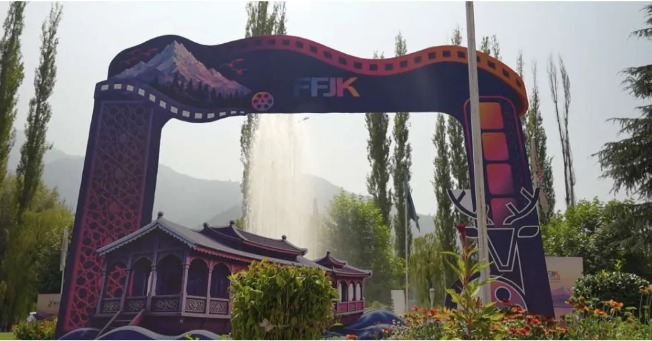
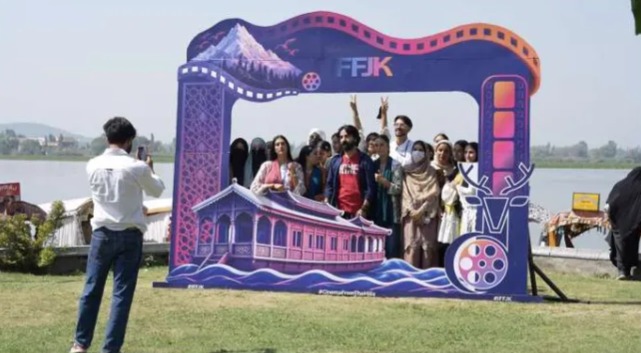
The first International Film Festival of Jammu and Kashmir, held from September 7 to 10 across Srinagar, Jammu and Gulmarg, was the most visible expression yet of that attempt. Organised by the Jammu and Kashmir Directorate of Information and Public Relations, the inaugural festival brought 135 films to the Union Territory after receiving more than 1,100 submissions from over 80 countries. The final selection included films from 40 countries, with more than 60 foreign films in the programme.
The scale mattered, but so did the decision to hold the festival here.
For four days, filmmakers, actors, producers, cinematographers, writers, technicians, critics and audiences were brought into the same spaces where J&K has for years tried to rebuild its association with cinema. Screenings were held at venues including the Sher-i-Kashmir International Convention Centre and INOX in Srinagar, with programmes also taking place in Jammu and Gulmarg. The festival was not restricted to a single competition; it included international and Indian selections, documentaries, short films, regional cinema, masterclasses, panel discussions and conversations with professionals from different parts of the industry.
The organisers called it a beginning. That is also the most useful way to examine it.
Because the real measure of such a festival will not be the number of films screened over four days. It will be what remains after the guests leave, the temporary venues are dismantled and the last screening ends.
The government’s ambition predates the festival.
The Jammu and Kashmir Film Policy-2024, approved in March 2024 and subsequently launched in August that year, was framed around a larger attempt to develop filmmaking as an economic activity in the Union Territory. It replaced the 2021 film policy and introduced mechanisms including a Single Window Cell for permissions, financial incentives and a framework for facilitating film production. The policy also envisages infrastructure for filmmaking and positions film tourism and employment generation among its objectives.
That distinction is important because J&K has never lacked the raw material for cinema.
What it has lacked, over long periods, is the wider ecosystem around it.
A film shooting in Kashmir can bring a production crew into the Valley for a few weeks. An industry requires something much larger: trained technicians, production houses, equipment suppliers, studios, editors, sound professionals, casting networks, writers, production managers, local financing, post-production facilities and audiences who can sustain cinema beyond an occasional outside production.
The policy therefore attempts to move the conversation from location permissions towards an ecosystem. It provides for a Single Window Cell and incentives linked to shooting in J&K, while also laying down conditions involving local artists and production activity. The policy says, for example, that eligible films seeking specified incentives must provide work to a minimum number of local artists and meet prescribed production and shooting requirements.
The first IFFJK was built on that policy architecture.
But the festival also exposed the other side of the equation: J&K does not only want films to come here; it wants films to be made here.
The strongest evidence of that ambition came not from the international competition but from the section carrying J&K’s name.
Five films were selected for the J&K Select competitive category: Searching for the Grandpa, directed by Mohammad Wali; Arifa, directed by Rohin Ravendran Nair; Batt Koch (The Lost Lane), directed by Siddarth Koul and Ankit Wali; Tasrufdaar (Djinns of Kashmir), directed by Kapil Mattoo; and Naqsh-e-Daur (The Story of Ghulam Nabi Dhar), directed by Baba Tassaduq Hussain.
Their subjects were considerably removed from the familiar postcard version of Kashmir.
One dealt with two children and a family setting around Eid. Another followed a woman returning to her ancestral home and confronting memories of her childhood and father. Batt Koch dealt with displacement, identity and the idea of home through a Kashmiri migrant family. Tasrufdaar used mystery and memory to approach the scars of Kashmir’s past, while Naqsh-e-Daur turned to the life and work of a traditional woodcarver from downtown Srinagar.
That range was significant because it suggested that the local cinematic conversation need not begin and end with landscape.
Kashmir has long been filmed as a place. These films attempted, in different ways, to film people who inhabit the place.
The distinction may appear small, but it goes to the heart of what the government says it wants the film sector to become.
At the closing ceremony, Tasrufdaar (Djinns of Kashmir), directed by Kapil Mattoo, won the Best Film award in the J&K Select category and a cash prize of Rs 10 lakh. The film centres on a middle-aged Kashmiri Muslim man who encounters the spirit of his late father’s childhood friend, a Kashmiri Pandit. It was made and acted by Kashmiris.
The award gave the local section an outcome that was more tangible than the presence of international guests.
Another J&K film, Naqsh-e-Daur, won the Best Cinematography award, making local cinema visible within the festival’s broader competitive structure.
The international winner was Iranian film Whisper My Name, while the festival’s competitive awards also recognised work in direction, acting and technical crafts.
The award structure itself had been designed to extend beyond the conventional recognition of actors and directors. The festival announced prizes for cinematography, sound design and editing alongside Best Film, Best Director and acting categories. The Best Film award carried Rs 25 lakh, Best Director and Best Debut Director Rs 15 lakh each, while the J&K Select winner was to receive Rs 10 lakh.
That emphasis on technical work is relevant to a region trying to build an industry.
A film is not produced by its actors alone. It requires cinematographers, editors, sound designers, production managers, costume teams, lighting crews, writers and dozens of other professionals whose names rarely appear in the public conversation around cinema.
For J&K, building those skills may ultimately matter more than bringing another star to a red carpet.
This was also why the masterclasses and industry conversations mattered.
The festival brought professionals into direct interaction with young people through sessions covering direction, screenplay, cinematography, editing, acting, sound, animation, artificial intelligence, documentary filmmaking and regional cinema. Its programme also included discussions on industry development and co-production.
For a young filmmaker in J&K, such a programme offers something that a conventional shooting permission cannot: access to people who work inside the industry.
The distinction is important. A production crew arriving in Kashmir can employ local people for a project. A functioning film ecosystem allows those people to build careers that continue after that project leaves.
That is the gap J&K is now trying to bridge.
The festival’s own programming reflected that ambition by placing international cinema alongside local work rather than treating the region merely as a host location. The official festival programme described the J&K Select section as a dedicated space for the region’s films, while its wider programme combined world cinema with Indian and regional selections.
There was also an attempt to reconnect contemporary filmmaking with Kashmir’s older cinematic memory.
The Floating Cinema programme screened films including Junglee, Kashmir Ki Kali, Arzoo and Kabhi Kabhie films associated with the period when Kashmir was deeply embedded in popular Indian cinema.
The choice was more than nostalgia. It placed the new festival against the history it was trying to revive.
The Kashmir that appeared in those older films was often an imagined one: snow, shikaras, gardens, songs and romance. But the filmmaking itself created work for local people and brought the Valley into the working geography of the Indian film industry.
That ecosystem weakened over time.
The reasons were not singular. Producers found newer destinations, security conditions changed, infrastructure remained uneven and the industry developed alternatives both within India and abroad. Kashmir retained its visual appeal, but visual appeal alone could not guarantee a production industry.
The current government is therefore trying to address two different things at once: restoring J&K’s attractiveness as a shooting destination and creating conditions for local filmmakers to become participants rather than service providers.
The IFFJK was the public face of that effort.
The Film Policy is the administrative framework behind it.
The local filmmakers, technicians and creative professionals are the people who will ultimately determine whether the two connect.
That is where the story moves beyond a four-day festival.
Because when the final screening ended on September 10 and the international guests began leaving, J&K was left with something more difficult than a festival schedule to work out: whether the attention generated by IFFJK can be converted into regular production, local employment, stronger technical capacity and films that can travel beyond the landscape in which they were made.
The significance of the first International Film Festival of Jammu and Kashmir lies not only in the films that reached its screens, but in the institutional effort that brought together filmmakers, technicians, producers, students and audiences in a region that has long been part of cinema’s visual history. For the Jammu and Kashmir administration, the festival was conceived as part of a broader effort to give that relationship a new direction: from being primarily a place where films are shot to becoming a place where films are discussed, developed, produced and promoted.
That shift has been taking shape through the Film Policy-2024, which seeks to create a more organised environment for film production in the Union Territory. The policy provides for a Single Window mechanism for film-related permissions and incentives, while placing emphasis on local talent, employment, film infrastructure and the promotion of J&K as a destination for filmmakers. The objective is to bring together the different elements required for a functioning film ecosystem and to make the region more accessible to both established productions and emerging filmmakers.
The policy is significant because it builds on something J&K already possesses in abundance: a landscape that has been part of Indian cinema for generations. From the meadows of Gulmarg and Pahalgam to the Dal Lake, Srinagar’s old quarters and the mountains beyond the Valley, Kashmir has supplied some of the most recognisable images in Indian popular culture. The new approach seeks to add another dimension to that association by creating opportunities for the people of J&K to participate more deeply in filmmaking.
The first IFFJK provided a platform to demonstrate that ambition.
The festival brought together more than 130 films from around 40 countries and created spaces not only for screenings but also for conversations around filmmaking, technology and the craft behind cinema. Its programme included international and Indian films, documentaries, regional cinema and a dedicated J&K Select section, while masterclasses and industry interactions allowed local students and aspiring filmmakers to engage directly with professionals.
For many of the young participants, this was an opportunity to see the film industry from a perspective that a cinema screen alone cannot provide.
A film is the visible product of hundreds of decisions made behind the camera. The actor may be the most recognisable face, but the final work also depends on the cinematographer who decides how a scene is photographed, the editor who determines its rhythm, the sound designer who builds its atmosphere, the production designer who creates its physical world and the many technicians who keep the production moving.
The festival consciously gave space to these aspects of filmmaking.
Its masterclasses covered areas of film craft and technology, while the awards recognised technical categories alongside Best Film, Best Director and acting performances. For J&K, where the development of local technical talent is an important part of the government’s film vision, this emphasis was particularly relevant.
A young person interested in cinema does not necessarily have to become an actor or director.
There are careers behind almost every frame.
The government’s attempt to create awareness around these possibilities is part of a larger skill-development conversation, one that can potentially connect the film sector with the region’s young population.
The presence of filmmakers and industry professionals from outside J&K also created another opportunity: access.
For aspiring filmmakers, getting an opportunity to speak to an established director, cinematographer, producer or editor can be as valuable as watching their work. The interaction can provide an understanding of how an idea moves from a script to production, how a project is financed, how a crew is assembled and how a completed film finds its audience.
These conversations are difficult to create through conventional government programmes alone.
A film festival provides a natural setting for them because the people involved in cinema are already gathered around the same programme.
That was one of the strengths of IFFJK’s design.
It did not treat the festival simply as a sequence of screenings. It created an environment in which audiences, students, local filmmakers and visiting professionals could meet.
For the administration, that serves a larger purpose.
J&K has a generation of young people growing up in a period when digital cameras, smartphones, online platforms and relatively inexpensive editing tools have made filmmaking more accessible than it was for earlier generations. What many of them still require is exposure, mentorship, professional networks and opportunities to present their work.
The J&K Select section provided one such platform.
Five films were selected for the inaugural competition, giving local filmmakers an opportunity to present their work alongside the wider festival programme. The subjects themselves demonstrated the range of stories emerging from the region, moving beyond conventional representations of Kashmir to explore family, memory, displacement, identity, history and individual lives.
Tasrufdaar, directed by Kapil Mattoo, received the Best Film award in the J&K Select category. The film brings together themes of memory and Kashmir’s divided social history through the story of a middle-aged Kashmiri Muslim man and the spirit of his late father’s childhood friend, a Kashmiri Pandit.
Naqsh-e-Daur, which focuses on the life and work of traditional woodcarver Ghulam Nabi Dhar, received the award for Best Cinematography.
The recognition given to these films served another purpose. It showed that local cinema can bring stories from Kashmir into a formal competitive setting rather than remaining limited to small screenings or online platforms.
That is important for the government’s larger objective of developing a film economy.
An industry grows when stories find producers, producers find crews, crews find regular work and completed films find audiences. Each successful production creates experience that can be carried into the next one.
This is where the Film Policy-2024 becomes relevant beyond the immediate question of attracting filmmakers to J&K.
The policy seeks to make film production easier through a Single Window system and provides a framework for incentives intended to encourage shooting and production in the region. It also recognises the importance of local participation, meaning that the benefits of filmmaking are intended to extend beyond the locations used by a production.
The economic possibilities are wide.
A large production requires hotels, transport, catering, local services, equipment, construction, costume work, artists and technicians. When more of these services are sourced locally, the economic footprint of a film becomes larger.
Over time, a steady flow of productions can also encourage specialised businesses to emerge.
Equipment rental companies can develop. Local production houses can expand. Technicians can build professional careers. Training institutes can introduce specialised courses. Post-production facilities can create another layer of employment.
This is how a location begins to develop into an industry.
The administration’s decision to place cinema within a wider economic and tourism framework is therefore significant. Film tourism is already an established phenomenon in many parts of the world, where audiences travel to locations associated with films and television productions. J&K has the natural advantage of landscapes that are already deeply familiar to Indian audiences.
The opportunity now is to connect that recognition with organised film production.
The revival of cinema infrastructure in J&K adds another dimension. A region needs not only filmmakers but audiences, and audiences need places where cinema can be experienced regularly. The reopening and development of cinema halls, alongside events such as IFFJK, contribute to creating a broader culture around film.
The festival also brought back memories of an earlier era when Kashmir occupied a prominent place in Hindi cinema.
The Floating Cinema programme included popular films associated with Kashmir’s cinematic history, allowing audiences to revisit the period when the Valley was repeatedly used as a setting for mainstream films. The choice connected the older image of Kashmir on screen with the emerging effort to create a new relationship with cinema.
But the new relationship is not intended to be limited to nostalgia.
The government is looking towards contemporary filmmaking and the future.
That future includes local stories, international collaborations, technical training, film tourism and opportunities for young people to enter an industry that extends well beyond acting.
The presence of international filmmakers at the inaugural festival also gave local participants an opportunity to see how cinema operates across different cultures and production systems. A filmmaker from another country may approach storytelling, financing, locations or production in a completely different way. Bringing those experiences to J&K creates possibilities for collaboration that would otherwise require local filmmakers to travel elsewhere.
This is where an international film festival can serve a purpose beyond awards.
It becomes a meeting point.
The first IFFJK created that meeting point in J&K.
The challenge now is also an opportunity: to build on the attention, contacts and experience generated by the inaugural edition and gradually develop a calendar of filmmaking activity that continues through the year.
With a policy framework already in place and an administration actively promoting J&K as a film destination, the foundation is being laid for a sector that can combine culture, tourism, employment and creative enterprise.
The story of cinema in Kashmir, in other words, is entering a new chapter.
The old Kashmir was frequently seen through someone else’s camera.
The emerging Kashmir wants to stand behind the camera too.
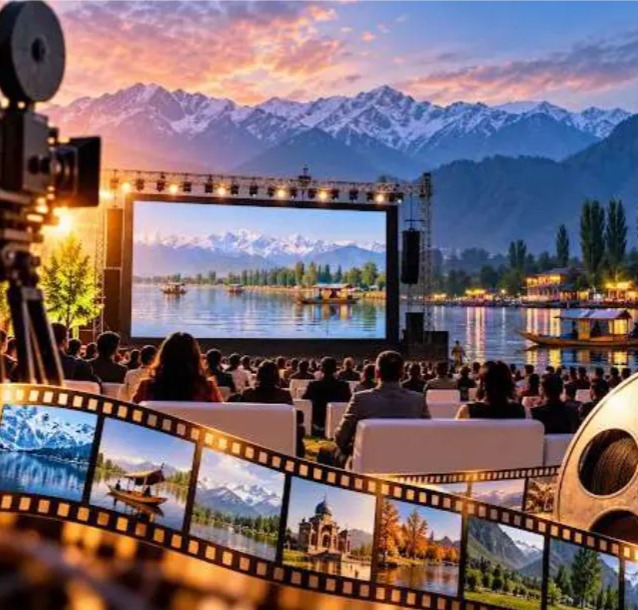
And the first International Film Festival of Jammu and Kashmir has given that ambition a public stage.
For Jammu and Kashmir, the first International Film Festival was also an opportunity to bring together two strands of its relationship with cinema: a long association with filmmakers who have travelled to the region for its landscapes, and a new policy effort to create conditions in which filmmaking can become a more sustained economic and creative activity. The distinction matters because the government’s Film Policy-2024 is not framed only around attracting productions to shoot in J&K. It envisages a wider ecosystem involving local artists, technicians, infrastructure, permissions, incentives, film tourism and opportunities for employment. The festival provided a public platform for that larger idea, bringing filmmakers, producers, actors, technicians, students and audiences into the same space.
The presence of international filmmakers and films was particularly significant for local participants because it placed Kashmiri work alongside cinema being made in different parts of the world. For filmmakers from J&K, the value of such a platform lies not only in awards or screenings but also in access to conversations that ordinarily take place outside the region. Direction, writing, cinematography, editing, sound, acting and production involve specialised skills, and the masterclasses and industry sessions during the festival brought many of those areas directly into the programme. For young people considering cinema as a career, this created an opportunity to see filmmaking as a profession with several different entry points rather than an occupation limited to actors and directors.
The J&K Select section gave that idea a local dimension. Five films were brought together under the section, offering different stories and approaches from filmmakers associated with the region. Mohammad Wali’s “Searching for the Grandpa”, Rohin Ravendran Nair’s “Arifa”, Siddarth Koul and Ankit Wali’s “Batt Koch (The Lost Lane)”, Kapil Mattoo’s “Tasrufdaar (Djinns of Kashmir)” and Baba Tassaduq Hussain’s “Naqsh-e-Daur (The Story of Ghulam Nabi Dhar)” represented the kind of work that can emerge when filmmakers from J&K tell stories rooted in their own surroundings.
“Tasrufdaar”, which received the Best Film award in the J&K Select category, is built around a middle-aged Kashmiri Muslim man who encounters the spirit of his late father’s childhood friend, a Kashmiri Pandit. Its setting and characters are local, but its subject reaches into questions of memory, relationships and a shared social past. The film’s recognition at the festival gave a local production a place within an event that also featured cinema from outside India. “Naqsh-e-Daur”, which received the award for Best Cinematography, turned its camera towards the life and work of traditional woodcarver Ghulam Nabi Dhar in downtown Srinagar, bringing an aspect of Kashmir’s cultural and artisanal life into the festival programme.
That local focus was important because the larger ambition of the festival was not simply to bring cinema into Kashmir but to make Kashmir’s own filmmakers more visible within the wider film community. A film ecosystem cannot be built only through the arrival of outside productions. It also requires writers who develop stories, actors who find work, cinematographers and editors who build careers, sound professionals and production crews who acquire experience, and producers who can take projects from an idea to the screen. The government’s policy framework seeks to create greater space for these different parts of the industry, while the festival offered one setting in which they could meet.
The same idea was visible in the decision to take the festival beyond a single venue. With programmes spread across Srinagar, Jammu and Gulmarg, the event connected cinema with three different settings within J&K. Srinagar provided the principal cultural and institutional setting, Jammu extended the programme to the region’s winter capital, while Gulmarg added the tourism dimension that has long been associated with the relationship between Kashmir and cinema. The locations also reinforced the possibility of film-related activity contributing to sectors beyond the film set itself, including hospitality, transport, tourism and local services.
The Floating Cinema programme offered another way of looking at that relationship. Films such as “Junglee”, “Kashmir Ki Kali”, “Arzoo” and “Kabhi Kabhie” were screened against the backdrop of Kashmir’s older cinematic memory. For generations of viewers, these films helped establish images of Kashmir in popular Indian cinema, while their locations became part of the visual vocabulary through which audiences outside the region encountered the Valley. Revisiting that cinema during the festival connected an older era of filmmaking in Kashmir with an emerging effort to build a contemporary film culture in the region.
But the government’s present approach goes beyond nostalgia. The Film Policy-2024 places emphasis on facilitating film production through a Single Window mechanism, encouraging investment, creating employment opportunities and developing infrastructure connected with the sector. The policy also seeks to increase local participation and promote film tourism. These provisions matter because production decisions are influenced by more than scenery. A filmmaker needs permissions to be predictable, technical support to be available, skilled manpower to be accessible and production logistics to function within a reasonable framework. The policy attempts to address these elements together.
The festival brought that policy discussion into direct contact with people from the industry. At the policy dialogue, Chief Secretary Atal Dulloo spoke about the need to develop local talent, strengthen skills and make J&K more accessible for filmmakers through facilitation and incentives. The emphasis on skill development is particularly relevant for young people in the region because a growing film economy can create opportunities well beyond the visible faces on screen. Every production requires technicians, assistants, designers, editors, camera crews, location managers, production coordinators, sound professionals, costume teams and a range of other workers.
For J&K, developing that workforce could also change the nature of opportunities available to local youth. Instead of technicians having to leave the region to gain experience or productions bringing most of their technical workforce from elsewhere, greater local capacity could allow more people to work on projects being made in their own region. Experience accumulated through one production can then become useful for another, creating the professional networks and specialised skills that are necessary for any mature creative industry.
The festival also put international cinema and local talent in the same conversation. The international section included films from countries with established filmmaking traditions as well as emerging cinematic cultures, while the masterclasses allowed participants from J&K to interact with professionals working in different fields. The presence of filmmakers from abroad therefore had a purpose beyond the screenings themselves. It opened a channel through which local practitioners could observe different approaches to filmmaking and, equally importantly, present their own work and experiences to people coming from outside the region.
That exchange is likely to be one of the more important long-term elements of such an initiative. Film industries develop through networks as much as through infrastructure. Producers need to know writers and directors; directors need actors and technicians; festivals provide spaces where such connections can begin. A contact made during a panel discussion or masterclass may not immediately become a production, but it can become a professional relationship that develops over time. For a region attempting to expand its presence in filmmaking, creating those connections is part of building the ecosystem.
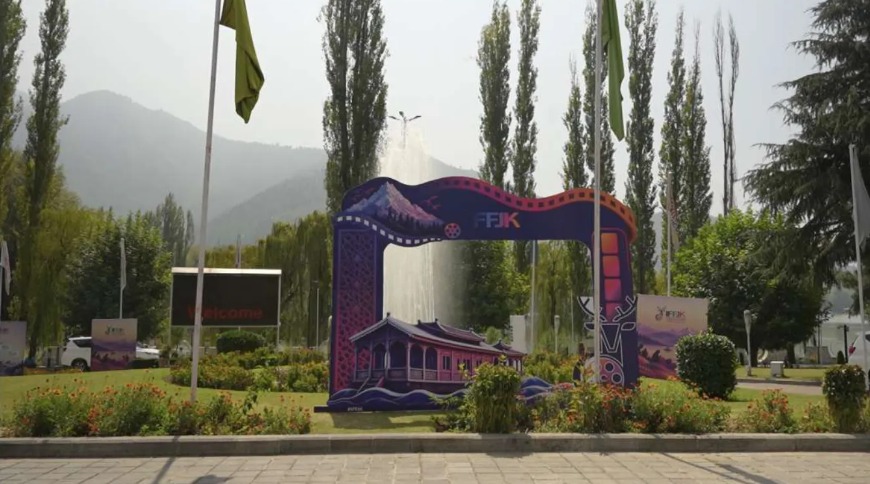
The closing message from Chief Minister Omar Abdullah also placed the festival within this longer trajectory. He said J&K should move beyond being merely a location where films are shot and become a place where stories are written, talent is nurtured and films are produced. The measure of the initiative, in that formulation, would extend beyond the four days of the festival to whether it contributes to careers, collaborations and stories from J&K finding audiences within India and abroad.
That makes the first IFFJK less an endpoint than an institutional beginning. A festival can bring filmmakers together for four days, but an industry takes years to develop. It requires continuity in policy, investment in skills, production infrastructure, opportunities for local talent and repeated interaction between the region and the wider film world. The first edition has put these elements into the same frame.
For a place that has occupied a distinctive position in the history of Indian cinema, the next phase is about determining what comes after the familiar image of Kashmir as a beautiful backdrop. The government’s policy and the festival have sought to place greater emphasis on the people behind the camera, the stories originating here and the economic activity that can grow around filmmaking. If that approach is sustained, the region’s cinematic identity can increasingly be shaped not only by where filmmakers come to shoot, but also by what J&K’s own writers, actors, technicians and producers create.
The significance of the first International Film Festival of Jammu and Kashmir, therefore, lies in the space it has created between the region’s cinematic past and the possibilities of its future. Kashmir has been on the screen for decades. The policy ambition now is to ensure that more of the people who live here can have a place in making what appears on it.