Mir Altaf
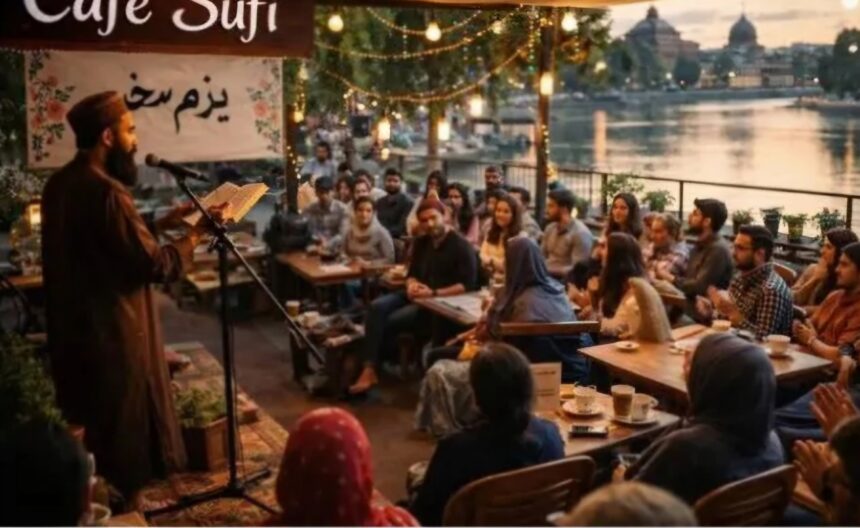
It was a routine scroll through Instagram when I came across a post that instantly stood out amid the usual flood of content. The post announced “Bazm-e-Sukhan” — a poetry gathering in the heart of Srinagar City, on the banks of River Jhelum at Café Sufi. For anyone who carries even a small love for Urdu literature, such a message feels less like information and more like an invitation from the soul.
Poetry gatherings, or Mushairas, are not new to Kashmir. The Valley has always been a land where language has flourished, where emotions were not only lived, but written, recited, and remembered. Yet, what made Bazm-e-Sukhan distinctly special was its setting: a café. To the best of my knowledge, this was among the first events of its kind in Srinagar where poetry was hosted in an open, modern space that the younger generation naturally relates to. That alone gave it significance beyond its literary value.
Out of excitement, I sent a message for registration. The response was positive. And when Saturday afternoon arrived, I made my way to the venue along with my friends. What followed was not merely a pleasant event, it was a powerful reminder that poetry, when given space, still has the power to bring people together in the most graceful manner.
From the moment the programme began, it was evident that Bazm-e-Sukhan was more than an ornamental cultural activity. Poetry flowed throughout the gathering, sometimes calm and reflective, sometimes intense and moving. The most remarkable feature was the diversity of participants.
There were senior poets, whose verses carried depth and maturity shaped by years of observation and experience. Alongside them were newcomers, many young and enthusiastic, trying to learn the nuances of Urdu poetry — the delicate weight of words, the discipline of rhythm, the subtleties of thought. Some were visibly nervous, others confident, but almost all were sincere. The audience, too, responded generously, encouraging talent and effort.
This combination of seasoned voices and emerging poets gave the event its true meaning. It showed that poetry is not fading; it is simply searching for spaces where it can breathe again.
Why cafés matter: poetry must meet the youth where they are.
One cannot ignore the reality of how cultural habits are changing. The younger generation, especially Gen Z, experiences the world differently. Their spaces of comfort are not always traditional auditoriums or formal literary halls. Instead, they gather in cafés, creative hubs, public meet-ups, and informal settings. If literature and poetry wish to survive not as relics but as living traditions, they must be carried into these spaces.
Hosting Bazm-e-Sukhan at Café Sufi was not merely a matter of convenience. It was a cultural statement. It reflected the idea that literature does not belong only to elite circles or formal settings; it belongs to people. And cafés, which are now the social centres of young urban life, can become powerful platforms for literary and cultural revival.
In many ways, holding a poetry event on the banks of Jhelum represented a meeting of past and present: heritage and modernity, tradition and today.
Poetry as healing: an antidote to anxiety in modern times.
Beyond cultural revival, such gatherings hold deep emotional and psychological value. The modern world is increasingly dominated by stress, uncertainty, overthinking, loneliness, and mental fatigue. Young people, too, carry invisible burdens — academic pressure, employment anxieties, social expectations, and an inner restlessness that often finds no outlet.
In such times, poetry can be more than art. It can be healing. Poetry allows people to express emotions that otherwise remain trapped inside. It gives words to pain, meaning to longing, and dignity to sadness. Listening to a couplet that mirrors one’s own experience can be strangely comforting, a reminder that we are not alone in our struggles of life.
At Bazm-e-Sukhan, one could sense this clearly. The audience did not attend only to admire literature; many came to feel. Poetry, after all, is one of the gentlest tools of emotional release. It can calm the mind, stimulate imagination, and push people towards creativity and introspection. In a time where mental health conversations are finally being taken seriously, poetry offers a natural emotional refuge that is accessible to all.
Poetry has always been the language of love and humanity, and that is precisely why it matters today more than ever. While our public spaces are increasingly filled with harsh opinions, instant judgements, and polarised identities, poetry refuses to reduce people into camps and categories.
As contemporary poet Vijendra Singh Parwaz writes, “Shayari sirf mohabbat ki tarafdaari hai.” The line is a powerful argument that poetry is not neutral. It takes a side, and it stands unapologetically with love. Not love limited to romance, but love as a civic and moral force: compassion over cruelty, dignity over humiliation, tenderness over aggression, and truth over noise. In an era where anger is marketed as strength and emotional numbness is mistaken for maturity, poetry quietly refuses surrender. It reminds us that when love disappears from language, humanity disappears from society.
A society remains alive not through buildings and roads alone, but through its arts and ideas. Poetry is one of the most powerful markers of a living civilisation. Bazm-e-Sukhan at Café Sufi was more than a Saturday gathering. It was a beginning to make poetry approachable and relatable. When young poets receive encouragement, when they hear senior poets recite with grace, and when audiences applaud sincerity, a culture begins to renew itself. Such events deserve support, repetition, and expansion. More cafés, cultural spaces and local institutions should consider hosting similar gatherings and making poetry a part of everyday public life, and let the language of love prevail.
Mir Altaf is a Kashmir based educator, writer & poet and can be reached at miraltaf966@gmail.com.