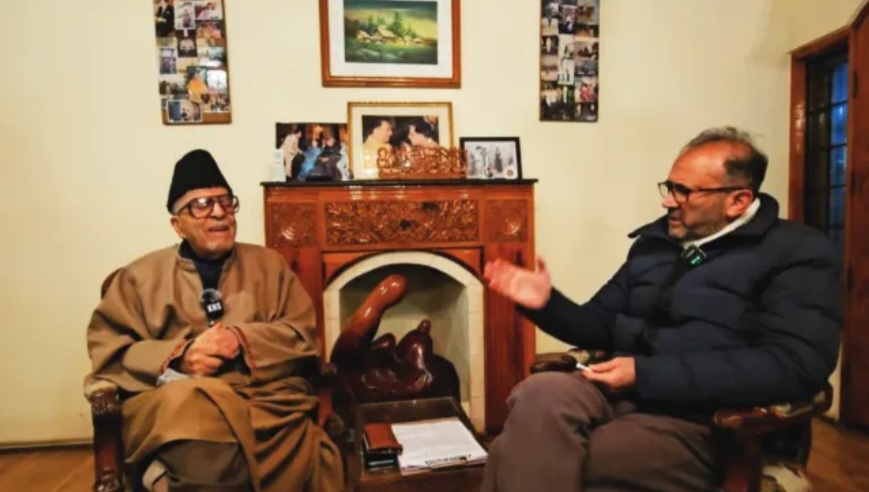
In a candid conversation with Kashmir Magazine Editor Mohammad Adlam Bhat, senior Congress leader Saif-ud-Din Soz speaks about the historic 1999 confidence vote against Prime Minister Atal Bihari Vajpayee, his differences with Farooq Abdullah, his admiration for Omar Abdullah, the erosion of Jammu and Kashmir’s special status, Congress’s own role in that process, and his advice to Rahul Gandhi.
Excerpts
KM: Professor Soz, thank you for joining us. Let us begin with your political journey. How do you look back at your career?
Soz: I entered national politics at a time when Parliament valued strong oratory and clarity of thought. My speeches were widely heard. Muslims across India knew me as someone who spoke fearlessly and articulately in Parliament. That recognition was not accidental; it came from consistent engagement.
There was a time when I was removed from the National Conference. That was a difficult moment. But politics is not static. Soon after, I received an invitation from Sonia Gandhi to join the Congress. That invitation changed the course of my career. I consider it Allah’s grace. From there, my role in national politics expanded.
KM: One of the most talked-about moments in your career was the 1999 confidence vote against Atal Bihari Vajpayee. What really happened that day?
Soz: That was April 17, 1999. Prime Minister Atal Bihari Vajpayee sought a vote of confidence in the Lok Sabha. The political atmosphere was tense. The government needed every vote. Let me say something clearly: I personally respected Vajpayee. I admired his personality and his political grace. I even told him that day that I liked his face and his politics. I was proud that he was Prime Minister of India. But I was helpless. I voted against him for two reasons. First, I believed that his government had not adequately reassured Indian Muslims especially on issues affecting minorities. That was my ideological disagreement. Second, and more importantly, I had a political disagreement with Farooq Abdullah. The National Conference had extended support to the BJP. I believed that supporting the BJP while publicly criticising it was political inconsistency.

So my vote against Vajpayee was also, in effect, a vote against Farooq Abdullah’s political line. The government fell by one vote. History records that moment.
KM: Did you face pressure or backlash after casting that decisive vote?
Soz: When I exited Parliament, journalists gathered at the gate. They asked why I had voted against Vajpayee when I had spoken respectfully of him.
I explained openly: my disagreement was political, not personal. I said Farooq Abdullah had supported the BJP and then criticised it publicly in Srinagar. I saw that as political contradiction.
I did not vote out of anger. I voted out of conviction. Later, leaders including Lalu Prasad Yadav came and embraced me. Many called me a hero. But I never considered myself a hero. I acted according to my conscience.
KM: Despite those differences, you say you have no grudge against Farooq Abdullah. How do you reconcile that?
Soz: Politics should not become permanent hostility. I have good feelings for Farooq Abdullah even today. We shake hands when we meet. What happened is part of history. True learning, I always say, requires judicious forgetting. You must forget certain conflicts wisely in order to move forward. I disagree with him politically at times. But personal bitterness is not healthy. Politics is long; resentment cannot sustain it.
KM: You mentioned Omar Abdullah. What is your assessment of his leadership?
Soz: Omar Abdullah is capable. I have always believed in his potential. When the time came for him to assume leadership, I supported it. In my view, the National Conference today cannot sideline him. He has become central to the party’s structure. Removing him would not be easy. But leadership requires constant engagement. In Kashmir’s politics, expectations are always high. Meeting those expectations demands tireless work.
KM: You have spoken strongly about Jammu and Kashmir’s constitutional status. Where do you stand today?
Soz: Let me be very clear. Jammu and Kashmir’s special status was eroded gradually over decades. It did not begin in 2019. The process began much earlier. Yes, Congress too bears responsibility for part of that erosion. I admit it openly. There is no point denying history. However, turning Jammu and Kashmir into a Union Territory was wrong. It was imposed through parliamentary majority, not consensus. A region with its own history, identity and constitutional recognition cannot be reduced so easily.
Even if Parliament passed it, that does not mean it reflects moral justice.
KM: You even said erosion began during Congress governments. That is a strong admission.
Soz: Yes, I acknowledge it. I am a Congressman and will remain one. Congress is a secular party and the best platform for Muslims in India to engage democratically. But historical honesty is necessary. Some erosions of autonomy did happen during Congress rule. We cannot rewrite history. That does not mean we abandon secular politics. It means we learn and correct.
KM: What is your view of Sheikh Abdullah’s legacy?
Soz: Sheikh Mohammad Abdullah remains unmatched in Kashmir’s political history. I have studied our history deeply. No leader equals him in stature. Yes, he made one mistake, accepting the 1975 Accord and returning to power in what many considered a reduced position. That caused disappointment among many Kashmiris. But even after his death, Sheikh Abdullah lives in our history. His emotional connection with people was extraordinary.
KM: You suggested that regional parties including Mehbooba Mufti and Sajjad Lone should work together. Why?
Soz: Politics in Jammu and Kashmir must revolve around secular principles. Whether it is Mehbooba Mufti, Sajjad Lone, Congress or others, ideological differences will remain. But for the larger interest of the people, there should be coordination on core issues. Not merger, not uniformity but a shared voice on safeguarding democratic rights.
Fragmentation weakens the region’s political strength.
KM: What role do you see for Rahul Gandhi nationally?
Soz: Rahul Gandhi and Priyanka Gandhi are hardworking leaders. Sonia Gandhi has given immense service to the party.
But politics is not a part-time engagement. It is not absenteeism. If Rahul Gandhi wants to lead the country, he must double his effort. Politics demands presence, morning to night, day to day. People may approach you at midnight with their problems. You must respond. His yatras have been successful. But sustained engagement is required beyond symbolic campaigns.
KM: At one point you said, “Politics is a kind of romance.” What did you mean?
Soz: Let me explain with an example.
Once, a young woman came to Sopore with her father. She had a serious grievance. She was in distress. I received a call about her situation.
I listened carefully. She cried. I delayed my lunch to understand her fully. I examined documents, heard arguments, spoke to concerned people, and ensured she received medical and institutional support. That day I ate lunch at 3:30 PM.
Why? Because politics is emotional involvement. When someone approaches you, you cannot look at your watch. Romance means immersion, you become one with the issue. You forget yourself. You become part of the problem and the solution.
If you are not emotionally invested, you cannot serve people properly.
KM : How do you balance idealism and political realism?
Soz: You must be principled but practical. In 1999, I respected Vajpayee but voted against him. That was realism guided by conviction. You must retain good memories and discard bitterness. Politics without emotional intelligence becomes cruelty. Politics without principle becomes opportunism.
KM: Finally, what message would you give to young politicians in Kashmir?
Soz: First, study history. Without understanding Sheikh Abdullah’s era, Indira Gandhi’s policies, the 1975 Accord, and later developments, you cannot interpret today’s politics.
Second, do not enter politics for position alone. Enter it for service. Third, remember that politics is continuous effort. It is not an event; it is a lifetime commitment. And lastly, never allow personal grudges to overshadow public responsibility.