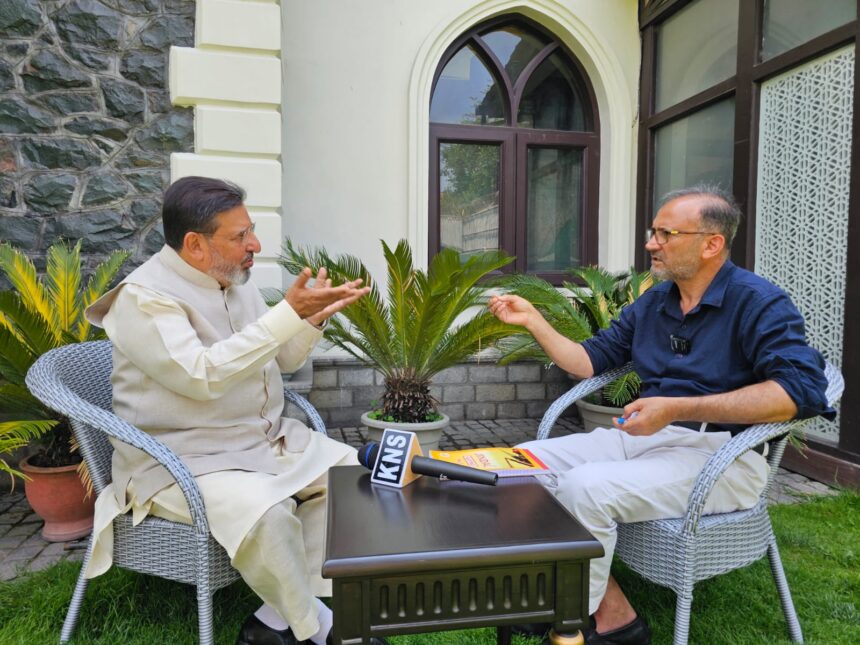
In a candid conversation with The Kashmir Magazine Editor M Aslam Bhat, Apni Party President Syed Mohammad Altaf Bukhari speaks at length on the changing political landscape of Jammu and Kashmir, the performance of the elected government, Article 370, statehood, New Delhi’s engagement with the J&K and why he believes dialogue, not confrontation, offers the only practical path forward.
Excerpts
KM: Nearly two years have passed since Jammu and Kashmir got an elected government. How do you assess the present political situation?
AB: If we assess the political situation objectively, there is a visible sense of uncertainty and disappointment among the people. The electorate participated enthusiastically in the Assembly elections and gave a decisive mandate. Winning fifty seats is not a small achievement. It reflected enormous public expectations and faith in the government.
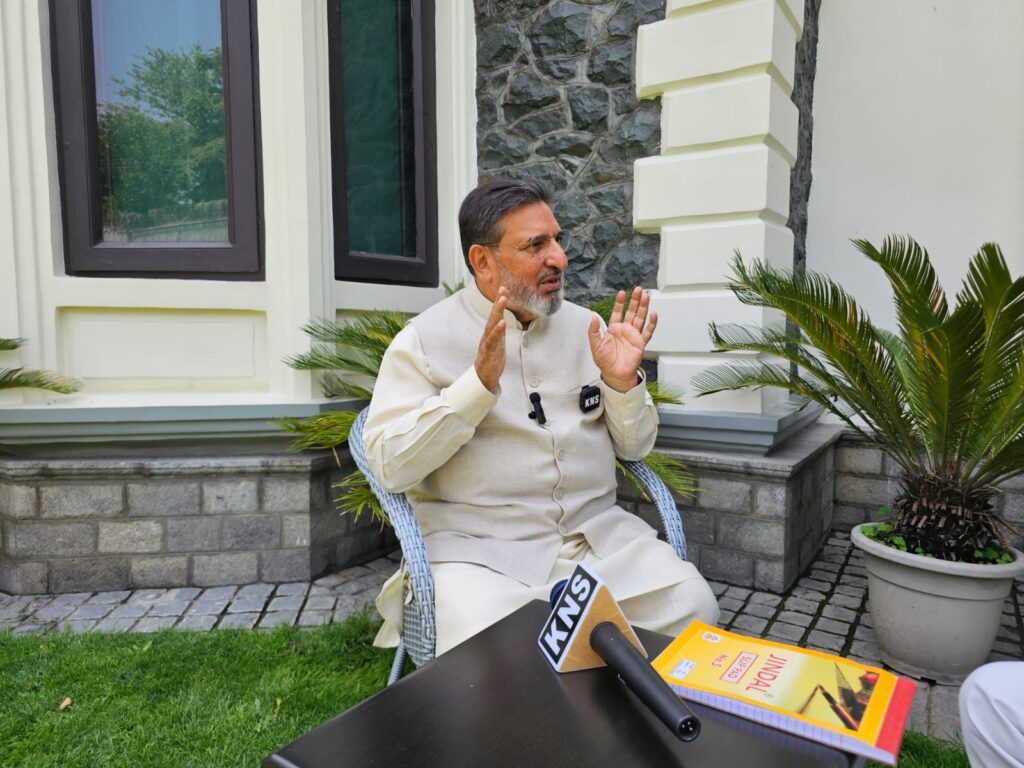
However, after nearly two years, many people feel those expectations remain largely unfulfilled. During the election campaign, several promises were made regarding governance, employment, development and public welfare. Today, people question how many of those commitments have actually translated into reality.
Of course, one may argue that a government’s performance should be judged only after completing its full term. That is a fair argument. But governance is also judged by the direction it takes from the very beginning. When people fail to see visible progress during the initial years, anxiety naturally begins to replace optimism.
The growing frustration is particularly evident among the youth. Employment opportunities remain limited despite thousands of educated young men and women entering the job market every year. I was recently looking at admission figures in some colleges and noticed that enrolment has declined. That worries me because it reflects a dangerous sentiment, that education may no longer guarantee a secure future.
For decades, Jammu and Kashmir has taken pride in having one of the highest literacy rates in the country. If young people begin losing faith in education itself, then we are not merely facing an employment crisis; we are confronting a social challenge whose consequences will be much deeper.
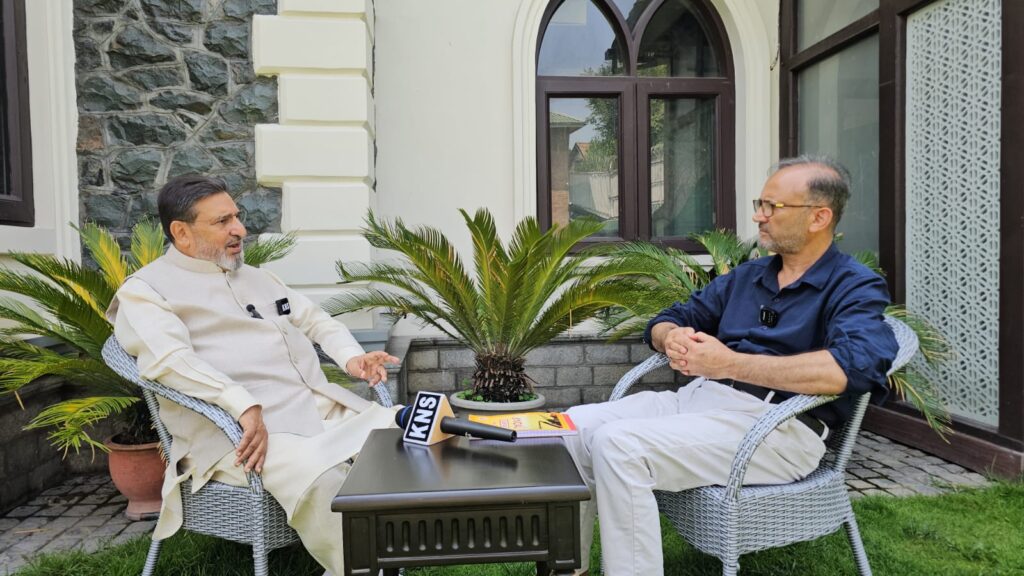
KM: You have repeatedly said that Srinagar has been neglected. Why do you believe the city has not received the attention it deserves?
AB: Srinagar is not merely another city; it is the political, cultural and economic heart of Jammu and Kashmir. Unfortunately, despite repeatedly electing representatives with overwhelming mandates, the city continues to suffer from neglect.
The people of Srinagar elected eight legislators from one political party, expecting that such a strong mandate would result in accelerated development. Instead, many residents now feel that the city has been taken for granted. There appears to be an assumption that Srinagar has no political alternative, and therefore its concerns can safely be ignored.
If you look at the old city, its condition speaks for itself. Housing remains one of the biggest challenges. In many localities, three generations continue living under one roof because there has been no comprehensive housing policy. Roads remain inadequate, drainage systems require major upgrading and the overall urban infrastructure has failed to keep pace with the city’s expanding population.
The tragedy is that Srinagar possesses extraordinary historical and cultural significance. It should have evolved into one of South Asia’s finest heritage cities. Instead, many of its heritage structures have deteriorated while unplanned urbanisation continues without a coherent long-term vision.
KM: What, according to you, should be the government’s immediate priorities for Srinagar?
AB: The city requires two major interventions. The first is a special economic package. Srinagar’s traditional economy has historically depended upon artisans, craftsmen and small businesses. Our shawl weavers, carpet manufacturers, copper artisans, papier-mâché artists and walnut wood craftsmen represent centuries-old traditions that have brought international recognition to Kashmir. Yet today many of these sectors are struggling for survival due to declining markets, rising costs and inadequate institutional support.
These artisans do not seek charity; they require policies that enable them to compete, innovate and sustain their livelihoods.
Secondly, Srinagar urgently requires a comprehensive infrastructure package. Housing, roads, drainage, traffic management, public transport and urban planning all require serious investment. Development cannot be limited to cosmetic beautification. It must improve the everyday lives of ordinary residents.
I have consistently urged both the Union Government and the administration to consider announcing a dedicated economic as well as infrastructure package exclusively for Srinagar. Such an intervention would not only revive the city’s economy but also restore public confidence.
KM: You have even suggested declaring Srinagar a heritage city. Why do you consider that important?
AB: Because Srinagar deserves that recognition. Few cities possess the historical depth, architectural character and cultural richness that Srinagar does. It represents centuries of civilisation, craftsmanship and coexistence. Tourism markets it as one of India’s greatest attractions, yet the level of investment in preserving its heritage remains inadequate.
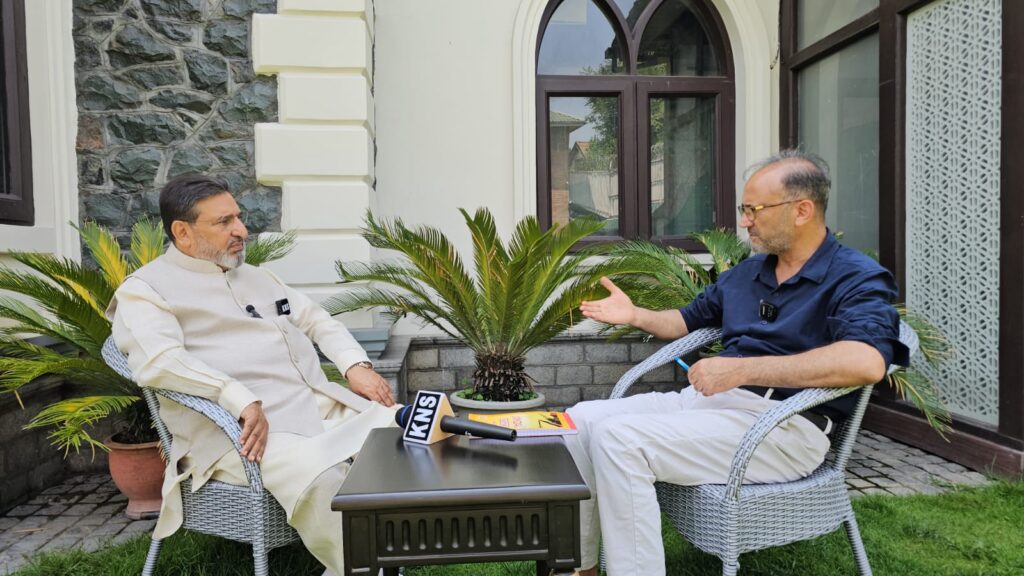
Declaring Srinagar a heritage city would not merely be symbolic. It would facilitate specialised planning, encourage conservation of historic neighbourhoods, improve tourism infrastructure and attract greater national attention towards preserving its unique urban identity.
More importantly, it would acknowledge that Srinagar is not simply an administrative capital. It is a civilisational asset whose preservation is in the national interest.
KM: In the Assembly elections, people rejected your party. Do you have any regrets?
AB: Elections are decided by the people, and in a democracy their verdict must always be respected. I have no regrets about contesting because I entered politics to serve the people, not merely to occupy office.
What pains me is something else. I believe many people could not understand the politics we were trying to pursue. We spoke about practical and achievable goals at a time when emotions dominated the political discourse. There was an atmosphere where people were willing to believe promises that, in my opinion, could never realistically be fulfilled.
Even today, wherever I travel, I meet people who tell me they expected a different outcome after the elections. Many openly admit that they feel disappointed because the promises made to them have not materialised. Politics should never be about creating expectations that cannot be fulfilled. It should be about honestly telling people what is possible and then working relentlessly to achieve it.
My concern has never been limited to my own electoral success. My concern is for every underprivileged family in Jammu and Kashmir whose aspirations continue to remain unaddressed. That is where my heart has always been.
KM: The elected government often argues that it operates under constitutional limitations and that many powers remain with the Lieutenant Governor. Do you consider this a genuine constraint or merely an excuse?
AB: Every constitutional arrangement comes with its own limitations. I understand that. But limitations cannot become a permanent explanation for the absence of governance.
If resources are available for one district, why should they not be available for another? Let me give you a simple example. Recently, a substantial development package was announced for Ganderbal. I welcome every investment made in any district of Jammu and Kashmir.
But my question is equally straightforward. Why should Srinagar not receive a similar package? Had the government announced even a comparable initiative for the city, I would have publicly appreciated it regardless of political differences.
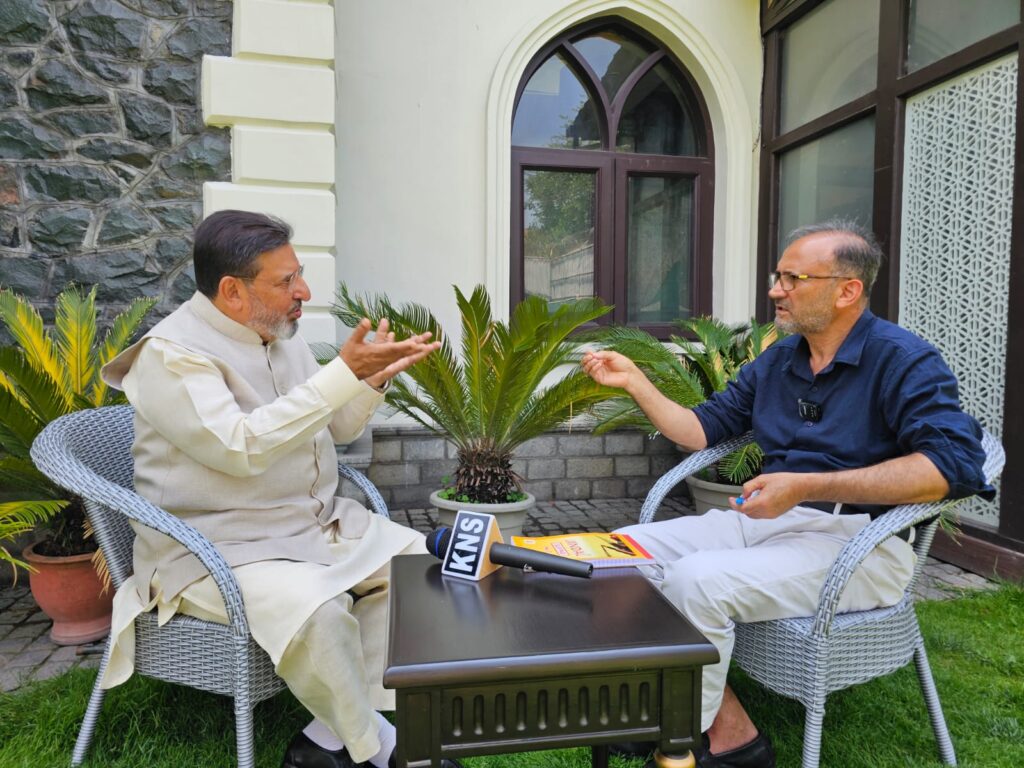
Governance is ultimately measured by delivery. Citizens are interested in results, not institutional explanations. Roads, drainage, housing, employment and infrastructure do not improve merely because governments explain constitutional arrangements.
People elected representatives to solve problems, not to narrate them.
KM: During your tenure as a minister, what do you believe distinguishes your government’s work from the present administration?
AB: I never claim that any government is perfect. Every administration has its shortcomings. But I believe our priorities were very clear.
When the devastating floods struck in 2014, Srinagar faced one of the greatest disasters in its history. As Minister for Public Works, our immediate focus was restoration. Within months, teams from the Government of India returned to assess the city’s condition. They were surprised by the speed with which essential infrastructure had been restored.
Our objective was never limited to resurfacing roads. We strengthened drainage systems, increased the number of dewatering pumps significantly and attempted to prepare the city for future emergencies.
Development is not about visible projects alone. It is about creating systems capable of protecting people during crises. Those investments may not attract headlines, but they determine how a city responds when disaster strikes.
KM: Your opponents frequently accuse the Apni Party of being close to the BJP or acting on behalf of New Delhi. How do you respond to these allegations?
AB: These allegations formed the foundation of the campaign against us during the last Assembly elections. Unfortunately, they were repeated so often that many people accepted them without questioning their basis.
Let me state this categorically: the Apni Party is neither an extension of the BJP nor the representative of any outside political organisation. We represent the people of Jammu and Kashmir.
Our politics is issue-based. If we believe a particular demand serves the interests of Jammu and Kashmir, we pursue it irrespective of who is in power in New Delhi.
People often forget that soon after our party was formed, we successfully raised several issues before the Government of India. Safeguards relating to land rights and government employment were addressed through legal and administrative measures. Those achievements are matters of public record.
Politics should ultimately be judged by outcomes, not labels. It is easy to accuse; it is far more difficult to deliver.
KM: You have often spoken about restoring statehood. Do you still believe it will happen?
AB: Absolutely. Statehood is not merely a political slogan. It is a constitutional commitment that has repeatedly been acknowledged by the Government of India.
I have consistently maintained that the restoration of statehood remains both necessary and achievable. But I have never believed it will come through confrontation alone.
Let us be realistic. The authority to restore statehood rests with Parliament and the Government of India. Whether one agrees or disagrees with the constitutional changes of August 2019, the practical reality is that any future political or constitutional arrangement will also have to emerge through engagement with the Union Government.
That is why our approach has always been one of dialogue rather than confrontation. Some people misunderstood that position. Today, however, almost every political party acknowledges that any meaningful progress on statehood will ultimately require engagement with New Delhi.
The objective should not be political point-scoring. The objective should be restoring democratic institutions in the interest of the people.
KM: Since 2019, Article 370 has remained at the centre of Kashmir’s political discourse. How do you view the issue today?
AB: Let me be very clear. The constitutional changes of August 5, 2019, deeply hurt the sentiments of the people of Jammu and Kashmir. Whether one agrees with that decision or not, nobody can deny the emotional impact it had. People felt their dignity had been affected, and those sentiments cannot simply be ignored.
Having said that, we also have to distinguish between emotion and political strategy.
In my view, Article 370 gradually ceased to remain purely a political issue once it entered the legal domain. After the constitutional changes were challenged before the Supreme Court, the debate largely shifted from politics to constitutional law. Once the Court delivered its judgment, the political landscape changed further.
That is why I have consistently maintained that those who continue making promises about restoring Article 370 must honestly explain how they intend to achieve it. Politics must be based on credibility. Leaders should tell people what is realistically achievable rather than what merely sounds attractive during elections.
KM: Many regional parties promised to restore Article 370 and protect Jammu and Kashmir’s special status. Do you believe they misled the people?
AB: I believe people deserve complete honesty. During the elections, several parties projected the restoration of Article 370 as an immediate political objective. People voted with hope because identity was an emotional issue. I understand those emotions completely.
But once elections were over, the public expected concrete action. Naturally, questions began to arise.
Whenever political parties make promises, they also have a responsibility to explain the constitutional and political roadmap for fulfilling them. Otherwise, public trust suffers.
That is precisely why our party adopted a different approach. We deliberately avoided making promises that we knew could not be delivered within the existing constitutional framework.
Politics should never become an exercise in selling hope without offering a realistic path towards achieving it.
KM: Critics often say your politics lacks confrontation with New Delhi. Why do you continue to advocate dialogue?
Altaf Bukhari: Because history itself has taught us that confrontation has delivered very little. For decades, politics in Jammu and Kashmir has largely revolved around confrontation, accusations and hardened positions. We have lived through unrest, uncertainty and instability. Every generation has paid a price.
My question is simple: what did ordinary people ultimately gain? Our youth still seek employment. Families still struggle economically. Development remains uneven. Investors remain cautious. If confrontation alone had solved these problems, we would not still be discussing them today.
Dialogue does not mean surrender. Dialogue means engaging with those who possess the constitutional authority to take decisions. Whether we like it or not, major constitutional and political questions concerning Jammu and Kashmir ultimately require engagement with the Government of India.
Our politics is therefore based on reconciliation rather than confrontation. That should never be misunderstood as weakness. Sometimes the greatest political courage lies in choosing dialogue when others prefer slogans.
KM: What, then, should New Delhi do to rebuild trust in Jammu and Kashmir?
Altaf Bukhari: Trust cannot be restored through administrative orders alone. It requires political engagement.
The Prime Minister and the Union Government should initiate sustained dialogue with the people of Jammu and Kashmir, not merely with political parties, but also with students, entrepreneurs, professionals, civil society, youth organisations and other sections of society.
Healing cannot happen overnight. It requires patience. It requires listening.
Most importantly, it requires people to feel that their concerns are genuinely being heard. The emotional distance created over recent years cannot disappear through speeches alone. It can only narrow through continuous engagement built upon mutual respect.
KM: You have repeatedly spoken about winning the hearts of the people. How, in your opinion, can that be achieved?
Altaf Bukhari: Winning hearts is never an event. It is a process. People often expect dramatic political announcements, but trust grows gradually. Every meaningful step matters. When young people find employment, confidence grows. When development reaches neglected areas, confidence grows. When constitutional commitments such as statehood are honoured, confidence grows. When people are treated with dignity and their voices are heard, confidence grows.
These may appear like small steps individually, but together they create an entirely different political atmosphere. Relationships between governments and citizens are built exactly the same way as one step leading to another.
KM: Looking back, what do you believe was the biggest political mistake made after August 2019?
Altaf Bukhari: The biggest challenge was not only the constitutional decision itself. It was the absence of sustained political communication afterwards. Whenever major political changes take place, people naturally seek reassurance. They want someone to explain what lies ahead. Many people in Jammu and Kashmir felt disconnected from that conversation. Political decisions may be constitutional, but public acceptance depends upon trust. That is why I continue to say that dialogue remains indispensable. No democratic society can permanently substitute communication with silence.
KM: Finally, what message would you like to give to the people of Jammu and Kashmir?
Altaf Bukhari: I would simply say this: remain hopeful. Our challenges are undoubtedly serious, but despair cannot become our politics. We need to invest in education, create employment, revive our economy, strengthen our institutions and prepare our youth for the future. Politics should unite society rather than divide it. Our children deserve opportunities, not endless uncertainty. If we can move beyond confrontation and focus on practical solutions, I firmly believe Jammu and Kashmir has the potential to regain its confidence and move towards a more stable and prosperous future.
KM: Thank you for having us
AB: Thank you