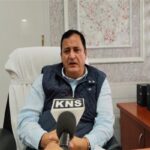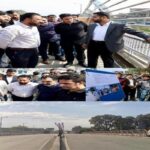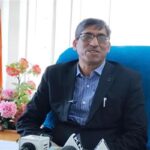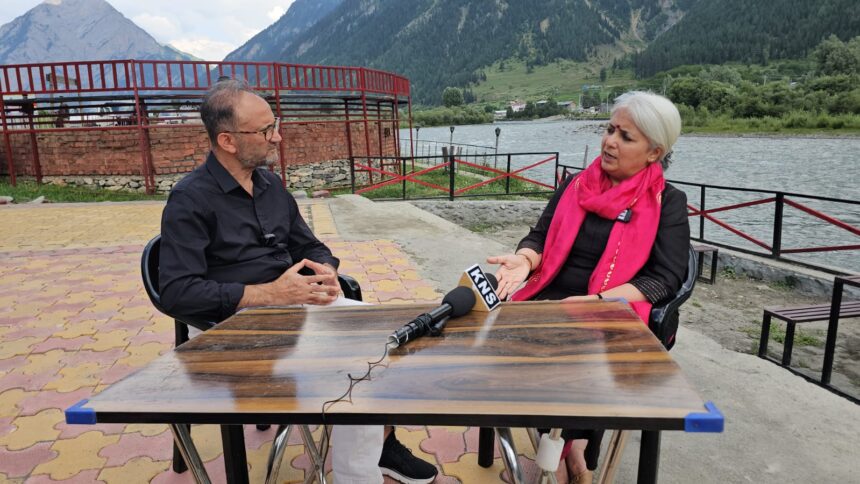
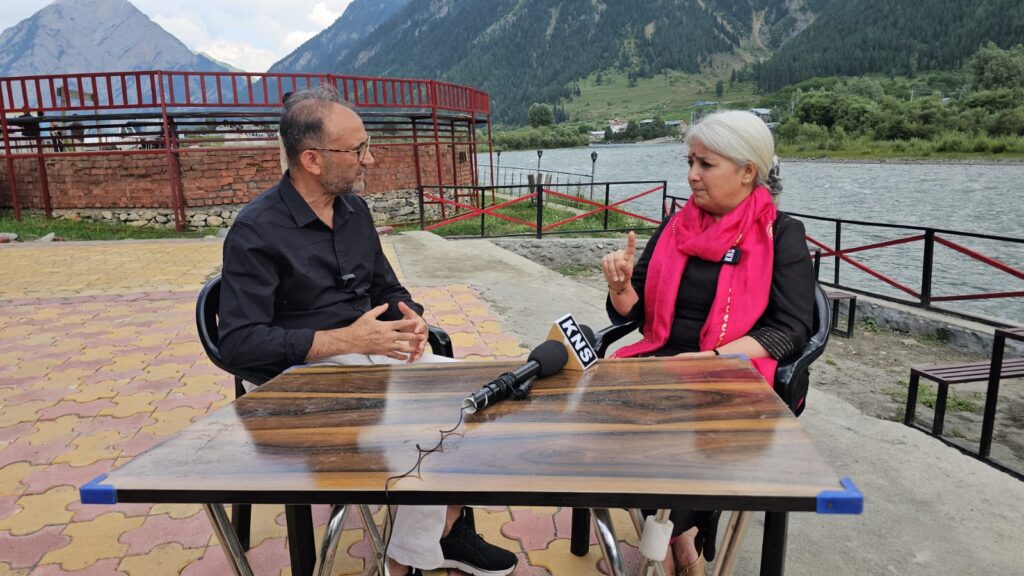
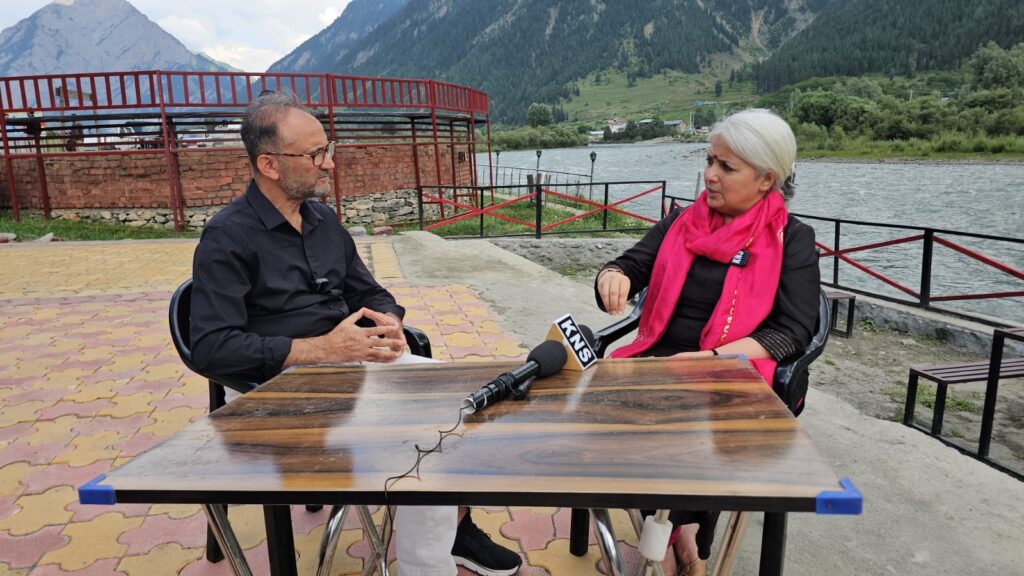
In a candid conversation with The Kashmir Magazine Editor M. Aslam Bhat, Deputy Commissioner Bandipora Indu Kanwal Chib opens up on sustainable governance, scientific waste management, Gurez’s tourism boom, Wular Lake conservation, infrastructure development and her vision for shaping the future of one of Kashmir’s most ecologically significant districts.
Excerpts
KM: You have been visiting Gurez quite frequently. What was the purpose of your latest visit?
Indu Kanwal: Gurez is among the district’s highest priorities during the working season, which is why I make it a point to visit the valley every two to three weeks. Field visits allow us to monitor ongoing projects, review implementation on the ground and ensure that funds released by the Government are utilised efficiently within the limited working season available in this region. Administrative reviews conducted only from district headquarters cannot substitute direct interaction with officials and the local community.

This visit, however, had a specific objective. Following a review meeting chaired by the Chief Secretary, all Deputy Commissioners were directed to ensure effective implementation of the Solid Waste Management Rules, 2026. Considering the rapid increase in tourist arrivals to Gurez, we felt it was important to begin implementing a structured waste management system before the peak season progressed further.
KM: Waste management has become one of the administration’s key priorities. How has the district approached the issue?
Indu Kanwal: Any policy must begin with reliable data. Without understanding the scale of the challenge, meaningful planning becomes difficult. Therefore, our first exercise was to prepare a comprehensive database of waste generation across the district. My officers spent nearly ten days collecting detailed information from both rural and urban areas, and we integrated data available with the Rural Sanitation Department and other concerned agencies to prepare a district-wide assessment.
The survey enabled us to identify the quantity of waste being generated, the available infrastructure and, most importantly, the major waste generators across Bandipora. Based on the criteria laid down under the Solid Waste Management Rules, we identified 89 Bulk Waste Generators in the district, including hotels, restaurants, educational institutions, security establishments and other commercial entities producing substantial quantities of waste every day.
Our approach was not to penalise these institutions immediately but to engage them first. We organised a district-level convention exclusively for Bulk Waste Generators, where nearly every identified establishment participated. The overwhelming response itself reflected that stakeholders were willing to cooperate provided they received proper guidance regarding scientific waste disposal and compliance with the rules.
Experts from the Directorate of Rural Sanitation, the Urban Development Department and other technical institutions were invited to explain the legal framework, available technologies and practical methods of waste management. We issued detailed advisories and clearly informed participants that after a reasonable transition period, institutions would be expected to manage their waste in accordance with the prescribed rules rather than relying entirely on the district administration.
KM: One of the initiatives that has attracted attention is the waste checkpoint established at Tragbal. What prompted that decision?
Indu Kanwal: Tourism has expanded significantly in Gurez, which is encouraging from an economic perspective. At the same time, increased tourist movement inevitably results in increased waste generation. Our concern was that unless preventive measures were introduced at the entry point itself, the ecological character of the valley could gradually come under pressure.
Traffic assessments indicate that nearly 400 vehicles carrying approximately 5,000 to 6,000 visitors enter Gurez on busy days during the tourist season. If every visitor carries disposable plastic bottles, beverage cans and packaged food items without an effective collection mechanism, the cumulative environmental impact can become substantial within a very short period.
To address this challenge, the district administration established a waste management checkpoint at Tragbal. The objective is not to inconvenience visitors but to ensure that recyclable waste is properly collected before it accumulates across the valley.
The results have been encouraging. We created a dedicated monitoring mechanism, including digital reporting through WhatsApp groups, enabling us to review the functioning of the checkpoint on a daily basis. The recyclable waste collected there, particularly PET bottles and aluminium cans, is of good quality and has commercial value. Local scrap dealers now collect this material regularly for recycling, creating a small but meaningful circular economy while simultaneously reducing environmental pressure.
An important aspect of this initiative is that the revenue generated from recyclable material is retained by the local workers engaged at the checkpoint. It serves as both an incentive and an example of how environmental conservation can also create livelihood opportunities at the local level.
KM: The Indian Army has also been associated with some of these initiatives. How important has inter-agency cooperation been?
Indu Kanwal: It has been extremely valuable. Sustainable governance, particularly in geographically challenging regions such as Gurez, requires collaboration rather than isolated efforts.
The local Army formations extended significant logistical and organisational support during our waste management initiatives, including the Tragbal checkpoint and the Bulk Waste Generators’ convention. Their cooperation enabled us to implement programmes within a relatively short period that would otherwise have required much more time.
Environmental conservation is not the responsibility of one department alone. It requires participation from government agencies, local communities, civil society organisations and security institutions alike. When all stakeholders work towards a common objective, implementation becomes much more effective.
KM: Infrastructure alone cannot solve the waste management challenge. How important is public awareness in making such initiatives successful?
Indu Kanwal: Public participation is, in fact, the foundation of the entire programme. Waste management cannot succeed merely because the administration issues directions or creates infrastructure. It succeeds only when citizens begin to see cleanliness and environmental protection as their own responsibility.
One of the most valuable suggestions we received during our interaction with local stakeholders came from members of the hotel association. They proposed installing continuous public awareness announcements at important entry points such as Tragbal so that visitors are repeatedly reminded about responsible waste disposal. I believe behavioural change begins with constant reinforcement. People are exposed to messages every day that influence their choices. Environmental responsibility should become part of that everyday conversation as well.
At the same time, awareness alone is not enough. Good practices must also be recognised. We are therefore developing a system through which organisations, institutions and community groups that demonstrate exemplary work in waste management will receive formal public recognition from the district administration. Appreciation should not remain confined to certificates handed over inside government offices. We want such recognition to be visible so that it encourages others to follow similar practices.
However, governance also requires accountability. Alongside incentives, there must be consequences for deliberate violations of environmental regulations. Appreciation and enforcement must work together. Neither approach is effective in isolation.
KM: You have often spoken against the growing dependence on public dustbins. What alternative model does the administration envision?
Indu Kanwal: My personal view is that the long-term objective should not be to install more dustbins but to create communities that no longer depend on them. If waste is generated responsibly and managed at the source, the requirement for public collection points automatically reduces.
Unfortunately, we continue to witness situations where community dustbins installed with public funds are misused or even removed from their intended locations. Such practices defeat the very purpose for which public infrastructure is created.

Our vision is therefore to gradually move towards source-level segregation and decentralised waste management. Every household, institution and commercial establishment should be responsible for handling its own waste in accordance with the prescribed norms. When that happens, public spaces remain cleaner and the burden on municipal systems also reduces significantly.
Ultimately, cleanliness is not a function of infrastructure alone. It reflects collective civic behaviour.
KM: The administration has announced that it will gradually stop collecting wet waste from households. Why was that decision taken?
Indu Kanwal: Because wet waste should ideally never become municipal waste.
Kitchen waste, vegetable residue and biodegradable material can all be processed locally through composting. If households begin composting at the source, nearly half the waste currently entering the collection system can be eliminated.
Before implementing this policy, however, we considered it necessary to provide proper training. Through the Krishi Vigyan Kendra and technical experts associated with SKUAST-K, awareness programmes have already begun to demonstrate practical composting methods to local communities. Similar training sessions are being organised across the district so that people understand not only why composting is important but also how easily it can be done.
Only after adequate awareness and capacity building will we gradually implement this transition. The objective is not to shift responsibility without support but to build a sustainable system that people can manage independently.
KM: Public response to new initiatives is often mixed. How do you deal with criticism while implementing reforms?
Indu Kanwal: Every public initiative attracts different kinds of responses, and that is natural in a democratic society. Some people immediately identify shortcomings, while others willingly become partners in finding solutions. As administrators, we have to be prepared for both.
Personally, I never expect universal approval. Criticism is part of public life, and my entire team understands that. If someone points out deficiencies in our work, we listen carefully because constructive criticism often helps improve implementation.
At the same time, I prefer to focus my energy on those citizens who genuinely wish to contribute. Even if a smaller section of society actively participates, meaningful change becomes possible. Experience has shown that once positive examples begin to emerge, others gradually join the process as well.
In Bandipora, particularly in Gurez, people increasingly recognise that environmental conservation is directly linked to their livelihoods. Tourism has expanded considerably over the past year. Local residents understand that preserving the valley’s natural beauty is essential not only for ecological reasons but also for sustaining tourism-based income in the years ahead. That awareness itself is one of the strongest motivators for responsible public behaviour.
KM: Waste management is often considered an expensive exercise. Does the district have adequate financial resources to sustain these initiatives?
Indu Kanwal: Financial resources are certainly an important aspect of waste management, but effective planning is equally important. I often say that budgeting is not merely about the amount of money available; it is about how wisely available resources are utilised.
During the last two years, considerable investment has already been made under the Swachh Bharat Mission towards creating basic infrastructure. Segregation sheds, vermicompost pits, collection vehicles and related facilities have been established across different parts of the district.
This year, another important step has been taken. A fixed proportion of the district’s capital expenditure has been earmarked specifically for waste management, ensuring that environmental infrastructure receives sustained financial support rather than depending entirely on isolated projects.
Equally significant is the concept of Extended Producer Responsibility (EPR). Manufacturers of plastic packaging and similar products also have an obligation to participate in waste management. We recently held detailed discussions with officials from the Government of India, including representatives associated with the Swachh Bharat Mission and the Ministry of Environment, Forest and Climate Change. Our next step is to engage directly with these companies so that producer responsibility becomes an integral part of Bandipora’s waste management strategy.
Environmental sustainability cannot depend solely on government expenditure. It requires participation from industry, local communities and every stakeholder connected with the waste cycle.
KM: Gurez has witnessed a significant increase in tourist arrivals over the past two years. How is the administration balancing tourism growth with environmental sustainability?
Indu Kanwal: Tourism has undoubtedly emerged as one of the strongest drivers of Bandipora’s economy, particularly in Gurez. The increase in tourist arrivals is encouraging because it has created new livelihood opportunities for local residents. However, tourism cannot be viewed merely in terms of visitor numbers. Unless it is managed responsibly, the very resources that attract tourists may gradually come under pressure.
Our effort has therefore been to integrate tourism with sustainable planning. Waste management is one part of that strategy, but infrastructure planning is equally important. Increased tourist footfall naturally places additional pressure on roads, parking facilities, sanitation and public utilities. If these requirements are not addressed in advance, both visitors and local communities suffer.
The objective is not simply to attract more tourists but to ensure that tourism remains sustainable over the long term. Gurez derives its identity from its pristine environment. Preserving that environment is therefore fundamental to preserving its tourism economy.
KM: What are the immediate infrastructure challenges the administration is trying to address in Gurez?
Indu Kanwal Chib: The most immediate challenge is managing the unprecedented increase in tourist traffic. During the peak season, hundreds of vehicles enter the valley every day. While this reflects the growing popularity of Gurez, it has also highlighted deficiencies in existing infrastructure.
Parking is one of the foremost issues. Many stretches of the road network are narrow and were never designed to accommodate the present volume of tourist traffic. We have therefore initiated work on developing organised parking facilities as part of a larger Rural Mart project at Pethkote. Besides creating dedicated parking space, the project will also provide opportunities for local entrepreneurs to market traditional products, handicrafts and agricultural produce. We intend to create an organised visitor facility rather than isolated infrastructure.
Public sanitation is another priority. The administration is establishing modern public toilet facilities at key tourist locations, including Razdan Pass, Lal Qila and Gurez. Basic amenities often determine the quality of a tourist destination as much as its natural beauty. Our effort is to ensure that tourism infrastructure develops in step with increasing visitor numbers.
Development in a geographically remote area cannot happen overnight. But if planning remains systematic and consistent, every tourist season should leave the district better prepared than the previous one.
KM: Besides Gurez, does the administration see potential in developing other tourism destinations across Bandipora?
Indu Kanwal: Certainly. Bandipora possesses enormous tourism potential beyond Gurez alone. Several locations across the district have exceptional natural beauty and deserve greater recognition. However, destination development requires careful planning rather than hurried promotion.
Places such as Ketsan, Chuntiwari, Athwatoo, Razdan, Dakhtoor and several other areas possess considerable tourism potential. Before encouraging large-scale visitor movement, however, it is essential to assess road connectivity, environmental carrying capacity, public amenities and safety requirements.
Tourism should never outpace infrastructure. Otherwise, the environmental cost eventually outweighs the economic benefits.
Our approach is therefore gradual. We first focus on improving accessibility, sanitation, waste management and basic facilities before promoting new destinations extensively. Sustainable tourism demands that development and conservation progress together.
KM: Wular Lake remains central to Bandipora’s identity as well as its economy. How do you view the ongoing conservation efforts?
Indu Kanwal: Wular is not merely a water body. It is central to Bandipora’s ecological identity and has historically sustained thousands of livelihoods. Whenever I speak about the district, I often say that Bandipora has been uniquely blessed by two extraordinary gifts of nature, Wular Lake and Gurez Valley. Together, they define much of the district’s environmental and economic character.
Protecting Wular therefore cannot be viewed simply as an environmental exercise. It is equally a question of safeguarding livelihoods, biodiversity and the district’s long-term sustainability.
Encroachment remains a complex issue. While illegal occupation of public land cannot be justified, every situation also has its own social and economic dimensions. In certain cases, families occupying portions of land belong to economically vulnerable communities and have lived under difficult circumstances for many years.
As administrators, we have to balance legal responsibilities with humanitarian considerations. Enforcement of the law remains necessary, but wherever possible, we also try to approach such matters with sensitivity and compassion. Development should not come at the cost of human dignity, just as environmental protection cannot be compromised through continued encroachment.
Ultimately, our objective is to preserve Wular while ensuring that solutions remain fair, lawful and socially responsible.
KM: Looking beyond individual projects, what is your broader vision for Bandipora over the next few years?
Indu Kanwal: My vision is quite straightforward. Development should improve people’s everyday lives while protecting the district’s natural resources for future generations.
Bandipora possesses tremendous strengths. It has ecological assets of national importance, immense tourism potential, hardworking communities and significant opportunities in agriculture, horticulture and allied sectors. The challenge before the administration is to ensure that these strengths are translated into sustainable economic opportunities.
Good governance is not measured only by the number of projects completed. It is measured by the quality of institutions we leave behind. If our systems become more transparent, if communities participate more actively and if environmental responsibility becomes part of everyday public behaviour, then development will automatically become more sustainable.
For me, administration is not simply about implementing schemes. It is about building public confidence. Once people begin viewing the administration as a partner rather than merely an authority, governance becomes much more effective.
Bandipora has all the ingredients required for long-term growth. Our responsibility is to ensure that development remains inclusive, environmentally responsible and centred on the needs of the people.
KM: Throughout our conversation, one theme has repeatedly emerged, public participation. Do you believe sustainable development is possible without active community involvement?
Indu Kanwal: I don’t think any administration, regardless of its capacity, can achieve lasting results without public participation. Government departments can formulate policies, allocate resources and create infrastructure, but ultimately it is the people who determine whether those initiatives succeed.
Take waste management as an example. The administration can establish segregation centres, deploy collection vehicles and frame regulations, but if people continue to litter public spaces or fail to segregate waste at the household level, the entire system comes under strain. Similarly, tourism can only remain sustainable if visitors, local businesses and residents collectively recognise that environmental conservation is directly linked to their own future.
I have always believed that governance should not function as a one-way process where the administration issues directions and the public merely follows them. Development becomes meaningful when communities begin to see themselves as stakeholders rather than spectators. Once that happens, solutions become more sustainable because people start protecting what they have collectively built.
That is precisely the approach we are trying to adopt in Bandipora. Whether it is environmental conservation, tourism management or implementation of development projects, we want people to participate not because they are being compelled to do so, but because they understand the long-term benefits for themselves and future generations.
KM: Bandipora is blessed with extraordinary natural resources, yet it also faces unique developmental challenges. As DC, what do you see as the district’s greatest strength?
Indu Kanwal: Without any hesitation, I would say Bandipora’s greatest strength lies in its natural assets and its people.
Few districts are fortunate enough to possess ecological landmarks such as Wular Lake and Gurez Valley within the same geographical boundary. These are not merely tourist destinations; they represent livelihoods, biodiversity, culture and the district’s identity. Protecting them is therefore not simply an environmental responsibility but an investment in Bandipora’s future.
At the same time, I have been consistently encouraged by the willingness of people to participate in positive initiatives. Whenever communities, local institutions, youth groups and civil society organisations come together with the administration, the quality of implementation improves significantly. That partnership gives me confidence that Bandipora can continue to grow while preserving its unique ecological character.
Development should never be viewed only through the lens of infrastructure. Roads, bridges and buildings are undoubtedly important, but equally important is the responsibility to ensure that natural resources are protected for generations to come. The real success of development lies in achieving both objectives together.
KM: Finally, what message would you like to convey to the people of Bandipora?
Indu Kanwal: My message is simple. Bandipora has enormous potential, but safeguarding that potential is a shared responsibility. Government departments will continue to discharge their responsibilities, but lasting change can only come when every citizen contributes in whatever way possible.
I would particularly appeal to young people to become active partners in protecting the district’s environment. Small actions, avoiding littering, segregating waste, respecting public spaces and encouraging responsible tourism collectively make a significant difference.
I also request hotel owners, traders, transporters, educational institutions, civil society organisations and local communities to continue working with the administration. Development is most effective when it is built on cooperation rather than confrontation.
Our objective is not merely to complete projects but to leave behind systems that are sustainable, transparent and capable of serving people for many years. If we succeed in creating that culture of shared responsibility, I am confident Bandipora will emerge as a model district where development and environmental conservation progress together.
KM: Thank you for having us
Indu Kanwal: Thank you