
Mohammad Saleem Shahid
The twenty-first century has witnessed many technological breakthroughs, but none has captured the imagination of the world as profoundly as Artificial Intelligence (AI). What was once the subject of scientific speculation has now become an indispensable part of everyday life. From healthcare and finance to agriculture and governance, AI is reshaping human civilization. Education, the foundation of every progressive society, now stands on the threshold of an equally transformative revolution.
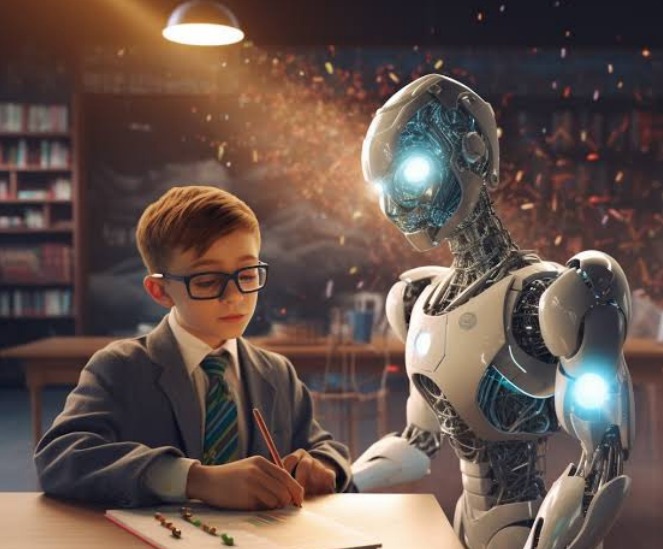
For generations, classrooms have followed a traditional model where one teacher delivered the same lesson to an entire class, despite the diverse abilities and learning needs of students. Artificial Intelligence has the potential to rewrite this narrative. By analysing individual learning patterns, AI can personalize education, identify weaknesses, recommend suitable resources, and provide immediate feedback. Every learner can receive an educational experience tailored to his or her pace and potential.
The possibilities are both exciting and inspiring. Students in remote villages can gain access to the same quality of educational resources as those in metropolitan cities. Language barriers can be reduced through real-time translation, while intelligent tutoring systems can provide round-the-clock academic support. Learners with disabilities can benefit from speech recognition, text-to-speech technologies, and adaptive learning tools, making education more inclusive than ever before.
Teachers, often burdened with administrative responsibilities, also stand to gain immensely. AI can automate routine tasks such as grading, attendance management, lesson planning, and performance analysis. This allows educators to dedicate more time to mentoring students, encouraging creativity, and nurturing moral values—responsibilities that no machine can truly replace.
Yet every technological revolution carries its own challenges. Artificial Intelligence, despite its extraordinary capabilities, must never become a substitute for human judgement. Blind dependence on AI can weaken critical thinking, originality, and intellectual curiosity. Students who rely entirely on machine-generated answers may gradually lose the ability to analyse, question, and innovate. Education is not merely about finding answers; it is about learning how to ask meaningful questions.
Another pressing concern is the ethical use of AI. Educational institutions must protect student privacy, ensure data security, and promote academic integrity. AI systems are created by humans and, therefore, may reflect human errors or biases. Responsible use, transparency, and continuous oversight are essential if AI is to remain a force for progress rather than a source of inequality.
The role of the teacher, therefore, becomes even more significant in the age of Artificial Intelligence. A machine can process information, but it cannot inspire hope. It can solve equations, but it cannot build character. It can predict performance, but it cannot understand emotions, empathy, or the dreams hidden behind a student’s silence. The true architect of education will always be the teacher, with AI serving as a powerful assistant rather than a replacement.
History reminds us that every great invention—from the printing press to the internet—has transformed society when guided by wisdom and responsibility. Artificial Intelligence is no exception. Its greatest contribution will not be replacing human intelligence but enhancing it. Used ethically and thoughtfully, AI can create classrooms where every learner receives individual attention, every teacher is empowered with better tools, and knowledge becomes more accessible than ever before.
The future has already entered our classrooms. The question is no longer whether Artificial Intelligence will change education, but whether we are prepared to shape that change with wisdom, ethics, and humanity. If we succeed, future generations will remember this era not simply as the age of Artificial Intelligence, but as the age in which education became more inclusive, more intelligent, and more deeply human.
“Technology can open the door to knowledge, but only wisdom can lead us through it.”
Author is Teacher at Higher Secondary School Zaloora.