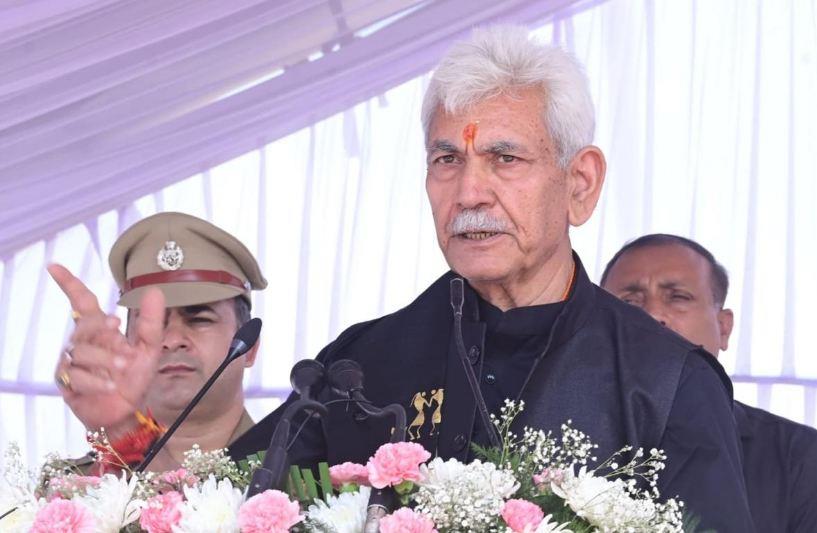
At a gathering of farmers and officials in Khudwani, Kulgam, Lieutenant Governor Manoj Sinha made a striking statement that drew cheers from the crowd.
“Only the police come under me,” he said. “The rest roads, electricity, water, agriculture belongs to the elected government.”
His comment was in response to a request from Minister Sakina Itoo, who asked for stronger support from the administration in agricultural matters. Sinha reassured everyone: “I will never stand in the way of any development. If the elected government wants to act on your demands, I am with you.”
In a place where governance has often been caught between administrative control and public mandate, the LG’s words were more than symbolic. They were a message that a new line of responsibility is now drawn in Jammu and Kashmir.
The event marked the closing ceremony of the Viksit Krishi Sankalp Abhiyan, a nationwide mission to modernize India’s agriculture. For Jammu and Kashmir, the message is more urgent, 70% of the population depends on agriculture or allied work.
Sinha called the campaign a “transformative step toward building a prosperous farm economy.” He said, “Our goal is to ensure every farmer in J&K becomes a proud contributor to India’s vision of becoming a developed nation by 2047.”
At the heart of the agriculture push is the Holistic Agriculture Development Programme (HADP). Sinha praised it as the first major agricultural reform of its kind in any Indian state or Union Territory in recent times.
Designed to turn J&K into a Rs 1 trillion agriculture economy by 2030, HADP has already shown visible results. There has been a sharp rise in mustard cultivation, beekeeping, and trout fish production.
pointed out that mustard farming is especially promising, offering three-fold benefits:
Power Clearly Defined


Leave a comment
Leave a comment