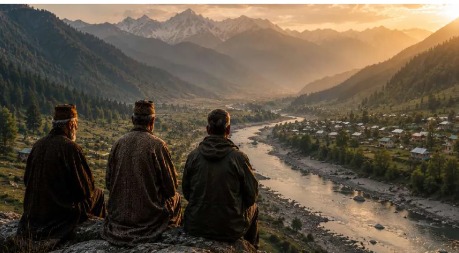
The environmental story of Kashmir is rarely told in full. Beyond the headlines, its glaciers are retreating, wetlands are shrinking, rivers are under stress and forests face mounting pressure from a changing climate and expanding human activity. Against this backdrop, a handful of individuals have quietly dedicated their lives to safeguarding the Valley’s natural heritage. Their stories reveal not only what Kashmir is losing, but also what can still be saved. Abrar Nabi Reports
Long before satellite imagery began documenting glacial retreat, before climate models warned of Himalayan warming and before environmental degradation entered policy debates, Kashmir’s relationship with nature was instinctive. Water was not merely a resource; it was civilisation itself. Springs determined where villages emerged. Lakes shaped commerce and culture. Wetlands moderated floods, sustained fisheries and hosted thousands of migratory birds. Forests protected mountain slopes while glaciers silently fed rivers that carried life across the Valley.
The transformation has not occurred through a single disaster but through the cumulative weight of countless human decisions. Wetlands have shrunk beneath expanding settlements. Natural springs have either dried up or become contaminated. Rivers have been altered by indiscriminate extraction of sand and gravel. Forests continue to experience pressure from encroachment, fragmentation and changing land use. Glaciers, the frozen reservoirs upon which much of Kashmir’s hydrology depends are retreating at an alarming pace under the influence of a warming climate. Scientific studies increasingly suggest that what the Valley is witnessing is no longer environmental degradation in isolated pockets but the gradual weakening of an interconnected ecological system.
Over the last two decades, researchers have documented significant changes in Kashmir’s hydrology. Springs that supplied drinking water to villages for generations have diminished or disappeared altogether. Wetlands that once absorbed floodwaters and supported biodiversity have steadily contracted. Lakes such as Dal, Nigeen, Khushalsar and Gilsar have endured decades of pollution, encroachment, sewage inflow and neglect. Wular, South Asia’s largest freshwater lake, continues to battle siltation, invasive vegetation and land-use pressures despite repeated conservation efforts.
A shrinking glacier eventually alters river flows. Degraded forests accelerate soil erosion. Silt enters lakes and wetlands. Wetlands lose their capacity to store floodwater. Groundwater recharge declines. Springs weaken. Communities travel farther in search of drinking water. Ecological decline becomes social decline.
Kashmir’s environmental story is therefore not simply about disappearing landscapes. It is about changing livelihoods, increasing water insecurity, declining biodiversity and growing climate vulnerability.
Scientists have been warning about this trajectory for years.
But while reports accumulate on government shelves and environmental indicators continue to worsen, another story has unfolded across the Valley. It is the story of ordinary citizens who refused to accept ecological decline as inevitable. They did not command institutions, did not possess extraordinary budgets.
Most had no formal authority to intervene. Yet they chose to act. Some cleaned lakes with their own hands. Some documented illegal mining through relentless field visits. Some restored forgotten springs. Some planted trees where forests had retreated. Some mobilised schoolchildren, volunteers and neighbourhoods around an idea that conservation begins with community ownership rather than government orders. Their work rarely dominated headlines. Yet together they have altered how environmental conservation is understood in Kashmir.
In many instances, they have demonstrated that ecological restoration is not merely the responsibility of governments. It is also an expression of citizenship. Among them are names that have become familiar within environmental circles.
The Lake Whisperer
At six in the morning, before Srinagar fully awakens, the lakes begin to speak.
Standing on the embankment of Khushalsar, Manzoor Ahmad Wangnoo watches the lake as though listening to an old friend.
Most people see water. He sees memory, history, warnings and above all, he sees responsibility.
For more than two decades, Wangnoo has spent much of his life trying to save Kashmir’s dying lakes, springs and wetlands, not because anyone appointed him to do so, but because he believes that if these waters disappear, Kashmir will lose something far greater than its landscape. It will lose part of its civilization.
Years ago, Wangnoo watched a short video of Khushalsar Lake. It did not resemble a lake.
The waterbody had become so choked with weeds, garbage, plastic and accumulated waste that stray dogs appeared to walk across what had once been open water.
For many, it was another depressing image. For Wangnoo, it became a turning point. Friends advised him against taking on what seemed an impossible task.
The lake had suffered decades of neglect. Government departments had struggled. Experts had written reports. People had accepted that Khushalsar was beyond saving. Wangnoo refused to accept that conclusion.
Environmental conservation often carries a romantic image. The reality is far less glamorous. Restoring a dying lake is not about speeches. It is about removing tonnes of waste, convincing residents that a plastic bottle thrown today becomes tomorrow’s environmental burden, persuading institutions to cooperate and showing up every single day.
Through the Nigeen Lake Conservation Organisation (NLCO), founded in 2001, Wangnoo had already spent years working on Nigeen Lake. But Khushalsar demanded something different. It demanded a movement. That movement came to be known as Mission Ehsaas because Wangnoo believed no lake could survive unless people first learnt to care for it.
Mission Ehsaas did not begin with machines. It began with people, Volunteers, Students, Residents, Boatmen, Municipal workers, Environmentalists and Children.
For months, and then years, they removed muck, plastic, tyres, construction debris and decades of accumulated waste.
The work was physically exhausting. At times discouraging. Yet slowly, something extraordinary happened. Water, Birds, Boats and People returned.
By the time large sections of Khushalsar and Gilsar had been restored, nearly 5,000 truckloads of waste and silt had been removed through sustained community efforts carried out in coordination with government agencies. Navigation routes that had remained blocked for decades became functional once again, reconnecting water channels that had shaped Srinagar’s history.
For Wangnoo, however, the greatest achievement was not ecological. It was psychological. People had begun believing that restoration was possible.
Most environmentalists become associated with one cause. Wangnoo’s journey expanded. He turned his attention towards another silent crisis I. e; Kashmir’s springs.
Across the Valley, countless natural springs had either dried up or become dumping sites. Urbanisation, encroachment and neglect had transformed many into forgotten corners of neighbourhoods.
Perhaps Wangnoo’s greatest contribution lies not in the number of lakes or springs restored, It lies in changing how Kashmir speaks about conservation.
For decades, environmental protection was viewed largely as the responsibility of government departments.
Mission Ehsaas challenged that assumption. It argued that governments can create policies. Communities create stewardship.
Today, schoolchildren participate in clean-up drives. Residents voluntarily report pollution. Religious leaders speak about protecting water. Neighbourhood committees monitor restored springs.
The idea that conservation belongs only to experts has gradually given way to a more participatory model. That may prove to be Mission Ehsaas’ most enduring legacy.
Prime Minister Narendra Modi mentioned Mission Ehsaas during Mann Ki Baat. Universities, environmental organisations and civil society groups acknowledged the initiative. In recent years, Wangnoo has received national and international recognition, including environmental leadership honours, for his sustained community-based conservation efforts.
Despite the successes, Wangnoo is careful not to describe the work as complete. He knows restored lakes can decline again. Springs can be polluted again. Plastic can return. Encroachments can resume. Conservation, he often argues, is not an event. It is a habit. That habit must be cultivated every day. Because environmental decline rarely happens overnight. Neither does environmental recovery.
The Nature’s Litigator
Morning arrives differently in Kashmir’s rivers. Before the machinery begins to roar and before trucks descend upon riverbeds, there exists a brief interval when streams still resemble what nature intended them to be. The water moves over rounded stones polished by centuries of mountain currents. Trout gather beneath overhanging banks where the flow remains undisturbed. Willows bend gently over the edges, and for a fleeting moment the landscape carries no visible sign of conflict.
By afternoon, the silence often gives way to another reality.
Excavators descend into the channel. Boulder after boulder is lifted from the riverbed. Gravel disappears into waiting trucks. Water changes colour. Fish habitat is disturbed. The river continues to flow, but something fundamental has already been taken away.
For most people, this transformation remains invisible. Rivers appear eternal. They seem too large to be damaged by individual actions.
Dr. Raja Muzaffar Bhat disagrees.
For more than two decades, he has argued that environmental destruction in Kashmir rarely begins with dramatic disasters. It begins through ignored files, overlooked regulations, routine administrative decisions and the gradual normalisation of ecological compromise. Unlike many environmental campaigners whose work centres on awareness alone, Bhat has consistently attempted to move the debate into the domain of governance, insisting that environmental protection is ultimately a question of law, public accountability and institutional responsibility.
That conviction has defined much of his public life.
A writer by inclination, an RTI activist by experience and an environmental campaigner by commitment, Bhat has spent years documenting issues that often escaped public attention, wetland encroachments, illegal riverbed mining, deteriorating streams, unmanaged solid waste, shrinking forests and failures in environmental governance. His work has rarely been confined to commentary. Reports have often been followed by Right to Information applications, field inspections, representations to authorities and, when administrative remedies proved insufficient, litigation before judicial forums.
His environmental journey cannot be separated from the Right to Information movement in Jammu and Kashmir.
Long before environmental governance became a widely discussed subject, Bhat was among those using the RTI Act to obtain official records on land use, wetlands, waste management and development projects. Documents that ordinarily remained inside government files became instruments of public debate. The philosophy was straightforward: meaningful environmental protection begins with access to information. A damaged wetland or polluted river is not merely an ecological issue; it is also evidence of administrative decisions that can be examined, questioned and, where necessary, challenged.
This approach gradually distinguished his work from conventional environmental activism.
For generations, riverbed material in Kashmir was extracted manually on a relatively small scale. Over the last decade, however, mechanised mining expanded rapidly across several streams and rivers. Heavy earthmoving equipment entered channels that had historically supported trout fisheries, groundwater recharge and fragile aquatic ecosystems. Environmentalists warned that indiscriminate extraction was altering river morphology, increasing erosion and damaging breeding habitats.
Rather than limiting himself to public criticism, Bhat turned to environmental law. He documented alleged violations. He approached regulatory authorities. He filed petitions before the National Green Tribunal.
His interventions have extended well beyond mining. Wetlands have remained another defining concern. To many observers, wetlands appear as idle stretches of marshland awaiting development.
For years, Bhat highlighted encroachments and degradation affecting Kashmir’s wetlands. Litigation associated with wetland conservation contributed to judicial directions that strengthened attention towards mapping, management plans and protection measures for wetlands in Jammu and Kashmir and beyond. Wildlife authorities in the Union Territory have publicly acknowledged his contribution to wetland conservation, noting that legal interventions helped advance management action plans for wetlands including Hokersar, Shallabugh and Hygam.
Dr. Raja Muzaffar Bhat has spent much of his life ensuring they also tell another story that nature is not merely something to be admired, but something protected by law, defended through evidence and safeguarded by citizens who refuse to look away.
For in the end, environmental movements are not remembered because they planted the most trees or cleaned the most streams.
They are remembered because they changed the way societies think and perhaps Dr. Raja Muzaffar Bhat’s greatest contribution has been precisely that: convincing Kashmir that ecological stewardship is not charity toward nature.
It is a constitutional, legal and moral obligation owed to future generations.
The Statesman of Sustainability
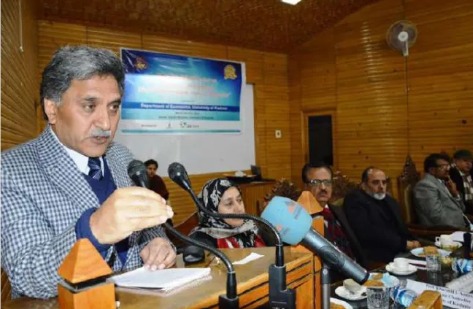
The decline of an ecosystem seldom begins with a dramatic announcement. No government declares that a wetland shall disappear, that a forest shall gradually fragment or that a river shall lose its natural course. Environmental collapse is usually the cumulative result of countless routine decisions taken over years, an encroachment overlooked, a regulation diluted, an illegal construction regularised, a forest patch diverted, a drainage channel blocked, a development project approved without sufficient regard for its ecological consequences. Individually, such decisions appear administrative. Collectively, they redefine landscapes. It is this slow and often invisible process that Khurshid Ahmad Ganai has spent much of his public life trying to understand, first as a senior civil servant responsible for governance and later as one of Kashmir’s most thoughtful voices on environmental policy.
Unlike many environmental advocates whose engagement begins outside government, Ganai’s understanding of Kashmir’s ecological challenges was shaped from within the administrative system itself. During a career spanning nearly four decades in the Indian Administrative Service, he occupied several key positions in Jammu and Kashmir, eventually serving as Financial Commissioner, Principal Secretary in multiple departments and later as Advisor to the Governor. Those years exposed him not merely to files and policy documents but to the complex relationship between development, administration and natural resources.
Retirement offered him an opportunity that few senior bureaucrats choose to pursue. Rather than withdrawing from public life, Ganai redirected his administrative experience towards issues that he believed would define Kashmir’s future far more profoundly than any single political development. At a time when climate change, rapid urbanisation, shrinking water resources and ecological degradation were beginning to alter the Himalayan landscape, he emerged as one of the leading voices arguing that environmental protection could no longer remain confined to forest departments or occasional government campaigns. It had to become a central principle of governance itself. That conviction found institutional expression through the Group of Concerned Citizens (GCC), an independent platform bringing together retired civil servants, scientists, academics, engineers, doctors, legal experts and environmental practitioners committed to evidence-based public policy. Under Ganai’s leadership, the GCC has consistently sought to engage governments not through agitation but through research, consultation and constructive policy recommendations. Its memoranda to successive administrations have addressed issues ranging from wetland conservation and glacier protection to public health, urban planning, river management and sustainable development, reflecting an understanding that environmental security underpins every other aspect of governance.
One of Ganai’s most significant contributions lies in the way he has reframed the environmental debate in Jammu and Kashmir. For decades, ecological concerns were often viewed as specialised subjects belonging to scientists, wildlife departments or environmental activists. Ganai has consistently argued that such compartmentalisation is fundamentally flawed.
Ganai has repeatedly drawn attention to these findings, emphasising that policy must be guided by science rather than short-term administrative convenience. Through seminars, policy dialogues and public engagements organised by the GCC, researchers, administrators and policymakers have been encouraged to interact directly, narrowing a gap that often prevents scientific knowledge from influencing governance in meaningful ways.
His interventions have also reflected a deep concern for Kashmir’s traditional relationship with nature. Long before concepts such as sustainable development entered public discourse, communities across the Valley had evolved practices that respected ecological limits. Springs were protected because they sustained life. Wetlands were valued because they moderated floods and supported livelihoods. Forests were regarded not merely as timber reserves but as sources of water, biodiversity and climatic stability. Ganai frequently argues that modern development need not reject this traditional wisdom; rather, it should integrate it with contemporary scientific understanding. Such a synthesis, he believes, offers the most realistic pathway towards sustainable development in a region as environmentally fragile as Jammu and Kashmir.
Beyond the Guardians
Every environmental movement has its recognisable faces. History remembers the individuals who speak from public platforms, argue before courts, restore rivers, write books or influence policy. Their names become synonymous with causes that eventually enter public consciousness. Yet no environmental movement survives because of a few well-known personalities alone. It endures because countless others, often unknown beyond their own villages or institutions, quietly continue the work that rarely attracts headlines. Kashmir’s ecological story is no different. Beneath the visibility of prominent conservationists lies an entire network of scientists, foresters, researchers, teachers, students, volunteers, bird watchers, wildlife rescuers, village elders and ordinary citizens who, in different ways, have chosen to defend the Valley’s natural heritage against forces far larger than themselves.
Across the mountains of Gurez, Kupwara and Kishtwar, forest guards begin their patrols long before sunrise, walking through dense forests where mobile networks disappear and human presence is measured in footprints rather than buildings. Their responsibilities extend far beyond preventing timber smuggling. They monitor wildlife movement, report forest fires, assist researchers, protect vulnerable habitats and often become the first line of defence against activities that threaten fragile ecosystems. Many perform these duties under difficult terrain and harsh climatic conditions, rarely receiving public recognition for work that quietly safeguards landscapes upon which millions ultimately depend.
In research laboratories and university departments, another group of guardians works with equal dedication. Scientists from the University of Kashmir, Sher-e-Kashmir University of Agricultural Sciences and Technology, the Wildlife Institute of India and several national research institutions continue documenting the changing ecology of the Himalaya. They study retreating glaciers, declining spring discharge, migratory bird populations, endangered wildlife, forest dynamics and changing climatic patterns, producing scientific evidence that increasingly shapes public understanding of Kashmir’s environmental future. Their work may not always capture public imagination in the manner of activism, yet without reliable science, meaningful conservation would remain little more than good intention.
Perhaps the greatest lesson offered by these quiet guardians is that conservation does not belong exclusively to environmentalists. A farmer protecting a spring, a teacher organising a nature walk, a student collecting plastic waste from a trekking route, a village committee preventing encroachment upon common land or a local fisherman refusing destructive practices all become participants in the same larger movement. Environmental stewardship is not defined by profession but by responsibility. The Valley’s future depends as much upon ordinary decisions made by ordinary people as upon policies framed in government offices.
The environmental challenges confronting Kashmir are therefore not temporary disturbances but structural realities that will shape the Valley’s future throughout the twenty-first century. The question is no longer whether change is occurring. The question is whether society can respond before ecological thresholds are crossed from which recovery becomes extraordinarily difficult.
This is where the stories of Manzoor Ahmad Wangnoo, Dr. Raja Muzaffar Bhat and Khurshid Ahmad Ganai converge. Though their methods differ, they are united by one profound belief that environmental decline is neither inevitable nor irreversible.
History often celebrates those who conquered territories, built monuments or shaped politics. Yet civilizations have endured because someone chose to protect the rivers that nourished them, the forests that sheltered them and the landscapes that gave them identity. Kashmir now stands at such a moment in its own history.
The Valley does not merely need environmentalists. It needs a society that understands that every spring revived, every wetland protected, every forest preserved and every river defended is an investment in its own future.
Paradise will not be saved by a handful of guardians. It will survive only when every Kashmiri decides that it is worth guarding.